USD: BBDXY - Extends Gains Above 1200, Approaching Strong Resistance 1215-1225
The BBDXY range overnight was 1205.10 - 1209.29, Asia is currently trading around 1211, +0.15%. The USD got a welcome reprieve from the surge in USD/JPY, after failing to build any downward momentum below 1200 last week. This move extended overnight as the USD was able to build on this pullback. The 1215-1225 area remains tough resistance, only a sustained close back above 1230 would start to challenge the conviction of the longer-term USD shorts, but the weaker hands are definitely beginning to fold.
- MNI BRIEF: International Role Of The Euro Crucial Now -Lagarde. The international role of the euro can no longer remain a secondary issue in the context of trade tensions and global fragmentation, European Central Bank President Christine Lagarde said Tuesday, noting it was crucial to move from being a safe-haven currency to being a truly global one.
- David Lee on X: “Citadel CEO Griffin on Gold - “People are looking for ways to effectively de-dollarize or de-risk their portfolio vis-a-vis US sovereign risk.”
- Bloomberg - “Reserve Managers Are Falling Out of Love With the Dollar. Headline numbers for dollar reserves rose in the second quarter but, under the surface, demand for the US currency is waning. Foreigners' attitude to the dollar is changing. The shift won’t be abrupt, but steady and measured as it has been for the last five years or so during which we’ve seen dollar reserves as percentage of total FX + gold reserves falling from 52% to 40%.”
- Zerohedge on X: "Over the last 1 month the US dollar has been MORE volatile than the S&P 500. This has happened twice in the last 7 yrs (dec 2023 and jul 2025) - "long gold", "long bitcoin", "long stocks" is on everyone's favorite trade list / but in reality it seems to just all equate to "short fiat.” - Goldman
Fig 1: BBDXY Weekly Chart
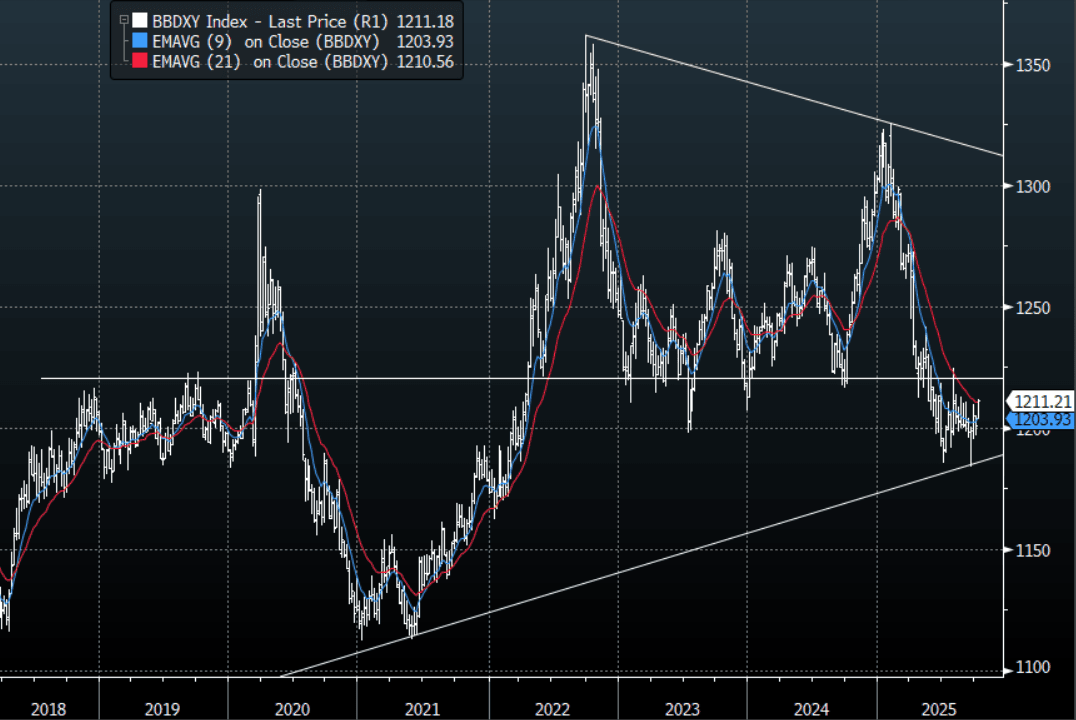
Source: MNI - Market News/Bloomberg Finance L.P
Want to read more?
Find more articles and bullets on these widgets:
Historical bullets
CHINA PRESS: Household Deposit Migration Not Driving Rally - Guan
Non-bank financial institutions have contributed more to China's recent market rally rather than household deposit migration, despite household deposits falling by CNY1.11 trillion in July, according to Guan Tao, former senior official at the State Administration of Foreign Exchange (SAFE). Residents savings have declined every July since 2009, reflecting seasonal factors rather than structural shifts, Guan said. He cautioned that attributing market movements to household deposits was reductive, noting that in April, deposits dropped by CNY1.39 trillion, an even larger fall than in July, yet the Wind All A Index fell 3.2%.
CHINA PRESS: Former CSRC Head Under Investigation
The former chairman at the China Securities Regulatory Commission (CSRC), Yi Huiman, has come under investigation for serious violations of discipline and law, the Central Commission for Discipline Inspection has announced. Yi, who stepped down from the CSRC chairmanship in February 2024 after a five-year tenure, had been serving as deputy director of the Economic Affairs Committee of the 14th National Committee of the Chinese People’s Political Consultative Conference (CPPCC).
CHINA PRESS: China FX Reserves Up 0.91% M/M
China’s foreign exchange reserves stood at USD3.3 trillion at the end of August, up 0.91% m/m, according to data released by the State Administration of Foreign Exchange (SAFE). Reserves increased as the U.S. dollar index weakened, while global financial asset prices strengthened, SAFE noted. Reserves had reached their highest level since 2016 which reflects the country’s capacity to withstand and manage external shocks, a chief economist told Securities Daily.


