CNH: USD/CNH - Breaks Below 7.0650 And Extends Lower
The overnight range was 7.0540 - 7.0614, Asia is currently trading around 7.0585. The pair broke though the 7.0650 support and accelerated lower, it continues to trade heavy with bounces very shallow. The market is building momentum lower after breaking below the support around 7.0800, the target looks to be towards the 6.97-7.00 area. On the day look for sellers to reemerge towards 7.0650-7.0800 as the market looks to test lower.
- MNI Brief - China’s Logistics Prosperity Index rose to 50.9% in November, up 0.2 percentage points from the previous month, the China Federation of Logistics and Purchasing said Wednesday. Chinese officials will aim to raise the household consumption-to-GDP ratio by an average of one percentage point per year over the next five years from the current 39.9% towards the 50-70% range typical of developed economies. (See MNI POLICY: China Targets Investment).
- The USD/CNH Average True Range for the last 10 Trading days: 136 Points
Fig 1 : USD/CNH Spot Weekly Chart
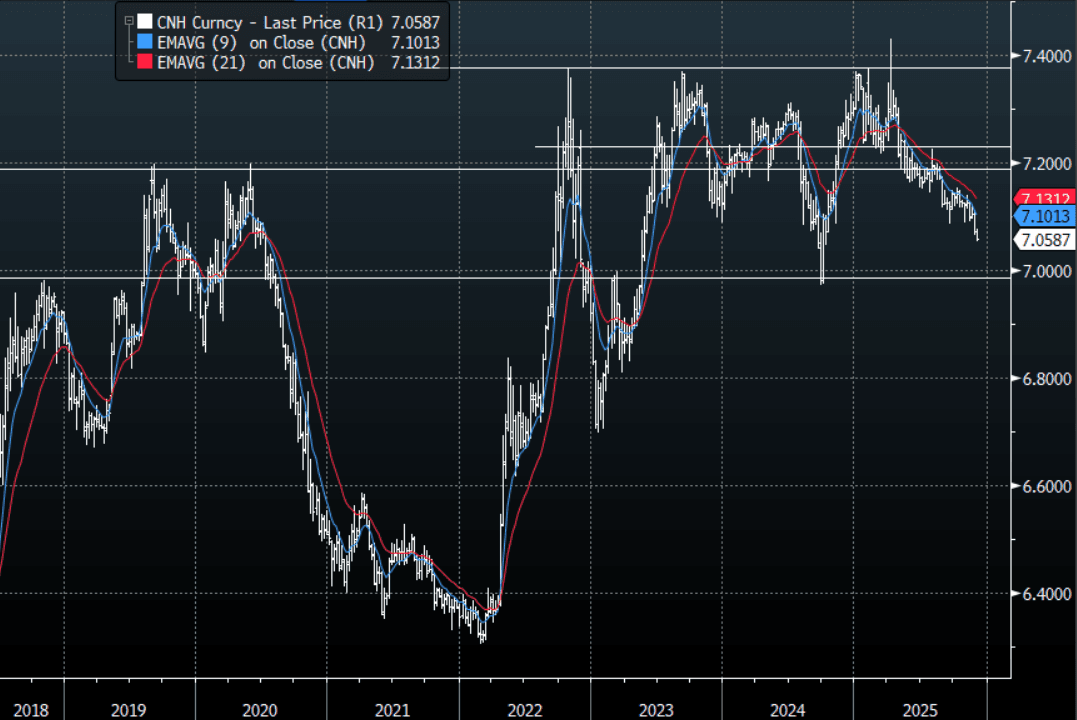
Source: MNI - Market News/Bloomberg Finance L.P
Want to read more?
Find more articles and bullets on these widgets:
Historical bullets
OIL: Crude Relieved OPEC Will Pause But ISM Raised Growth Fears
There was a relief rally in the APAC and early European sessions on Monday following OPEC’s December output increase in line with November but specifically because it said it would keep quotas unchanged in Q1, a time of soft demand. Oil then trended lower reaching a trough following the disappointing US manufacturing ISM, which may suggest slower growth and thus also energy demand.
- WTI is flat at $61.00/bbl off the low of $60.51 reached when the ISM printed at 48.7 down from 49.1, a small rise had been expected. It made a high of $61.50 earlier, below resistance at $62.59. The bear trigger is at $55.96.
- Brent rose 0.1% to $64.86/bbl off the intraday trough of $64.33. It reached a peak of $65.32, just below initial resistance at $65.98, 9 October high. Initial support is at $63.37, 24 October low.
- The market has been range trading as uncertainty remains elevated. There are currently significant seaborne flows in line with increased production. However, Ukraine’s attacks on Russian facilities may impact supply. It struck a tanker in the Black Sea and damaged port infrastructure at Tuapse.
- The outlook for 2026 is unclear with OPEC pausing the unwinding of output cuts in Q1 and most members facing capacity constraints. Lower prices are discouraging US shale producers. The IEA expects a record oil surplus next year which could also drive production cuts.
- On the demand side, there is a structural decline but the impact of increased protectionism on the global economy remains unclear. However, sanctions on Russian majors Lukoil and Rosneft appear to be reducing demand for Russian crude as buyers look to other suppliers.
ASIA: Government Bond Issuance Today
- South Korea to Sell KRW4.1tn 30-Year Bonds
- Hong Kong to Sell HK$63.73 Billion 91-Day Bills
- Hong Kong to Sell HK$17 Billion 182-Day Bills
- Bank of Thailand to Sell 50 Billion Thb of 364-Days Bills
- Bank of Thailand to Sell 65 Billion Thb of 91-Days Bills
- Bank Indonesia to Sell 181D SVBI Bills
- Bank Indonesia to Sell 92D SVBI Bills
- Bank Indonesia to Sell 32D SVBI Bills
- Bank Indonesia to Sell 365D SVBI Bills
- Bank Indonesia to Sell 273D SVBI Bills
- Philippines to Sell Agg PHP35.0 Bln 5-Year Bonds
- Philippines to Sell Agg PHP35.0 Bln 10-Year Bonds
ASIA: Coming Up in Asia Today
| 0100GMT | 0800HKT | 1000AEDT | South Korea CPI MoM OCTOBER |
| 0100GMT | 0800HKT | 1000AEDT | South Korea CPI YoY OCTOBER |
| 0100GMT | 0800HKT | 1000AEDT | South Korea CPI Ex Food and Energy YoY OCTOBER |
source: Bloomberg Finance LP / MNI


