BRAZIL: USDBRL Gathering Topside Momentum Following 50-Day EMA Breach
Nov-21 15:57
- As noted earlier, with Brazilian markets closed for a holiday yesterday, the local currency might be playing a degree of catch up to the most recent developments for broader risk sentiment. Despite Fed’s Williams putting a top in the dollar against G10 peers, the Brazilian real has been extending its most recent bearish swing.
- Gains for USDBRL have been exacerbated on a break of the 50-day EMA, a significant technical point since mid-October, and it is worth noting the pair is now trading back above the previously influential pivot of 5.40. A stronger recovery would expose the key resistance at 5.5214, the Oct 10 high.
- Worth noting that according to local newspapers, President Lula’s nomination of Attorney General Jorge Messias to the Supreme Court has increased tensions between the government and the Senate, where leaders would have preferred Rodrigo Pacheco to be given the post. This could be helping sour local sentiment approaching the weekend.
- CIBC said that although they expect the BRL to lose some ground in line with the overall risk-off move into the weekend, they believe tariff exemptions for some agricultural products provided by the US yesterday should benefit the currency over its LATAM peers. They maintain their preference for the BRL into early 2026, and would reload USDBRL shorts on spikes above 5.40.
Want to read more?
Find more articles and bullets on these widgets:
Historical bullets
EURIBOR OPTIONS: Large Dovish Z6 Call Spread Buyer
Oct-22 15:49
ERZ6 98.875/99.00 call spread, paper pays 0.75 on 17k
US STOCKS: Midday Equities Roundup: Ratcheting Lower
Oct-22 15:46
- Stocks have reversed early Wednesday gains, now weaker and extending lows ahead midday. No particular headline to blame for the reversal - more a confluence of factors including the ongoing US Gov shutdown, corporate earnings and China trade.
- Currently, the DJIA trades down 115.25 points (-0.25%) at 46,805.39, S&P E-Minis down 28 points (-0.41%) at 6,744,
Nasdaq down 207.5 points (-0.9%) at 22,741.78. - Industrials, Information Technology and Consumer Discretionary sector shares lead the decline: Laggers in the former include Super Micro Computer -6.31%, Texas Instruments -5.17%, Teledyne Technologies -5.04% and Palantir Technologies-4.25%. Consumer Discretionary: DoorDash-3.22%, Lululemon Athletica -2.70%, Amazon.com -1.79% and Mohawk Industries -1.75%
- On the positive side, Consumer Staples and Health Care related shares lead gainers in the first half: Kenvue +2.75%, McCormick & Co +2.62%, Monster Beverage +2.06% and General Mills +2.00%. After reporting better than expected earrings Intuitive Surgical surged +16.24%, Boston Scientific +4.55%, Zimmer Biomet Holdings +3.62% and Baxter International +2.70%.
- Earnings expected to release after the close include Southwest Airlines, Raymond James, Churchill Downs, Alcoa, Crown Castle, United Rental, Lam Research, Tesla,
US DATA: Chicago Area Econ Surveys Point To Better Activity, Weak Otherwise
Oct-22 15:36
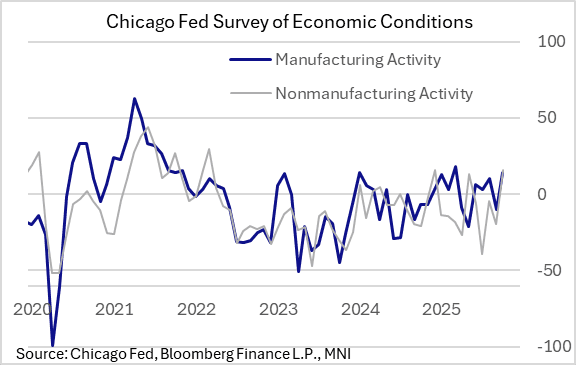
The Chicago Fed Survey of Economic Conditions (CFSEC)'s regional activity index rose to +15 in October from -14 prior, suggesting above-trend growth in the 7th Fed District. While this series is volatile, we note that this is the highest reading since March 2022, and comes with improvements in both manufacturing (+14 after -10) and nonmanufacturing (+16 after -19).
- This represents an indication of solid regional activity - but the subindices were actually quite poor across the board: hiring and capex intentions were negative (ie below average), while both labor cost and nonlabor cost pressures were also negative, suggestive of more moderate inflation.
- The indices roughly mirror the MNI Chicago Business Barometer (PMI) and national ISM Services/Manufacturing, though with more month-to-month volatility, so can be considered a positive in the services activity column after weak NY and Philly Fed surveys for October, as well as a solid manufacturing reading vs mixed NY / Philly.
- The latest Chicago Fed entry to the Beige Book covering September: "Economic activity in the Seventh District was little changed over the reporting period, and contacts expected a slight decrease in activity over the next year. Consumer spending increased modestly; construction and real estate activity increased slightly; employment was flat; nonbusiness contacts saw no change in activity; business spending declined slightly; and manufacturing activity declined modestly."