US: Trump's Declining Approval Failing To Boost Democrats
Polling analyst Lakshya Jain writes in The Argument: https://www.theargumentmag.com/p/why-democrats-...
Want to read more?
Find more articles and bullets on these widgets:
Historical bullets
FED: KC's Schmid: Fed Inflation-Fighting Credibility Essential Amid Energy Shock
Kansas City Fed President Schmid on Tuesday delivered the most hawkish Fed commentary since the outbreak of the war in the Middle East, saying in a speech that he's "more focused on the risks to inflation" than unemployment, and "I viewed high inflation as the more salient risk to our dual mandate even before the energy shock arrived". As perhaps the FOMC's most hawkish participant, it's unsurprising rhetoric, and he's possibly the member that penciled in a 2027 rate hike in his Dot Plot - he was a dissenter against the last two rate cuts of 2025, but he is not a voter in either 2026 or 2027.
- He says "the economy enters this period of heightened geopolitical risk from a position of strength", with "a number of fundamental strengths in the U.S. economy, including solid demand momentum, strong productivity gains, and relatively low unemployment"; on the latter he says that it seems the labor market "remains broadly in balance".
- He nods to growth risks from the recent spike in oil prices (as well as demographics). But even so, he doesn't appear to be particularly concerned: "Large oil price increases have historically had a negative impact on U.S. economic growth. Much of this history stems from the severe oil shocks experienced in the 1970s and 1980s. I expect that the growth effects today will be less severe....increased spending on energy is no longer a transfer of money from U.S. energy consumers to foreign energy producers. Instead, it is more akin today to a transfer of money from U.S. energy consumers to U.S. energy producers."
- In sum he sees "sustained higher oil prices" as only "a modest drag on economic growth".
- While there's some dispute about the growth impact, he says "the effects of the recent rise in energy prices on inflation are far less ambiguous. Higher energy prices will increase inflation. Headline inflation figures will be directly affected by higher gasoline prices. However, measures of inflation that exclude energy prices—referred to as core inflation—will increase as well. From food production to delivery and transportation costs to airfares, higher energy prices will also increase core measures of inflation."
- He says progress toward the 2% inflation target "has stalled", and on other FOMC colleagues' arguments that the energy price jump will prove only transitory in terms of inflation impact: "this oil shock comes at a time when inflation already has been too high for too long. I don’t think we can be complacent about the risks to inflation expectations. With inflation already running hot, now is not the time to assume that the inflation from higher oil prices will be transitory."
- In particular, this is a question of Fed credibility, a theme Schmid has highlighted before. "price pressures never arise as either intrinsically persistent or transitory. Rather, whether a price shock is ultimately transitory or not depends on the Fed’s perceived actions ... The observed stability in inflation expectations reflects the earned credibility of the Fed and the belief that monetary policy will keep inflation in check. It is now our job to follow through with policy actions that validate those expectations."
US: Trump's Approval Rating Continues To Sink Amid Iran Fallout
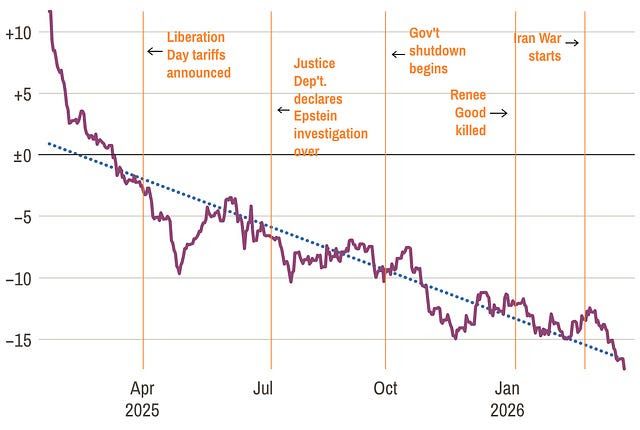
Data analyst Nate Silver writes on Substack that Trump just hit a new low in Silver Bulletin’s tracking. “For the first time in his second term, Trump’s approval rating in our average is (just barely) below 40 percent at 39.7. And his net approval rating is -17.4, also a new low. The recent decline has been pretty steep: about 5 points of net approval over the past several weeks.”
- Silver notes, “From a political standpoint, the most important events since November are probably the killing of two American citizens by border agents in Minneapolis in January, and then, of course, the Iran War, which began on Feb. 28…
- “Iran has had a much clearer impact. So far, though, it’s probably less about the war itself than about the impact on gas prices, which are now at about $4 nationally, having risen by more than a dollar over the past month. It’s still the economy, stupid”
- Silver notes on the political implications for Trump, "In 2024, 40 percent of voters in the exit poll said that “high prices for gas, groceries and other goods” was the single most important factor deciding their vote, and they broke 2:1 for Trump. It would be hard to pick a more visible indicator of affordability."
Figure 1: President Trump's Approval Rating, with Key Events
Source: Silver Bulletin
GBPUSD TECHS: Bearish Extension
- RES 4: 1.3715 76.4% retracement of the Jan 27 - Mar 13 bear cycle
- RES 3: 1.3620 61.8% retracement of the Jan 27 - Mar 13 bear cycle
- RES 2: 1.3575 High Feb 26
- RES 1: 1.3361/3479 20-day EMA / High Mar 23
- PRICE: 1.3183 @ 16:58 GMT Mar 31
- SUP 1: 1.3159 Intraday low
- SUP 2: 1.3125 Low Nov 26 ‘25
- SUP 3: 1.3038 Low Nov 20 ‘25
- SUP 4: 1.3010 Low Nov 4 & 5 and a key M/T support
The trend condition in GBPUSD remains bearish - moving average studies are in a bear mode position highlighting a dominant downtrend. Monday’s breach of support at 1.3219, the Mar 13 low, strengthens a bear theme and confirms a resumption of the downtrend. This opens 1.3125, the Nov 26 ‘25 low. Resistance to watch is at the 50-day EMA, at 1.3422. A clear break of it is required to undermine the bearish theme.


