GLOBAL POLITICAL RISK: Trump Reiterates Iran Requested Extension - FoxNews
US President Trump has spoken with FoxNews via telephone. Trump largely reiterated an earlier Truth ...
Want to read more?
Find more articles and bullets on these widgets:
Historical bullets
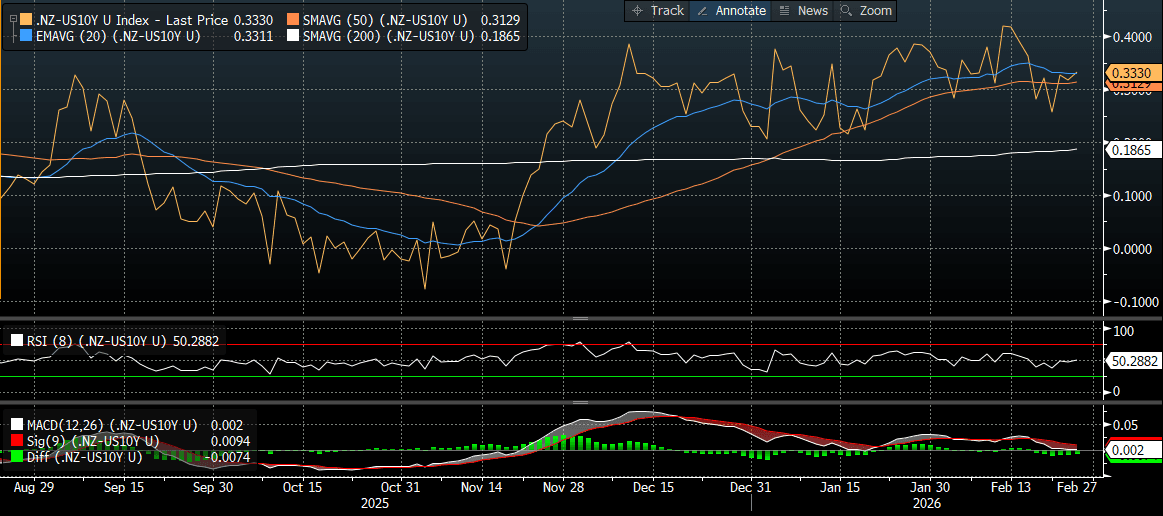
BONDS: NZGBS: Cheaper, NZ-US 10Y Wider, US State-Of-Union Due
NZGBs are 2bps cheaper, with the NZ-US 10-year yield differential 3bps wider. US tsys finished with a modest twist-flattener, with yields 2bps higher to 2bps lower.
- Several (largely 2nd tier) data releases were overshadowed by the upcoming State of the Union address by Pre Trump (2000ET).
- ADP employment increased an average 12.75k per week in the four weeks to Feb 7, a fresh high since late November.
- Retail sales growth slowed to 6.7% Y/Y in the week ending February 21 compared with 7.2% the week prior, per the Johnson Redbook index.
- Boston Fed President Collins (non-2026/2027 voter) reiterated her view in a panel discussion Tuesday that holding rates for "some time" appears to be appropriate, with some stability in recent labor market data alongside persistently high inflation calling for a "patient, deliberate approach".
- Swap rates are 1-2bps higher.
- RBNZ-dated OIS pricing is little changed across meetings. No tightening is priced for April, while December 2026 assigns 29bps.
- The local calendar will be empty, ahead of ANZ Business Confidence data on Thursday.
- On Thursday, the NZ Treasury plans to sell NZ$250mn of the 1.50% May-31 bond and NZ$200mn of the 4.25% May-34 bond.
Bloomberg Finance LP
FED: Richmond's Barkin: Well-Positioned On Policy, Risks "On Both Sides"
As for Barkin, he - as usual - was noncommittal on his rate outlook, saying that he sees policy as currently well-positioned given risks to both sides of the dual mandate. Some key Barkin quotes from Tuesday's panel discussion:
- On his rate outlook: "We have risks on both sides. Nobody wants inflation to stall, and nobody wants the labor market to weaken further. We're well-positioned should either of those risks look like they're crystallizing, and we'll make a call when we get there."
- On the labor market: "It's my clear sense that the market is loosened. With the exception of a few skilled trades, people broadly describe availability as relatively easy and compensation pressure is relatively modest. I'd say the hard part to calibrate is what's happening with labor supply...so we're in this awkward situation of trying to calibrate what feels like softening labor demand with also softening labor supply. And so the numbers, when you get an unemployment rate that presumably balances the two, that's just a good number to watch. And ... it's hard to take too much from any one number, though the last couple of months have been reassuring there."
- On inflation: "Well, the numbers have been coming in pretty consistently at around 3% and our target is 2%. So they're definitely higher than we want them to be.... I think most businesses feel like they just have very limited pricing power. ... I think across the broad economy, you are seeing disinflationary forces operate. All that said, I'd like to see it in the data here, because I really believe that when people set prices at companies, they do it in large part based on what inflation is. That's a reference number that is out there for every price-setting decision. And until you actually bring the inflation rate down, you're going to see individual companies out there feeling like they need to push further. And so I'm hopeful that we're headed back to the right place, but I'd like to see it."
- On the IEEPA tariffs being struck down by the Supreme Court: "I just think it creates uncertainty, which feeds into the story of people being a little cautious on hiring or investment. In terms of inflation, I take the secretary at his word that the net impact of all this will kind of net out in terms of cost pressure when all is said and done. I suspect it's not going to change the trajectory that much. The refund process will be interesting; I don't know how easy or hard that will be. I kind of see it, to the extent there are refunds, like a corporate tax cut—some middlemen who paid this tariff will benefit, and then some retailers in the chain will try to take that benefit to their bottom line. There will be some back-and-forth negotiation there, but to get it to the consumer, I think that would have to be a decision taken at multiple levels and it won't happen quickly or probably much. So, I'm not sure this changes my outlook much at all, other than the increase in uncertainty."
US: Trump To Announce Plans For New Tax Cuts Via Reconciliation: CNBC
CNBC reports that "President Donald Trump is set to announce a new tax cut proposal during his State of the Union on Tuesday night, he said during a pre-address luncheon at the White House." This would include both personal and corporate tax cuts, per CNBC, which attended the luncheon.
- Recall that reconciliation is the process by which the Republican Party, which narrowly controls both the House and Senate, can pass tax and spending bills along party lines. This is how 2025's "One Big Beautiful Bill" was passed and though the party retains its Senate majority, it has a narrower majority in the House (218-214) which makes navigating a controversial bill more difficult.
- MNI's Political Risk team noted possible other bills that Trump could seek to pass via reconciliation that might be announced in the State of the Union later today: "Punchbowl News reports that, “Trump is sure to … call on Congress to pass a new health care bill — which can only be done through reconciliation.” The Wall Street Journal reports, “He is planning to call on Congress to pass a legislation codifying the healthcare framework he released earlier this year, which calls for redirecting federal subsidies from insurers to consumers. [Republicans] have so far shown little interest in taking it up during a midterm election year."


