SGD: SGD NEER Off Recent Highs, But Still Close To Top End Of Policy Band
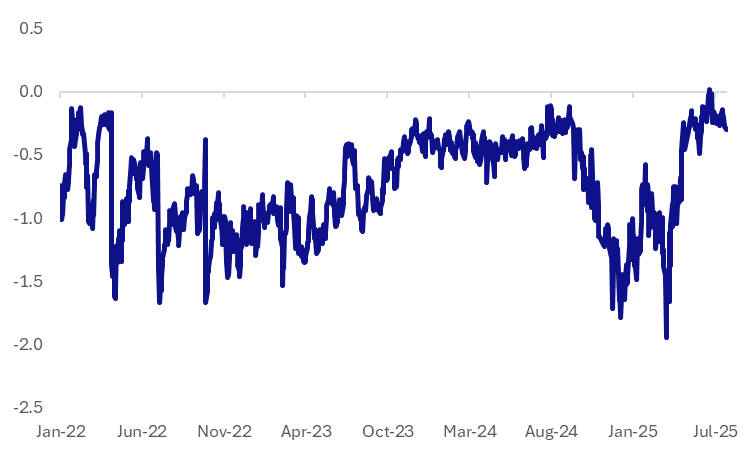
The most likely outcome from tomorrow's MAS policy meeting outcome is an unchanged decision, or further easing, which could take the NEER slope back to flat. The sell-side consensus is for no change tomorrow, while the chart below plots the SGD NEER as a percent deviation from the top end of the band (per Goldman Sachs estimates). The elevated level of the NEER relative to the top end of the band suggests some downside risks if we see an MAS easing tomorrow.
- Insofar as the NEER position relative to band extremes gives us a sense of market expectations around the MAS policy meeting outcome, it could be argued the market isn't expecting a dramatic shift at tomorrow's policy announcement.
- At the January 2025 meeting, the NEER was -1.3% from the top end of the band the day before the decision, while in April it was close to -1%. At both of those meetings the MAS eased. Currently we sit around -0.30% from the top end of the band, albeit off recent highs.
- Of course, broader USD weakness, along potential inflows into Singapore in recent months (around the de-dollarization theme) have also aided the SGD and likely boosted it within the policy band range.
- For spot USD/SGD, we sit near 1.2870 in latest dealings, which is close to the 50-day EMA resistance point. Further north is the 100-day, close to 1.2980. Recent lows rest just under 1.2750 for the pair.
Fig 1: SGD NEER - % Deviation From Top End Of The Band (Goldman Sachs)
Source: Goldman Sachs/Bloomberg Finance L.P./MNI
Want to read more?
Find more articles and bullets on these widgets:
Historical bullets
US FISCAL: Available "Extraordinary" Measures To Ward Off X-Date Pick Up
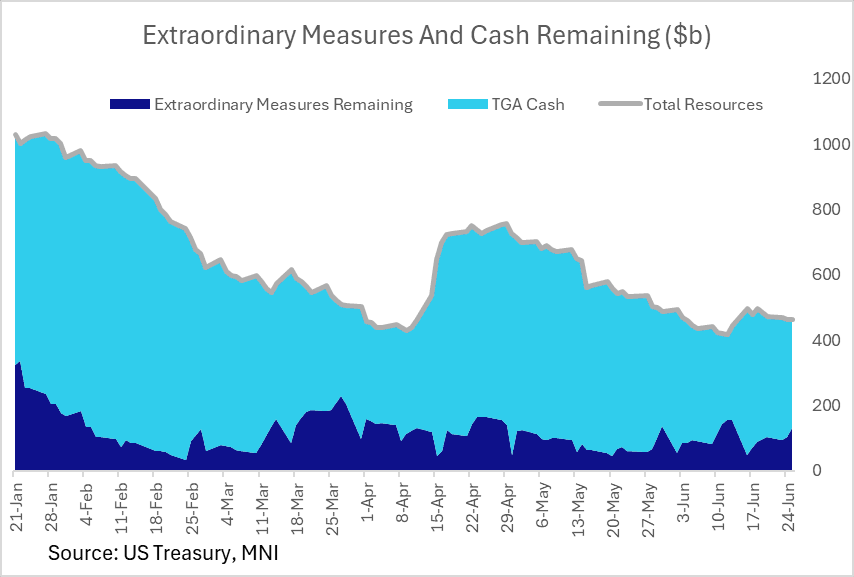
Treasury reported Friday that as of Jun 25 it had $130B in remaining "extraordinary" measures (of a total $378B available) to ward off an "x-date" of running out of resources before defaulting. That's the highest in 2 weeks.
- Combined with $334B cash as of Jun 25 (after a bit of a buildup after the mid-June tax deadline), that's a total of roughly $465B in total resources available.
- We noted earlier this week that Treasury told Congress that it was required to extend its debt issuance suspension period from Jun 27 to Jul 24, in effect prolonging the use of extraordinary measures while we await a resolution to the debt limit impasse, probably through the fiscal legislation currently going through Congress.
- Realistically, fiscal dynamics so far this year point to potential for Treasury to get into September without running out of cash + extraordinary measures. That seems to be the broad market expectation.
US DATA: Cleveland, Dallas Fed PCE Medians Show Progress But Still Above-Target
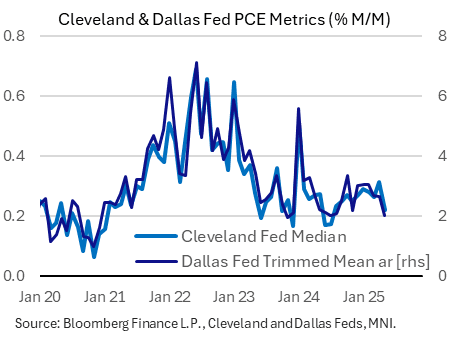
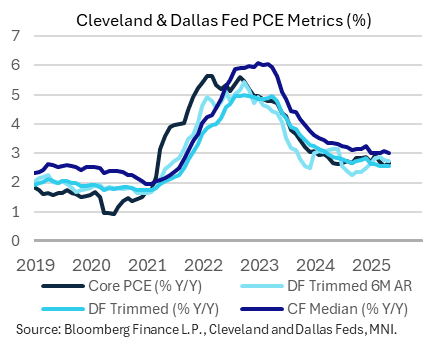
The Cleveland and Dallas Fed's median PCE metrics showed a notable drop in May. All indices suggest PCE inflation running above 2%, and higher than the actual core and headline PCE measures, but pressures appear to have cooled from a pickup in the early months of the year.
- The Cleveland Fed's median PCE measure came in at 0.22% M/M, a 10-month low after April's 15-month high 0.31%. This left median PCE at 3.01% on a Y/Y basis, down from 3.06% prior for a the joint-lowest (with Feb) since September 2021.
- The Dallas Fed's annualized median rate fell to 2.01%, from 2.65% prior for a 10-month low. The 6-month annualized rate edged lower to 2.74% (2.76% prior), a 4-month low, with the Y/Y rate ticking down to 2.55% from 2.56%, echoing the Cleveland Fed for the lowest reading since September 2021.
USDCAD TECHS: Pivot Resistance Remains Intact
- RES 4: 1.4111 High Apr 4
- RES 3: 1.4016 High May 12 and 13 and a key resistance
- RES 2: 1.3920 High May 21
- RES 1: 1.2710/3803 20- and 50-day EMA values
- PRICE: 1.3658 @ 16:23 BST Jun 27
- SUP 1: 1.3618 Low Jun 26
- SUP 2: 1.3540 Low Jun 16 and the bear trigger
- SUP 3: 1.3503 1.618 proj of the Feb 3 - 14 - Mar 4 price swing
- SUP 4: 1.3473 Low Oct 2 2024
USDCAD has pulled back from its recent highs. The primary downtrend remains intact and short-term gains appear to have been corrective. Key support and the bear trigger has been defined at 1.3540, the Jun 16 low. Clearance of this price point would resume the downtrend. Any reversal higher would instead signal scope for a stronger retracement. Pivot resistance to monitor is at the 50-day EMA, at 1.3803.


