CHILE: Sell-Side Analysts See Rate Cuts Resuming Next Month
- As noted earlier, today’s BCCh minutes reiterated the Board’s cautious stance as it looks to collect more data before considering another rate cut. However, some of the members noted that inflation risks had already reduced, even ahead of the benign October CPI inflation data. As such, the option for a December rate cut looks very much to be on the table:
- Santander notes that the minutes indicate that underlying inflation remains at the centre of the analysis. They also note that the minutes de facto incorporate the prevailing view of the Council that the neutral policy rate is located at the high end of the estimated range (i.e. around 4.25%). However, in Santander's view, with an economy evolving in line with the Monetary Policy Report and the downside surprise in the October data, along with reduced external cost pressures, the baseline scenario remains a 25bp cut in December. They then see a final move to 4.25% during 2026.
- Meanwhile, Goldman Sachs believes that the minutes incorporated a couple of dovish signals, centred around inflation risks. They also note that the minutes described headline and core inflation through September as “close to” projections, hinting for the first time to an acknowledgment that Q3 inflation came below the average foreseen in the IPoM. Looking ahead, GS has a more constructive on the disinflation process and also expects the BCCh to resume rate cuts in December, followed by another cut in Q1 2026 to a terminal rate of 4.25%.
Want to read more?
Find more articles and bullets on these widgets:
Historical bullets
FED: Powell Keeps October Cut On Track, Notes Jobs Vs Activity Divergence (1/2)
In what is among the very last major FOMC communications before the pre-meeting blackout period begins Friday night, Chair Powell's commentary Tuesday largely maintains the status quo in terms of signalling another 25bp rate cut at the end of October.
- In his written remarks, he says "based on the data that we do have, it is fair to say that the outlook for employment and inflation does not appear to have changed much since our September meeting four weeks ago" when of course they cut rates 25bp eyeing "Rising downside risks to employment". Though in a slightly less dovish note, "data available prior to the shutdown, however, show that growth in economic activity may be on a somewhat firmer trajectory than expected."
- In Q&A, Powell repeats his September commentary that "there really isn't a risk free path" with some danger of inflation persistence but "the labor market has demonstrated pretty significant downside risks as payroll jobs have declined in both the supply and demand for for labor has declined quite sharply".
- On the risks of easing: "if we move too quickly, then we may leave the inflation job unfinished and have to come back later and finish it. And if we move too slowly, there may be unnecessary, painful losses in the employment market."
- He echoes other speakers including Gov Waller last week in saying that the activity and labor market data aren't necessarily telling the same story, and future policy could depend on how that discrepancy plays out: "Even even subsequent to the September SEP, we've seen economic activity data which are surprising to the upside... you do have a bit of a tension there between the labor market data that we see very low levels of job creation. And yet people are spending. So economic activity is strong. And... we're going to have to see how that plays out.... if economic activity were stronger, then that would tend to support labor market activities in hiring. And so we'll have to see how that works out."
- Commenting on nonfarm payroll "breakeven" growth, Powell notes that a figure "I'm not going to try to give you a pinpoint number, but... the standard error around these things is, you know, 50,000 plus or minus, something like that... I think the range of plausible numbers... probably does go below zero... it's clearly come down a great deal."
- He points to the Beveridge Curve to suggest that "further declines in job openings might very well start to show up in unemployment."
US: FED Reverse Repo Operation
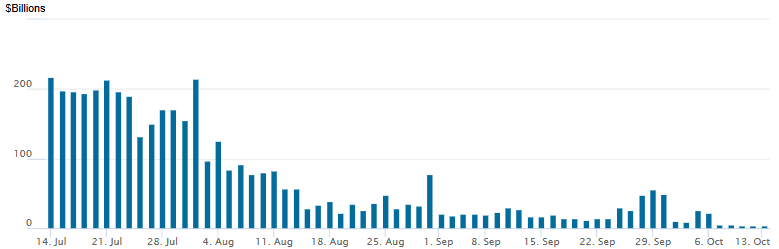
RRP usage resumes, usage slips to new low of $3.516B (lowest level since early April 2021) with 7 counterparties from $4,124B last Friday. Compares to this year's high usage of $460.731B on June 30.
EURUSD TECHS: Bear Leg Remains Intact
- RES 4: 1.1919 High Sep 17 and a bull trigger
- RES 3: 1.1820 High Sep 23
- RES 2: 1.1779 High Oct 1 and a key short-term resistance
- RES 1: 1.1680 20-day EMA
- PRICE: 1.1609 @ 17:05 BST Oct 14
- SUP 1: 1.1542 Low Oct 9
- SUP 2: 1.1516 76.4% retracement of the Aug 1 - Sep 17 bull leg
- SUP 3: 1.1392 Low Aug 1 and bear trigger
- SUP 4: 1.1313 Low May 30
A bear mode in EURUSD remains in place despite the late rally off lows on Tuesday. The recent breach of the 50-day EMA and a support at 1.1646, the Sep 25 low, exposes 1.1516, a Fibonacci retracement. Note that moving average studies are in a bull-mode position. This continues to highlight a dominant medium-term uptrend, suggesting the move down is likely a correction - for now. Initial firm resistance is 1.1779, the Oct 1 high.


