US STOCKS: Russell Index - Stalls Toward 2600, Can Risk Turn Last Week Around
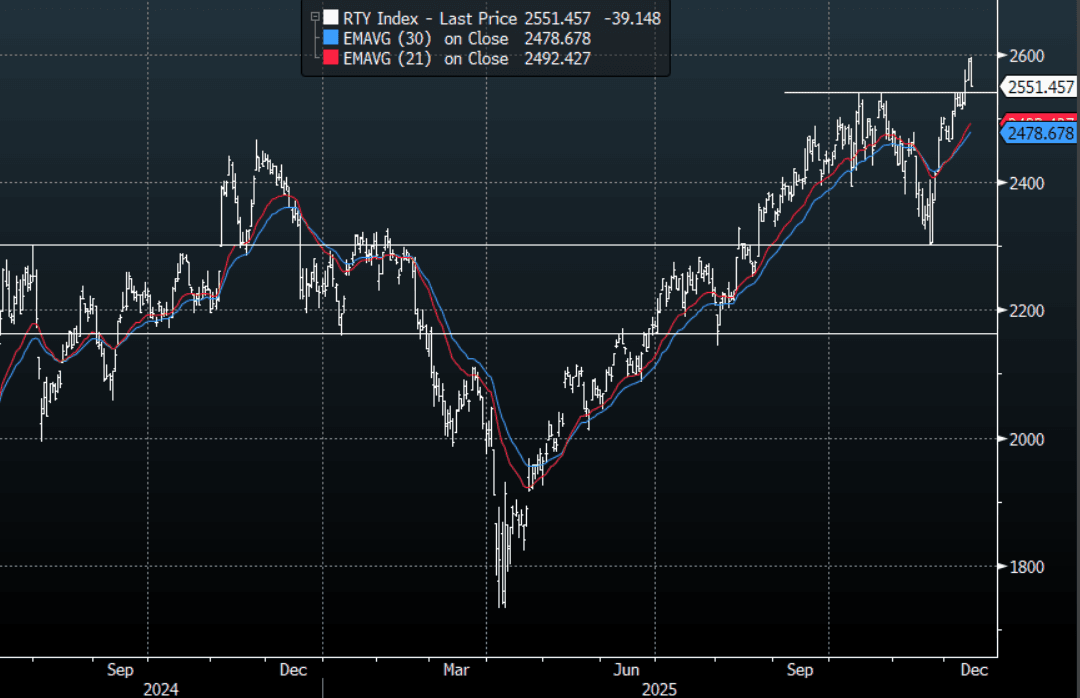
The Russell 2000 overnight range was 2548.82 - 2595.98, closing -1.51%. The Russell 2000 topped out towards the 2600 area after breaking the multiple tops around 2540. Risk had a poor weekly close as once untouchable AI names are being questioned. A dovish Fed is particularly good for small caps but it is highly unlikely small caps will be left unscathed in the event of a broader correction should it unfold. How risk starts this week will thus be important, if the market can shrug off the malaise from last week it could resume its trend higher. On the day watch to see how risk starts the week, first support is back toward the 2510-30 area, if this fails to hold we could see a deeper pullback toward the 2455-2475 support.
- The Kobeissi Letter on X: “Many US small-cap firms are struggling: 40% of Russell 2000 companies reported negative 12-month earnings in Q3 2025, near the highest percentage on record. This percentage has more than doubled since 2007 and has remained in a clear upward trend. This is also in line with the post-2008 Financial Crisis peak of ~40%. By comparison, ~33% of the index's firms were unprofitable following the 2001 recession. Fundamentals across many small-cap stocks remain extremely weak.”
- Probably all good reasons for why there has been such a willingness to short them, unfortunately though it has not stopped them from making new all-time highs.
- The Russell 2000 Index Average True Range(ATR) for the last 10 Trading days: 39 Points
Fig 1: Russell 2000 Daily Chart
Source: MNI - Market News/Bloomberg Finance L.P
Want to read more?
Find more articles and bullets on these widgets:
Historical bullets
CANADA DATA: October CPI Preview: Analysts Eye Lower Gasoline Prices (2/2)
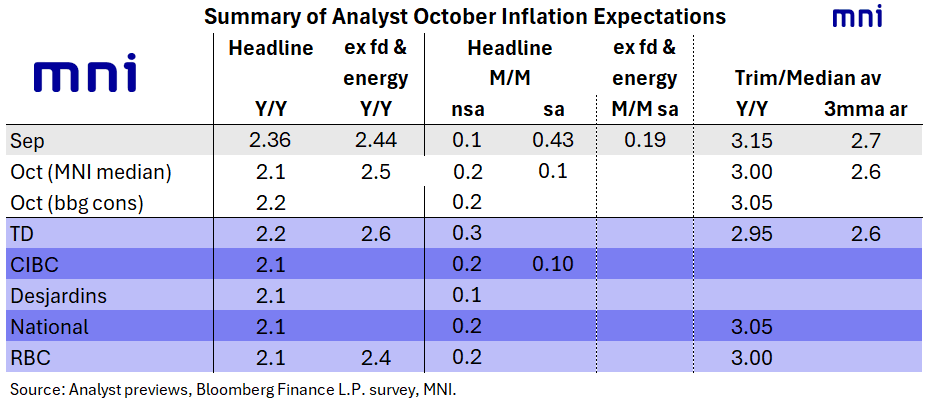
Canadian analysts' expectations for October inflation:
- CIBC: "Inflation should have eased slightly in October, mainly due to a drop in gasoline prices following an increase in the prior month that was atypical of usual seasonal patterns....Measures of core inflation may not decelerate as much, with rent inflation still stubbornly higher relative to market asking prices.... Inflationary pressures should have eased again relative to the prior month but, with various year-over-year core measures still averaging closer to 3% than 2%, the inflation data are likely to reaffirm that the Bank of Canada is on hold for the foreseeable future."
- Desjardins: "The removal of retaliatory tariffs last month continues to filter through to consumer prices, which should help temper headline inflation in the coming months. With goods inflation excluding food and energy already trending lower, the elimination of countertariffs is expected to further support this normalization. Services inflation, which remained sticky due to strong readings in late 2024, is likely to continue its downward trajectory, with additional progress anticipated through Q4. A similar trend is evident in the Bank of Canada’s core measures, which likely moderated slightly in October but remain near 3%."
- National: "Despite a drop in energy prices, headline prices may still have increased 0.2% in the month (not seasonally adjusted). If we’re right, the annual inflation rate could decline by three-tenths of a percentage point to 2.1% as a result of a highly negative base effect. Looking at the Bank of Canada's core measures, we expect the CPI-med to move from 3.2% to 3.1% on an annual basis, while the CPI-trim should ease from 3.1% to 3.0%.
- RBC: "moderation is expected to be primarily driven by lower gasoline prices, which fell 5% from September. We expect food price growth to hold close to September’s 3.8% annual rate in October. The October data will include the annual update on property tax prices in the CPI data. Significant property tax increases again took effect in some major population centers, but nationally we expect a smaller increase (4%) than the 6% increase in October a year ago. Headline CPI growth continues to be distorted on the downside by the removal of the carbon tax from energy products in most provinces in April. Broader measures of ‘core’ inflation are expected to remain above the Bank of Canada’s 2% target rate in October."
- TD: "A larger drag from energy and further disinflation in shelter should drive the headline print, while core measures edge lower to 2.95% y/y in a sign of thawing underlying price pressures. However, we don't expect material implications for the near-term rate outlook given hawkish BoC guidance last month."
CANADA DATA: October CPI Preview: Moderation Won't Sway BOC From Holding (1/2)
Canadian CPI is expected to have pulled back in October from September's 7-month high 2.4% Y/Y. Consensus (Bloomberg median) sees October CPI at 2.2% Y/Y (2.4% prior), with M/M at 0.2% (0.1% prior), while the average Median/Trim measure is seen at 3.05% (3.15% prior).
- MNI's analyst median skews a little softer than that. In the next note we include some sell-side expectations for Monday's release - several haven't yet published their forecasts but we will provide our usual roundup on Monday ahead of the print.
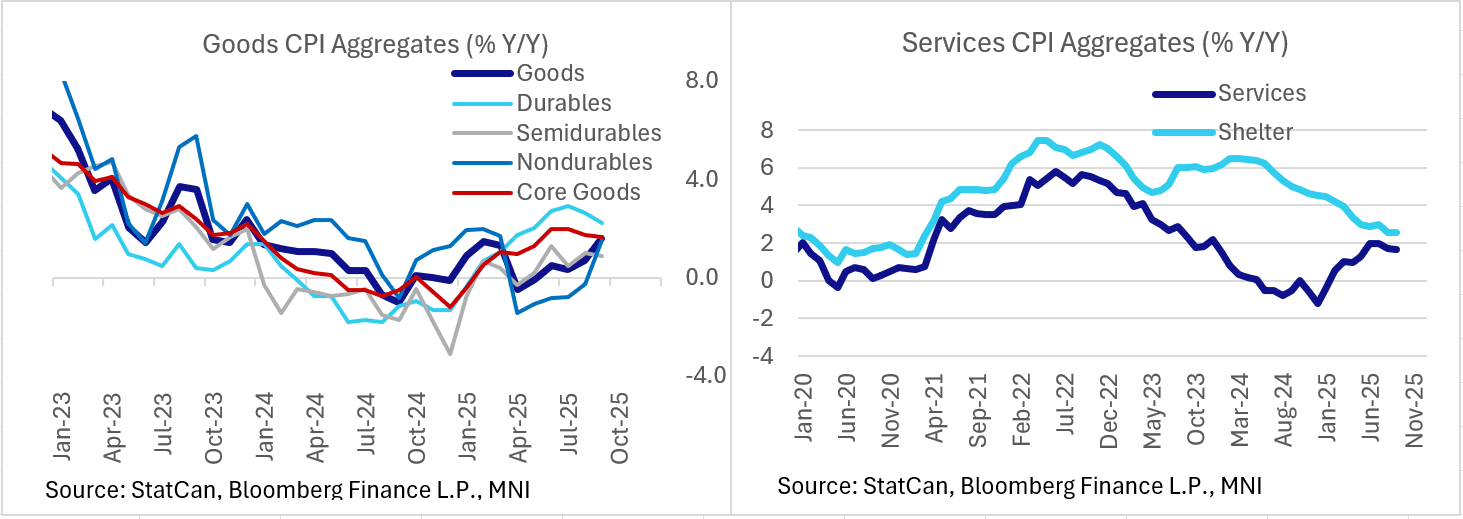
- A variety of factors are seen behind the moderation, including Ottawa's removal of retaliatory tariffs on the US in September, as well as softer gasoline prices. Overall, core goods inflation is moderating with core services merely a little stickier, and it was largely food/energy inflation and downstream effects thereof that spurred the latest tickup in overall CPI.
- The standout takeaway from the September CPI report was in the stubborn trim/median average failing to decelerate in the month as expected. Though that particular measure has been increasingly discounted by Bank of Canada policymakers, core metrics were also largely sequentially steady/higher. None appeared to be game-changers however in terms of the overall consensus narrative of gradual disinflation from the summer's highs but nonetheless ensured the report carried a slightly hawkish tone overall with continued evidence that prices may be a little sticker than hoped.
- October's data are unlikely to change the Bank of Canada's assessment at the October meeting that "Looking at the full range of inflation indicators, Governing Council concluded that underlying inflation was still around 2½%."
- In any case they "acknowledged that year-over-year inflation would be choppy in the coming months" so would be likely to maintain the bias to hold rates for the foreseeable future even in the event of a downside surprise.
US STOCKS CLOSE: Equities Recover From Intraday Pullback
Equities recovered from a sharp intraday sell-off to close roughly flat Friday, with the Nasdaq and S&P 500 almost unchanged but the the Dow Jones retracing 0.7% after Thursday's outperformance.
- Reeling from concerns over AI-related valuations and waning prospects for a December Fed cut, the S&P fell as much as 1.3% (6,646.87) which would have marked the lowest close in a month, but bounced to trade roughly flat on the session.
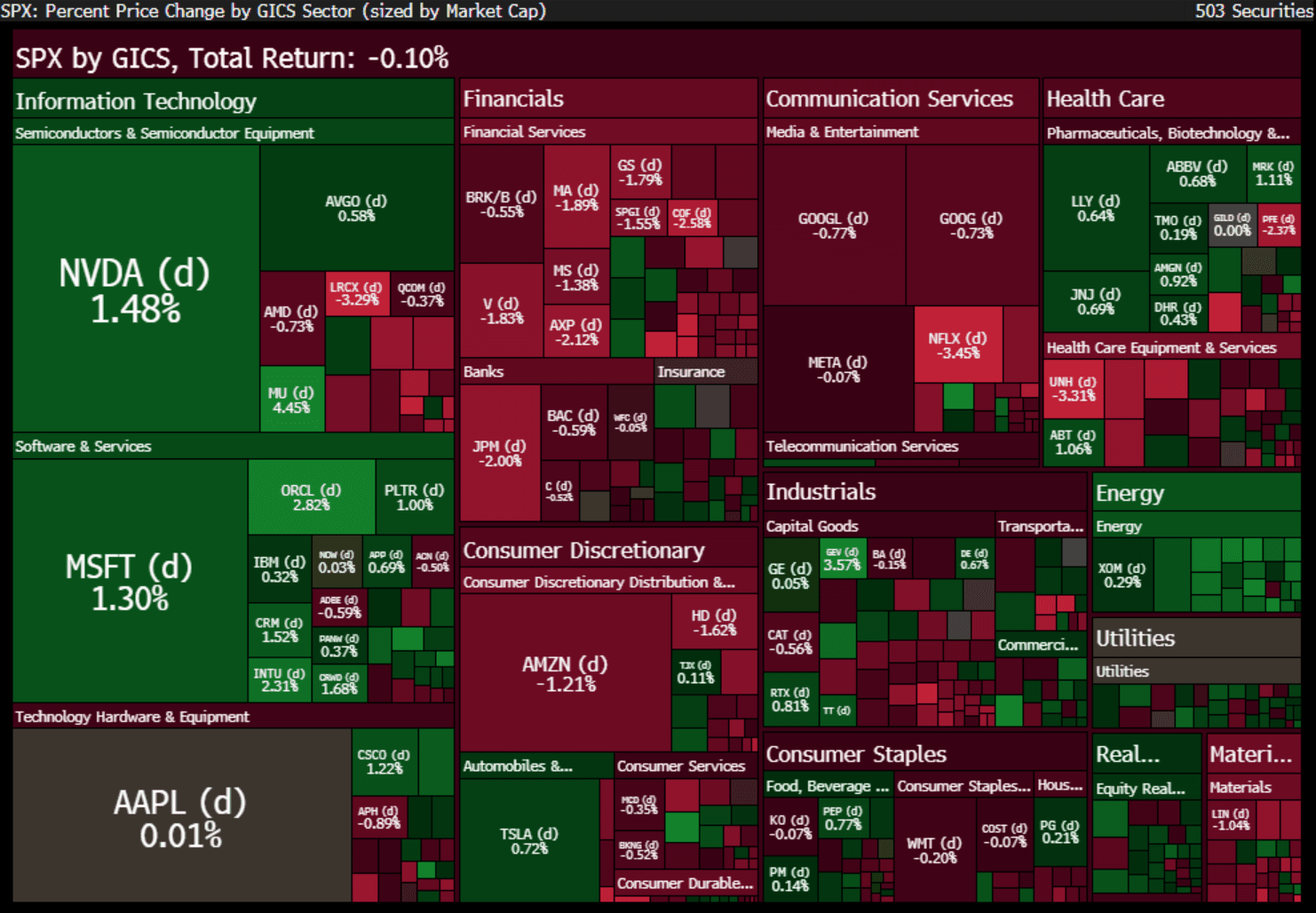
- Energy (+1.4%) and tech (0.7%) outperformed on the S&P 500, with losses led by financials (-1.0%) and materials (-1.2%).
- Megacaps NVidia (+1.6%) and Microsoft (+1.3%) were the biggest upside contributors, offsetting downside for Google (-0.7%), Netflix (-3.4%) and Amazon (-1.1%) in the tech/communications space, while JPM (-1.8%), Visa (-1.7%) and Mastercard (-1.8%) pulled down financials.
- Latest futures levels: Dow Jones mini down 325 pts or -0.68% at 47253, S&P 500 mini down 6.25 pts or -0.09% at 6762.5, NASDAQ mini down 13.75 pts or -0.05% at 25125.25.