SECURITY: Probability Of US Troops Entering Iran Spikes After WSJ Report
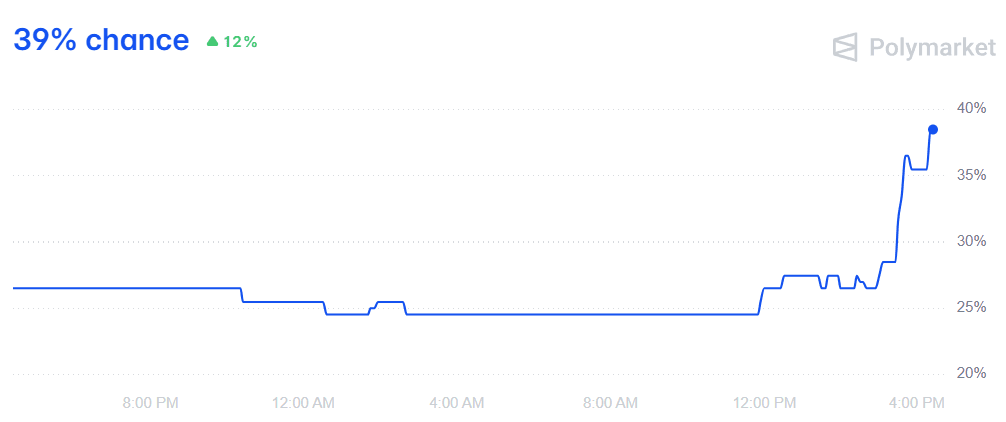
The implied probability of US forces entering Iran by March 31 has spiked following a Wall Street Journal report claiming that the US has deployed a Marine unit to the Middle East, according to Polymarket. See: SECURITY: Pentagon Deploys Marine Unit To Middle East - WSJ
- As we noted earlier, "The move appears to edge the US closer to authorising US 'boots on the ground' in Iran, as it seeks to gain control of the Strait of Hormuz. The prevailing view among military analysts is that any US ground operations would likely be limited to special operations forces for specific missions. Such a Marine unit could also be deployed as part of a naval operation aimed at securing or escorting commercial shipping."
- The roughly 40% implied probability remains lower than the 57% recorded on March 8 when President Donald Trump declined to rule out deploying US troops to the country. The risk has receded throughout the week amid Iran's robust military response to the US-Israeli strikes, the lack of movement on a potential US-backed Kurdish ground operation, and intelligence reports (WSJ, Reuters) from the US and Israel warning that Iranian regime collapse is unlikely.
- Bloomberg notes, "The 14th day of the war marked the largest attacks yet against the Islamic Republic," with Defense Secretary Pete Hegseth telling reporters earlier that the US-Israeli alliance has struck around 15,000 targets since the war began.
Figure 1: US Forces Enter Iran by March 31
Source: Polymarket
Want to read more?
Find more articles and bullets on these widgets:
Historical bullets
OPTIONS: Larger FX Option Pipeline
- EUR/USD: Feb13 $1.1750(E2.1bln), $1.1775(E1.3bln), $1.1800(E3.2bln), $1.1820-25(E1.4bln), $1.1850(E4.4bln), $1.1875(E1.2bln), $1.1900(E1.6bln), $1.1950(E2.7bln)
- USD/JPY: Feb13 Y152.00($1.5bln), Y154.00($1.5bln), Y155.00($1.4bln), Y156.00($1.4bln), Y158.00($1.3bln), Y158.50($1.6bln), Y159.00($2.0bln), Y160.00($3.1bln); Feb17 Y156.00($1.9bln)
- GBP/USD: Feb13 $1.3470-75(Gbp1.0bln)
- EUR/GBP: Feb13 Gbp0.8736-45(E1.0bln)
- AUD/USD: Feb13 $0.6800(A$1.6bln)
- USD/CAD: Feb13 C$1.3770-75($1.0bln)
- USD/CNY: Feb13 Cny6.9000($1.2bln), Cny6.9700($1.2bln)
FED: US TSY 17W BILL AUCTION: HIGH 3.595%(ALLOT 84.52%)
- US TSY 17W BILL AUCTION: HIGH 3.595%(ALLOT 84.52%)
- US TSY 17W BILL AUCTION: DEALERS TAKE 36.22% OF COMPETITIVES
- US TSY 17W BILL AUCTION: DIRECTS TAKE 6.02% OF COMPETITIVES
- US TSY 17W BILL AUCTION: INDIRECTS TAKE 57.76% OF COMPETITIVES
- US TSY 17W BILL AUCTION: BID/CVR 3.38
FED: KC's Schmid: Appropriate To Hold Rates; Eying Smaller Balance Sheet
KC Fed President Schmid (not a 2026 FOMC voter) continued to convey a hawkish monetary policy view in a speech Wednesday, and we continue to believe he's among a sizeable minority on the FOMC who don't have rate cuts as part of their 2026 baseline. In short, "With demand outpacing supply and inflation running closer to 3% than 2%, I see it as appropriate to maintain a somewhat restrictive policy stance."
- He says that after cutting rates, Fed policy is "arguably no longer restraining activity all that much, if at all. As I’ve said before, I think it is best to judge whether interest rates are restrictive or accommodative based on how the economy performs. With growth showing momentum and inflation still hot, I’m not seeing many indications of economic restraint....further rate cuts risk allowing high inflation to persist even longer." Unsurprisingly, in a post-speech Q&A he said that the January Employment Report was "good news" (as quoted by Bloomberg).
- Schmid weighs in on the recently-hot topic of productivity and its impact on the inflation outlook. He sounds skeptical that recent gains are AI-led, instead pointing to a "falloff in labor market churn" and household and business investment demand keeping growth strong.
- In the end, he asks, "Is growth being led by supply or demand? With so many competing but intertwined developments, it can be hard to tell. But we do have one reliable indicator that can cut through all the confusion and provide a quick answer. That is inflation. Overall, with inflation still running hot, it appears that demand is outpacing supply across much of the economy. I remain open to the possibility, and I’m even optimistic, that AI and other innovations will eventually lead to a non-inflationary, supply-driven growth cycle. However, based on the current rate of inflation, we are not there yet."
- He comments on recent balance sheet decisions too, supportive of decisions to roll off MBS holdings and shorten the duration of the SOMA portfolio. He's been one of the most ardent advocates on the FOMC of reducing the Fed's market footprint. It's perhaps of increasing importance now though, given that the nominated/incoming Fed Chair Warsh has signaled that he'd like to shrink the balance sheet.
- Schmid: "it is my view that in normal times the Fed’s balance sheet should not influence the shape of the yield curve. The balance sheet growth initiated in December is reducing this distortion by concentrating new purchases in Treasury bills. In shortening the average maturity of our holdings, the FOMC is continuing to reduce the influence of the Federal Reserve’s balance sheet on longer-term interest rates" and "winding down our mortgage holdings is critical to ensuring that the Fed minimizes its footprint in financial markets".
- He does signal support for regulatory changes and other factors that could structurally reduce reserve demand and thus lower the size of the asset side of the Fed's balance sheet: "I think there are opportunities to reduce reserve demand over time, especially as the regulatory environment and payments technologies continue to evolve. Guiding towards a lower level of reserves is not only feasible in my opinion, but something that should be pursued to allow for a smaller balance sheet."


