US DATA: PMI Mfg Orders Slow, Input Cost Inflation Highest In 2.5 Years
Apr-01 13:55
- The manufacturing PMI was revised up slightly in the March final release to 50.2 (cons 49.9, flash 49.8), although still sees a sizeable decline from 52.7 in February (highest since Jun 2022).
- The press releases summarizes the report as: “Production declines in March as order book growth slows on tariff uncertainty”
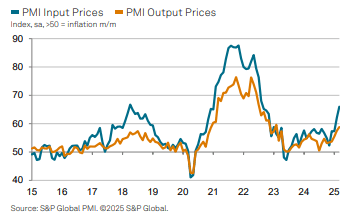
- It also confirms strong input cost inflation indicated in the flash release, at its highest in “over two-and-a-half years”. The flash release, for both manufacturing and services, had noted that “Input price inflation accelerated sharply, especially in manufacturing, to a near two-year high, often attributed to the impact of tariff policies. However, competition limited the pass-through of higher costs to selling prices.” Here, specifically for manufacturing, output price inflation increased to a 25-month high.
Some highlights from the full press release (here):
- “US manufacturing sector growth stalled in March. Having grown strongly in February, production declined as order books expanded only modestly despite evidence of a stabilization of exports.
- Confidence in the outlook for business activity softened, amid some uncertainty over the impact of federal government policies.
- Employment numbers were unchanged after four months of job gains. Softer trends in output and new orders, plus uncertainty in the outlook, weighed on hiring decisions.
- Cost pressures intensified, largely due to the impact of tariffs, with input price inflation rising to its highest level in over two-and-a-half years.”
- Further on prices: “The steep increase in input prices fed through to a greater rise in manufacturing selling prices during March. Latest data showed that output price inflation picked up for a fourth successive month to a 25-month high.”
Want to read more?
Find more articles and bullets on these widgets:
Historical bullets
US OUTLOOK/OPINION: A Stacked Week Ahead For US Macro
Feb-28 21:45
- Next week sees a series a key risk points, starting with trade policy and Trump’s Mar 4 deadline for an additional 10% tariffs on China (for 20% total) and the imposition of the delayed 25% tariffs on Canada and Mexico. US Treasury Sec Bessent offered a potential offramp here, saying Friday afternoon the US wants to see Canada and Mexico match tariffs on China. Whilst following through with that could see temporary de-escalation in US trade tensions with Canada and Mexico, it would likely stoke greater likelihood of China retaliation and/or further fiscal support.
- It’s bookended by ISM manufacturing (Mon) and services (Wed) reports, watched to see whether sharp increases in manufacturing prices paid seen in other surveys first show up in this broader measure and whether there is sign of spillover to services.
- The main data release of the week comes on Friday though, with the nonfarm payrolls report for February.
- The January report saw a modest miss for nonfarm payrolls but it was more than offset by a robust two-month net revision along with a smaller than expected benchmark revision. Further, the unemployment rate again surprised lower at 4.0% for its lowest since May 2024 in a further step away from the 4.3% the median FOMC member forecast for 4Q25 in the December SEP.
- Early days for the Bloomberg survey see nonfarm payrolls growth at a seasonally adjusted 155k in February and for the unemployment rate to hold at that lower 4.0%.
- Note that the nature of the DOGE “deferred resignation program”, with some 77k federal employees accepting the offer, shouldn’t see any direct impact on payrolls growth (in the establishment survey) until the October report as workers will remain on the payroll in the interim. One area where the direct impact could show however is the household survey. Assuming those who accepted the offer are treated as equivalent to a furloughed worker, they’ll register as unemployed. A word of caution though, it’s a much more volatile survey, with a 90% confidence level of +-600k for employment vs +-136k for payrolls.
- Note that post-payrolls Fedspeak sees a notable addition this time, with Fed Chair Powell set to talk on the economic outlook with both text and Q&A, starting at 1230ET. Data and tariff deliberations should still set the tone, but at this juncture we wouldn’t be surprised to see a continued call for patience in rate cut expectations considering dovish repricing seen over the past week. This is a theme that could be seen from other notable Fedspeakers throughout the week, including permanent voters Williams, Waller and Kugler.
STIR: Significant Dovish Repricing In US Rates This Week
Feb-28 21:14
- The softer growth outlook has dominated signs of renewed inflationary pressures this week - see a key summary of the week's macro developments in the MNI US Macro Weekly here.
- Fed Funds futures have a next 25bp Fed cut now fully priced for June and over the week have added nearly an entire 25bp cut over 2025 with a cumulative 70bp of cuts vs the 50bp implied by the median FOMC dot in Dec.

Significant dovish adjustment over the week:

MACRO ANALYSIS: MNI US Macro Weekly: No Escaping Tariff Distortions
Feb-28 21:12
- We have published and e-mailed to subscribers the MNI US Macro Weekly offering succinct MNI analysis across the range of macro developments over the past week.
- Please find the full report here: https://media.marketnews.com/US_macro_weekly_250228_3f0cf485bb.pdf


