MNI US MARKETS ANALYSIS - Oil Rally Slows Ahead of G7 Call
Highlights:
- Oil rally runs out of steam as G7 could act with stockpile release, in concert with IEA
- Iran names new Supreme Leader, but unlikely to meet Trump's criteria
- EUR, GBP sink as rallying natural gas price hits best level since Russia crisis
US TSYS: NFP Gains Reversed With Oil Surge In Another Active Pre-NY Session
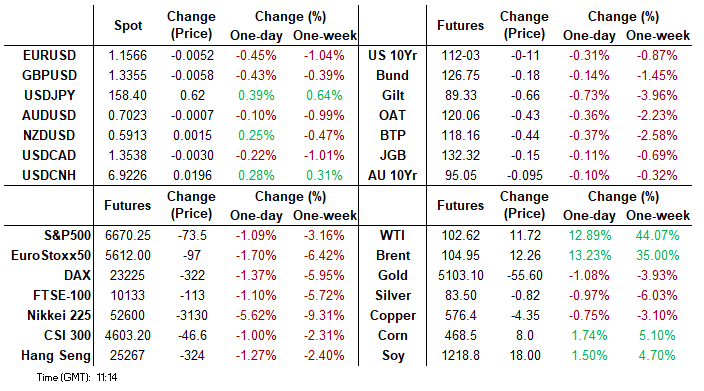
Treasuries are solidly lower on the day despite a sizeable paring of Asia losses as crude oil futures pare some of a particularly sharp increase after the weekend on the Middle East conflict. WTI 1st futures came close to $120/bbl overnight and whilst currently have eased back to $102.7 are still 13% higher from Friday. Geopolitics is likely to dominate today’s session in an otherwise light calendar ahead of Wednesday’s CPI report.
- Cash yields are 3.8-5bp higher on the day, led by the front end.
- 2Y yields sit at 3.610% (+5bp) off an earlier high of 3.633% that pushed above Friday’s pre-NFP high - it last traded above 3.65% in Sep 2025.
- 10Y yields cleared 4.20% overnight for the first time in nearly a month although have since retraced to 3.181% (+4.3bp).
- TYM6 trades at 112-02 (-12) off an earlier low of 111-26+, on a return of extremely heavy overnight volumes at a cumulative 945k.
- 111-26+ set a fresh recent low and confirms a continuation of the bearish theme, with next support at 111-21+ (Feb 9 low) and sights ultimately on 111-06+ (Jan 20 low). Initial firm resistance is seen at 112-23+ (20-day EMA).
- Data: NY Fed consumer survey incl inflation expectations Feb (1100ET)
- Bill issuance: US Tsy $89B 13W & $77B 26W bill auctions (11130ET)
- Politics: Trump participates in roundtable (1530ET), Trump delivers remarks to Republican Members Issues conference (1635ET)
STIR: US Rates Off Lows But Oil Surge Sees Dovish NFP Reaction Reversed
- US rates have pared overnight losses but have still broadly reversed Friday’s dovish shift on the February payrolls report on the back of today’s further large net increases in energy prices (WTI >$100bbl).
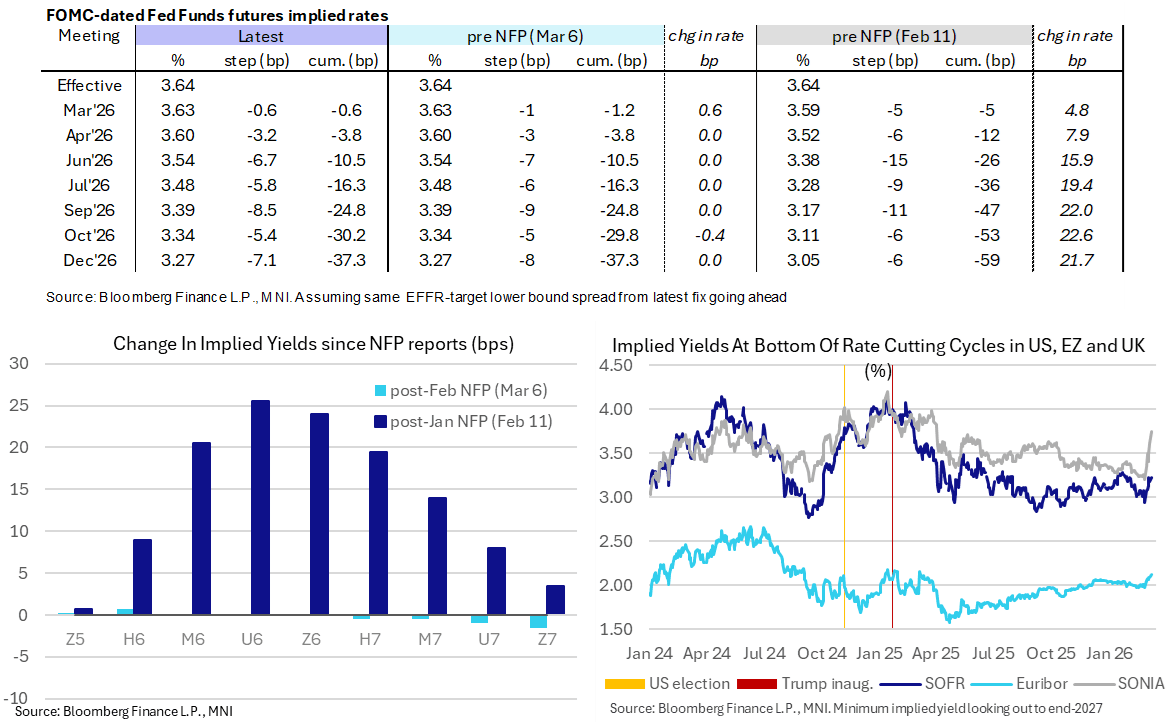
- FF cumulative cuts from 3.64% effective: 0.5bp Mar, 4bp Apr, 10.5bp Jun, 16.5bp Jul, 25bp Sep, 30bp Oct and 37.5bp Dec.
- SOFR futures are currently as much as 6 ticks lower in late 2026/early 2027 contracts, whilst the terminal implied yield of 3.225% (U7, +4.5bp) nudges above Thursday's close and is at the high end of the ytd range at 2.94-3.285% for closes.
- The FOMC is now in media blackout ahead of the Mar 17-18 meeting. See the US Macro Weekly for the pertinent takes from a deluge of post-NFP Fedspeak before the blackout: https://mni.marketnews.com/46M3D4V
- It’s a particularly light docket today (headlined by NY Fed inflation expectations) with data focus on Wednesday’s US CPI February report. Our preview will be published later today with a summary of analyst views coming in the interim.
SOFR: Mix Of Net Long Setting & Short Cover Seen On Friday
OI data points to long setting providing the most prominent positioning swing in the white, red and green SOFR futures packs as contracts settled higher on Friday. Instances of long setting and short cover essentially offset in the blues.
- Note that net long setting in the whites was driven by one contract (SFRU6), with net short cover seen across the remainder of the pack.
| 06-Mar-26 | 05-Mar-26 | Daily OI Change |
| Daily OI Change In Packs |
SFRZ5 | 1,302,516 | 1,306,175 | -3,659 | Whites | +2,250 |
SFRH6 | 1,346,511 | 1,348,202 | -1,691 | Reds | +36,270 |
SFRM6 | 1,280,326 | 1,299,033 | -18,707 | Greens | +8,711 |
SFRU6 | 1,201,756 | 1,175,449 | +26,307 | Blues | -594 |
SFRZ6 | 1,311,946 | 1,337,373 | -25,427 |
|
|
SFRH7 | 928,399 | 933,355 | -4,956 |
|
|
SFRM7 | 922,875 | 864,230 | +58,645 |
|
|
SFRU7 | 737,301 | 729,293 | +8,008 |
|
|
SFRZ7 | 1,049,209 | 1,057,544 | -8,335 |
|
|
SFRH8 | 536,955 | 527,945 | +9,010 |
|
|
SFRM8 | 436,253 | 438,067 | -1,814 |
|
|
SFRU8 | 404,973 | 395,123 | +9,850 |
|
|
SFRZ8 | 392,327 | 386,851 | +5,476 |
|
|
SFRH9 | 227,758 | 219,083 | +8,675 |
|
|
SFRM9 | 189,348 | 194,596 | -5,248 |
|
|
SFRU9 | 172,112 | 181,609 | -9,497 |
|
|
MNI US Macro Weekly: War Shock Meets Weak Jobs Data
Hidden PDF
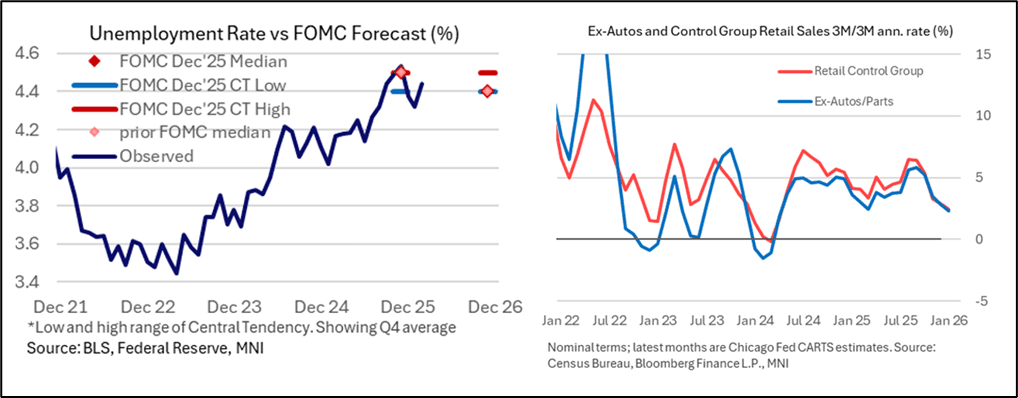
- In the key release of a tumultuous week that was overshadowed by geopolitical developments, both the establishment and household surveys disappointed in the February Employment report with a 92k NFP drop, an unemployment rate rise to 4.44%, and large lower revisions.
- But survey quirks and one‑offs complicate interpretation and it comes after a relatively solid January report. As such it doesn't appear to have greatly impacted FOMC participants' overall views on the rate outlook as we head into the pre-March FOMC blackout period.
- Indeed it sounds as though all of the FOMC participants will have to weigh the surprisingly soft report alongside the potential macro implications of the conflict in the Middle East before coming up with a synthesis and forming March SEP projection updates.
- Soaring energy prices and broader market uncertainty over the war in the Middle East started over the weekend saw rate cut pricing evaporate. Cumulative pricing at one point suggested that a rate cut would have to wait until after the September FOMC, having last Friday pointed to about a 50/50 chance of a second 25bp cut by that point (after July).
- End-2026 pricing briefly touched ~32.5bp of cuts in the hour prior to the release of the February employment report, a 28bp repricing vs prior to the US-Iran conflict. The unexpected drop in payrolls and uptick in the unemployment rate was enough to bring a September rate cut to fully priced (29bp), even if a cut as soon as July remained slightly elusive.
- Otherwise, data were mixed. Import prices remained firm, with ex‑petroleum import prices posting their strongest four‑month stretch since 2024 amid tariff effects and fading China concessions.
- Growth indicators softened, with GDPNow falling to 2.1% on weaker expected consumption. Business surveys diverged: ISM Manufacturing held gains but saw a sharp jump in Prices Paid, while ISM Services surprised strongly with broad‑based strength and cooling prices; S&P PMIs pointed to ~1.5% Q/Q growth.
- Retail sales and consumption signals were mixed, with headline and category breadth softening despite a modest Control Group gain.
- The week ahead features key inflation releases, with February CPI (Wed) and January PCE (Fri) central to shaping expectations before the March 17–18 FOMC meeting and new SEP; additional data in the week to come include GDP revisions, JOLTS, durable goods, and housing indicators.
EUROPE ISSUANCE UPDATE
[EU-BOND SYNDICATION] 10-year mandate - in line with expectations:
"The EU has mandated Barclays, DZ BANK, Morgan Stanley (B&D/DM), Societe Generale and UBS as Joint Lead Managers for its upcoming EUR Fixed Rate RegS Bearer new 10-year benchmark due 12th December 2036. No further group. The transaction will be launched in the near future, subject to market conditions."
- This is in line with our expectations. Note that we wrote in our EGB Issuance, Redemption and Cash Flow Matrix last week that we pencil in the launch of a new 10-year. This may be as a single line syndication or potentially alongside a tap or a new 20-year issue.
- We expect the transaction tomorrow with a E7-9bln size.
EU COMMISSION: VdL-'EU Can No Longer Be Custodian Of Old World Order' (1/1)
European Commission President Ursula von der Leyen has delivered a speech to the annual conference of EU ambassadors in Brussels. VdL used the speech to outline her views on the geoeconomic and security outlook for the EU. Select comments below:
- On the 'rules-based international order': "...Europe can no longer be a custodian for the old-world order, a world that has gone and will not return. We'll always defend and uphold the rules-based system we helped build with our allies, but we can no longer rely on it as the only way to defend our interests or assume its rules will shelter us from the complex threats that we face."
- On foreign policy, "We urgently need to reflect on whether our doctrine, decision making – all designed in a postwar world of stability and multilateralism – have kept pace with the speed of change around us."
- Says EU must ask "Whether the system we built [...] is more help or a hindrance to our credibility as a geopolitical actor. I know this is a stark message and a difficult conversation to have.[...] The point is that, if we believe – as I do – that we need a more realistic and interest-driven foreign policy"
- On EU independence/strategic autonomy: "We need to be prepared to project our power more assertively. For instance, to counter aggression and foreign interference with all of our tools..."
EU COMMISSION: VdL-'EU Can No Longer Be Custodian Of Old World Order'
VdL: "Security must become the organising principle of our action. This must be the default mindset [...]. Some may say we are stepping out of our comfort zone. Others argue that we should focus only on what is happening on our own borders. But the threats we face come from all directions and all domains...".
- The language von der Leyen used is notable for several reasons. Within the EU institutions, there have been questions asked about the role of the Commission President regarding foreign policy. Reports have suggested something of a power struggle between VdL and High Representative for Foreign Affairs and Security Policy Kaja Kallas, while others note member states viewing VdL's comments as overreach into areas of national rather than EU competence on foreign policy.
- While von der Leyen's speech will garner headlines about her comments on the 'old world order', and whether she is looking to signal a turn away from rules-based diplomacy towards a more aggressive stance from Brussels, crucially it should be noted that on many areas other than trade and sanctions policy, powers in relation to security and foreign policy remain with member states rather than the EU.
- The difficulties the EU has had in imposing further sanctions on Russia or providing loans to Ukraine due to objections from Hungary demonstrate that, without legal treaty changes that end unanimity rules on areas of foreign policy formation in Brussels, there is only so much that the Commission can do in the security sphere.
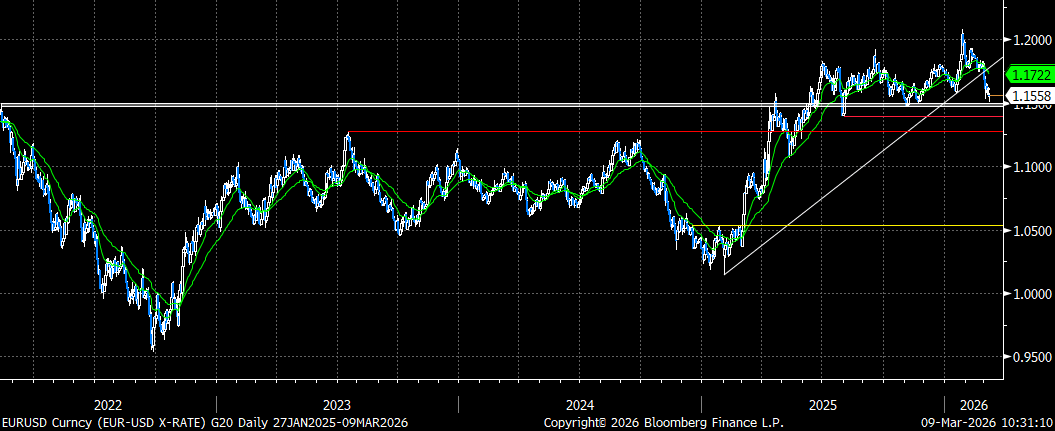
EURUSD Continues to Eye 1.15/1.1470 Support
- FX markets continue to trade as a function of energy prices, albeit in a more contained manner. While the initial positive impulse to the dollar has faded, EURUSD remains 0.6% lower on the session, hovering around the 1.1550 mark. A bear cycle remains in play for the pair, and the overnight lows have narrowed the gap to a key inflection area between 1.15/1.1470.
- We wrote on how analysts had been focussing on this area last week here: https://mni.marketnews.com/4liTmmD . Below here, the focus would turn to 1.1392, the Aug 1 ‘25 low.
- In the crosses, the oil impulse has supported CAD’s resilient tone, leading EURCAD to extend its recent breakout to the downside, now 2.5% below the key 1.6066 support that gave way last week. Price action picked up momentum on a break of the July 2025 lows and will now look to 1.5492 as the next objective.
- Elsewhere, EURCHF moved below 0.9000 for the first time since 2015 with domestic sight deposit data suggesting the SNB has not attempted to curb franc strength last week. 0.8981 has been the printed low so far, and should downside in the cross persist, 0.8913 would be a target based on a Fibonacci projection.
FOREX: USD Boosted By Initial Crude Surge, EURCAD Extends Lower
- FX markets continue to mostly trade as a function of energy prices, with the crude surge to well near $120/bbl translating to an extension of USD strength. This prompted the DXY to briefly reach a fresh recovery high of 99.70 overnight. The subsequent pullback for crude has seen the DXY retreat by around 30 pips, keeping us around 0.45% higher as we approach the NY crossover.
- Losses have been concentrated around the major, with the likes of EUR, JPY and GBP all down around 0.5%, while the oil impulse has supported CAD’s resilient tone. This has led EURCAD to extend its recent breakout to the downside, now 2.5% below the key 1.6066 support that gave way last week. Price action has picked up momentum on a break of the July 2025 lows and will now look to 1.5492 as the next objective.
- USDJPY reached a 158.90 overnight, narrowing the gap to the Jan 14 high and bull trigger which stands at 159.45. Market participants will be monitoring spot closely as we have re-entered levels where prior rate checks from both the BOJ and Fed were reported to have taken place in January.
- Notably, EURCHF moved below 0.9000 for the first time since 2015 with domestic sight deposit data suggesting the SNB has not attempted to curb franc strength last week. 0.8981 has been the printed low so far, and should downside in the cross persist, 0.8913 would be a target based on a Fibonacci projection.
- NY Fed 1-Yr Inflation Expectations for February will be outdated when released today, ECB's Elderson is the sole speaker on the calendar as the Fed remains in blackout. US CPI is the key data point this week on Wednesday.
OPTIONS: Expiries for Mar09 NY cut 1000ET (Source DTCC)
- EUR/USD: $1.1600(E1.9bln), $1.1650(E1.6bln)
- USD/JPY: Y155.00($1.5bln), Y156.00($694mln), Y157.00($691mln), Y158.00($737mln)
- EUR/GBP: Gbp0.8745-50(E708mln)
- AUD/USD: $0.7000(A$1.1bln)
- USD/CAD: C$1.3600($522mln)
EQUITIES: Latest Sell-Off Reinforces Bearish EuroStoxx Theme
- A clear bear cycle in EuroStoxx 50 futures remains intact and the latest impulsive sell-off reinforces the current bearish theme. The recent breach of both the 20- and 50- day EMAs highlighted a stronger reversal. Sights are on the next key support at 5500.00, the Nov 21 ‘25 low. A clear break of this level would strengthen the bear cycle. Initial firm resistance is at 5833.00, the Mar 6 high.
- S&P E-Minis have traded sharply lower today as the contract begins the week on a bearish note. The break of 6751.50, the Feb 6 low, confirms a range breakout and highlights a stronger short-term reversal. Sights are on 6583.00, the Nov 21 ‘25 low and a key medium-term support. A clear breach of this level would strengthen the bear theme and open 6534.52, a Fibonacci projection. Initial firm resistance is 6751.50, the Feb 6 low.
COMMODITIES: WTI Futures Break Through Psychological $100 Handle
- A volatile impulsive bull wave in WTI futures remains intact. The contract continues to appreciate and the breach of the psychological $100.00 handle strengthens a bull theme. Note that the contract is in an extreme overbought condition and that volatile activity is likely to remain in place for now. Attention is on the next psychological hurdle at $120.00. First support is today’s intraday low of $98.00.
- Gold is unchanged and continues to trade below $5419.11, the Mar 2 high. For now, a short-term bullish theme remains intact following recent gains. The metal has cleared all key retracement points of the sharp sell-off between Jan 29 - Feb 2. This strengthens the short-term bullish theme and signals scope for an extension towards key resistance and the bull trigger at $5595.5, the Jan 29 high. Initial firm support to watch lies at $5083.0, the 20-day EMA.
| Date | GMT/Local | Impact | Country | Event |
| 09/03/2026 | - |  EU EU | ECB Cipollone at Eurogroup Meeting, Brussels | |
| 09/03/2026 | 1500/1100 | ** |  US US | NY Fed Survey of Consumer Expectations |
| 09/03/2026 | 1530/1130 | * | US | US Treasury Auction Result for 13 Week Bill |
| 09/03/2026 | 1530/1130 | * | US | US Treasury Auction Result for 26 Week Bill |
| 10/03/2026 | 2330/0830 | ** |  JP JP | Household spending |
| 10/03/2026 | 2350/0850 | *** | JP | GDP |


