OPTIONS: Expiries for Mar09 NY cut 1000ET (Source DTCC)
Mar-06 15:47
- EUR/USD: $1.1600(E1.9bln), $1.1650(E1.6bln)
- USD/JPY: Y155.00($1.5bln), Y156.00($694mln), Y157.00($691mln), Y158.00($737mln)
- EUR/GBP: Gbp0.8745-50(E708mln)
- AUD/USD: $0.7000(A$1.1bln)
- USD/CAD: C$1.3600($522mln)
Want to read more?
Find more articles and bullets on these widgets:
Historical bullets
OPTIONS: Expiries for Feb05 NY cut 1000ET (Source DTCC)
Feb-04 15:46
- EUR/USD: $1.1725-35(E2.0bln), $1.1800(E2.9bln), $1.1825-35(E1.8bln), $1.1880(E706mln)
- USD/JPY: Y153.00($1.6bln), Y154.00($1.1bln), Y155.00($1.0bln), Y156.00($1.2bln), Y156.15-25($1.1bln)
- GBP/USD: $1.3490-00(Gbp798mln)
- EUR/GBP: Gbp0.8650(E624mln)
- AUD/USD: $0.6840-50(A$1.4bln)
- USD/CAD: C$1.3675($740mln)
- USD/CNY: Cny6.9711($600mln)
US DATA: ISM Services Opens 2026 On Firm Ground, But So Do Price Pressures
Feb-04 15:42
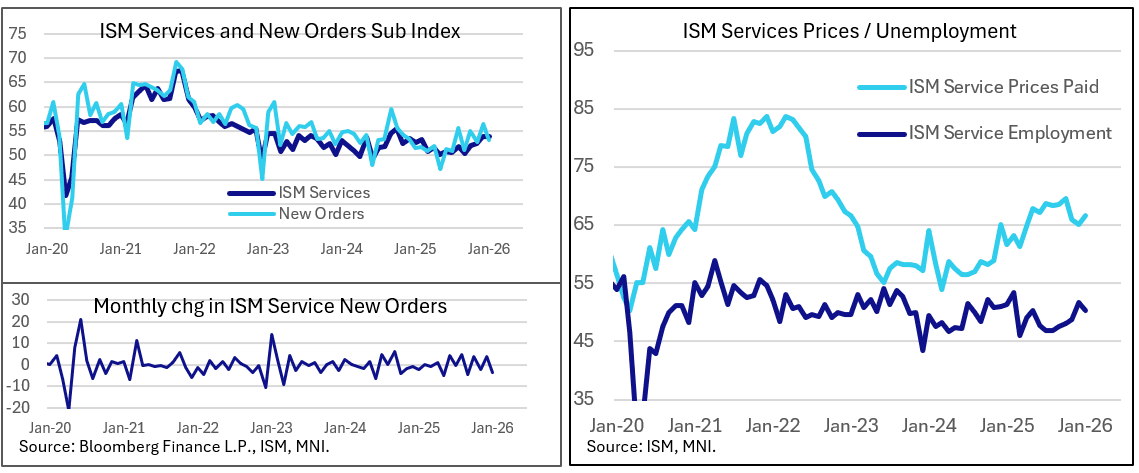
January's ISM Services report was solid overall, with some mixed dynamics beneath the surface including continued persistence in price pressures. Overall it shouldn't change perceptions of activity in the services sector, which entered 2026 on solid footing and appears to be maintaining that momentum.
- The headline PMI came in at 53.8 for a joint-15 month high. This was a steady reading vs December's 53.8, revised down from 54.4 as part of the annual seasonal adjustment revisions; it's unclear whether the consensus for a drop to 53.5 considered this revision.
- As expected, New Orders couldn't sustain December's torrid pace, falling 3.4 points to 53.1. But that is still above the average seen over the last year and bodes well for future activity.
- Similarly, Employment stumbled a little, falling to 50.3 from December's 10-month high 51.7, though that makes 2 consecutive months above 50 following 6 consecutive contractions. A cautionary note here is that just 5 industries reported better employment on net (one of which is the relatively non-cyclical Health Care & Social Assistance), with 8 reporting declines.
- New export orders disappointed at 45.0 (down 9.2 points) which marked the lowest since March 2023, after December's 15-month high. And Imports returned to contraction after one month in expansion (48.2, down 2.1 points). These categories are a little unusual in that around 40% of respondents do not participate in imports/exports or don't measure them separately from overall orders, though clearly there remains trade-related strain in the industry.
- Prices Paid rose 1.5 points to 66.6 for a 3-month high with 17 industries reporting higher prices (and non reporting declines), suggesting that inflationary pressures in the sector persist. We also saw an uptick in this category in the ISM Manufacturing report, which lends a cautionary tone to the week's data.
- On the unambiguously positive side, we took note of the jump in Business Activity, by 2.2 points to a 15-month high 57.4.
- Elsewhere, Inventories fell below 50 after 2 months of expansion, at 45.1 (down 9.1 points), with Inventory Sentiment in "too high" territory for the 33rd consecutive month. Supplier Deliveries picked up 2.4 points to 54.2, a 14th month indicating slower deliveries and thus boosting the overall PMI per the ISM's methodology.
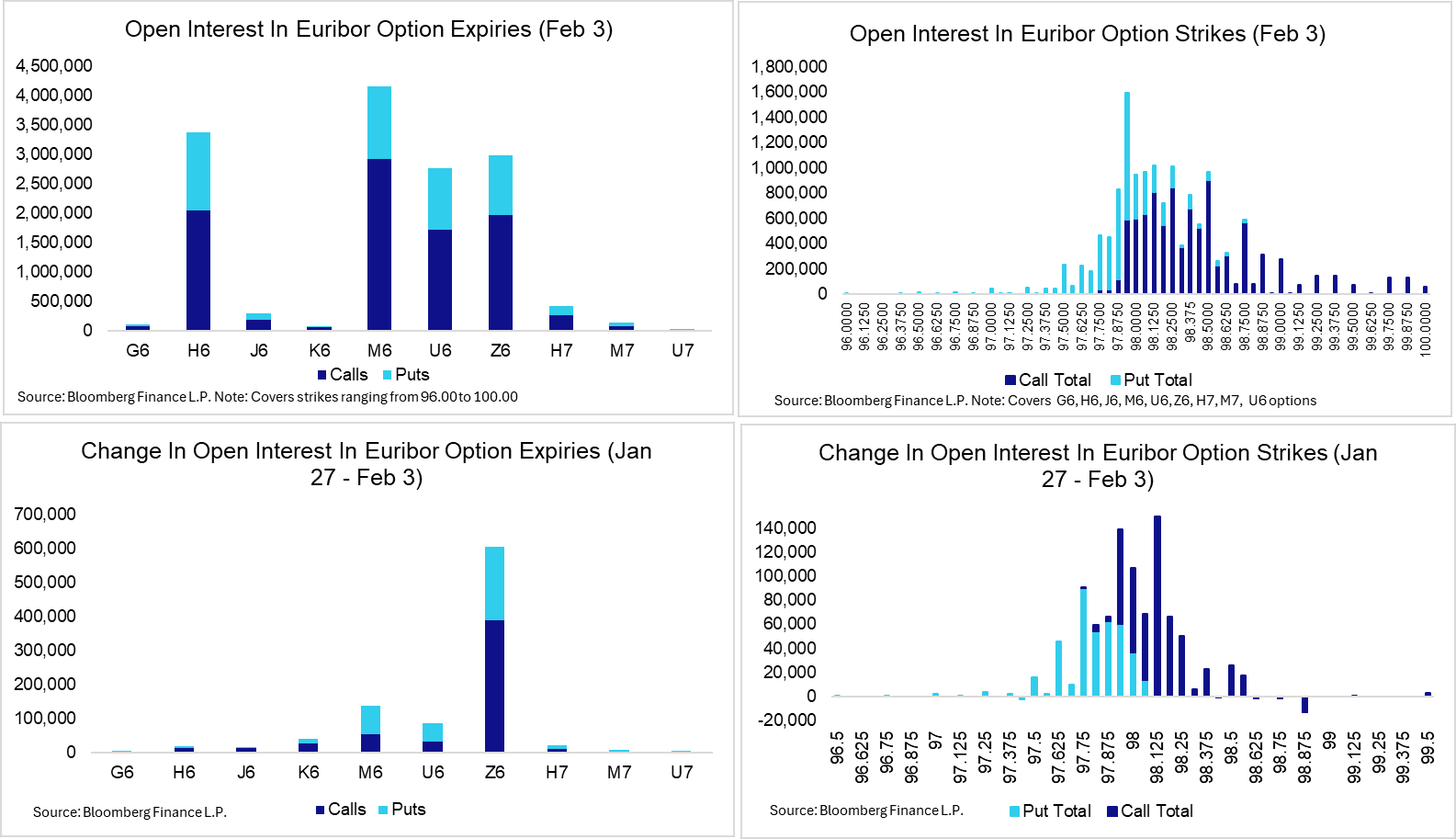
EURIBOR OPTIONS: Weekly Changes In OI Centred In Z6, Upside Structures Prevalent
Feb-04 15:40
In the week to February 3, changes in Euribor options OI were centred in the Z6 expiry. We calculate a near-400k increase in Z6 call OI, alongside just over a 200k rise in put OI.
- The Z6 call strikes seeing the largest increases in OI have been between 98.00 and 98.1875, though we’ve also seen noteworthy rises in lower delta strikes through to 98.50. Large upside structures seen in recent days include:
- ERZ6 98.00/98.06/98.12/98.18 call condor, bought for 0.25 in close to 60k.
- ERZ6 98.25/98.37 call condor, bought for 1.75 in 17.5k.
- ERZ6 97.93/98.00/98.06 call fly, bought for 0.5 in 8.5k.
- On the put side, increases in 97.625 put and 97.75 put OI have been most notable. This likely reflects interest in a ERZ6 98.12/9825 call spread vs 97.75/97.62 put spread structure (where the call spread was bought for net 1.0 and 1.25 in 56.5k on Jan 28).
- Despite the overwhelming consensus for steady rates in 2026, some analysts have highlighted that if the ECB is to deliver more easing, it would likely involve at least two 25bp cuts:
- Goldman Sachs: “The ECB usually cuts at least twice and by more than 50bp when away from the lower bound. The hurdle to move policy by at least 50bp under a Taylor rule would therefore be twice as large and broadly matches the ECB’s historical record”
- Deutsche Bank: “Given that the benefits of a one-off 25bp rate cut will be considered marginal (within the margin of error for growth and inflation forecasting), the ECB is likely to ease only if it thinks more than one 25bp cut is required. This raises the hurdle to further easing”.
- This may provide some rationale for some of the low-delta call structures seen in recent days, if they are indeed speculative in nature. However, more likely is that such structures are intended as hedges against existing hawkish positions in futures/elsewhere.