MNI INTERVIEW: UK Pay Deals To Cluster Near 3% in '26 -Attwood

UK annual pay awards for 2026 are currently coalescing around the 3% level and any shift in coming months will likely be modestly lower, the head of a leading earnings survey firm told MNI.
"Currently the forecasts are saying 3%, the data is currently showing 3%. My feeling is, if it goes any way, any direction, away from that 3%, downward is more likely than upward," Brightmine senior content manager Sheila Attwood said in an interview.
“While inflation is continuing to ease, and the latest data is showing the UK economy returning to growth, this has yet to translate into a meaningful shift in pay awards. Early January settlements suggest most employers are still taking a cautious approach, keeping increases tightly controlled as they balance affordability with ongoing cost pressures.”
According to Attwood, most companies surveyed say affordability is key to the awards they offer staff.
"The proportion of organisations saying it is a downward pressure [on awards] is way above those that saying it's an upward pressure," she said. (See MNI INTERVIEW: UK Consumer Savings Still Drag on Economy- ONS )
NI HIKE
More than half of firms told Brightmine that last year’s hike in national insurance is forcing them to reduce pay budgets, and, while 40% say that they can absorb the cost, it remains a concern for them as well.
"That was an interesting finding from my perspective, in that it is still something that firms are having to think about in their budget planning, and there is definitely wider interest amongst policymakers and economists that it is," said Attwood.
LIVING WAGE
In addition, the increase to the national living wage "will require higher rises for the lowest-paid workers, absorbing a larger share of pay budgets and leaving less headroom elsewhere," she said.
While inflation ticked higher at the end of 2025 firms, it is widely expected to ease, and this outlook will be taken into account in April pay reviews, according to Attwood.
"The other thing which is interesting around inflation is that I also ask questions about how they're managing employee expectations. When the labour market is particularly tight, [employers] want to make sure that they are maintaining their workforce. And inflation has the part to play there, because individuals as employees are more likely to just look at inflation and go, 'well, how does my pay review sit against that?'” she said.
"Inflation does have an impact, beyond just an organisation looking at it from the financial perspective, but in terms of how can they manage employee expectations.”
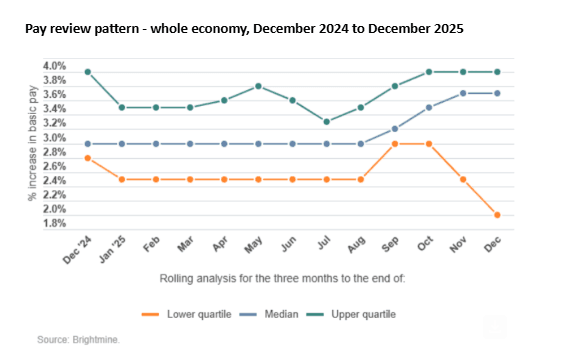
The latest Brightmine pay awards data, closely watched by the Bank of England as part of a wider data suite given the less rreliable official labour market data in recent years, saw
The median basic pay award for the three months to the end of December rose by 3.7%, according to Brightmine’s data, which, despite a low sample size, is closely watched by the Bank of England, particularly given the unreliability of official labour market data in recent years. Awards clustered between 2% and 4%.
BOE Deputy Governor Claire Lombardelli, one of the more Monetary Policy Committee’s more hawkish members, has said wage growth of around 3.1% is in line with the 2% inflation target. In the three months to November, the Office for National Statistics said average earnings growth stood at 4.5% - the lowest in nearly four years - with private sector earnings rising 3.6% annually. (See DM BRIEF: UK Regular Earnings Growth Lowest in nearly 4 Years )