MNI EUROPEAN OPEN: 100bp Fed Step Isn’t Ruled Out
EXECUTIVE SUMMARY
- FED’S MESTER SAYS CPI DATA GIVES NO REASON FOR SMALLER JULY HIKE (BBG)
- FED’S DALY FLAGS CURRENT PREFERENCE FOR 75BP HIKE, NOTES 100BP MOVE IS POSSIBLE
- FED’S BOSTIC SAYS JUNE CPI CONCERNING, ‘EVERYTHING IS IN PLAY’ (BBG)
- EU CUTS EURO-AREA GDP FORECAST, SEES 7.6% INFLATION, DRAFT SHOWS (BBG)
- ITALY'S GOVERNMENT FACES COLLAPSE AS 5-STAR SHUNS CONFIDENCE VOTE
- SUNAK TOPS FIRST VOTE TO BE NEXT UK PM (RTRS)
- CHINA IS SAID TO GET CAUTIOUS ON OUTBOUND SPENDING AS FED HIKES (BBG)
Fig. 1: U.S. 5- & 10-Year Breakevens
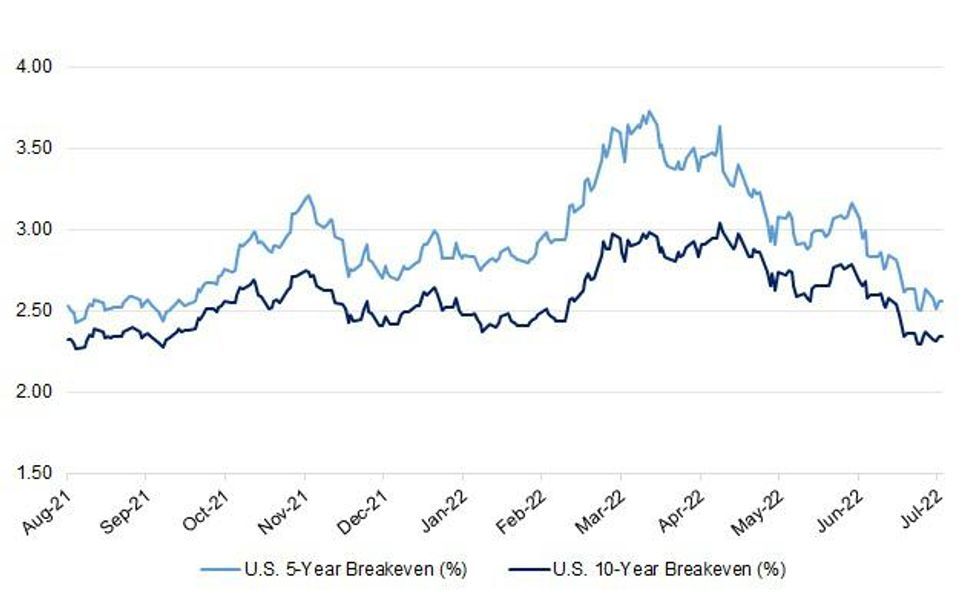 Source: MNI - Market News/Bloomberg
UK
POLITICS: Former finance minister Rishi Sunak won the biggest backing from Conservative lawmakers on Wednesday in the first vote to choose who will succeed Boris Johnson as party leader and British prime minister, while two more rivals were eliminated. Sunak, whose resignation as finance minister last week helped precipitate Johnson's fall, secured support from 88 of the party's 358 Members of Parliament (MPs), with junior trade minister Penny Mordaunt second with 67 votes and foreign minister Liz Truss third with 50. (RTRS)
EUROPE
EU: The euro area’s rebound from the pandemic will be weaker than anticipated while inflation will be faster because of Russia’s war in Ukraine, according to draft projections by the European Commission. With surging prices crimping demand and the danger of winter energy shortages draining confidence, gross domestic product is likely to advance 2.6% this year and 1.4% in 2023 -- down from May predictions for gains of 2.7% and 2.3%, according to new forecasts from the European Union executive arm seen by Bloomberg. (BBG)
ITALY: Italy's 5-Star Movement will not take part in a parliamentary confidence vote on Thursday, party leader Giuseppe Conte said on Wednesday in a move that looked likely to trigger the collapse of Prime Minister Mario Draghi's government. (RTRS)
U.S.
FED: Federal Reserve Bank of Cleveland President Loretta Mester said a hot inflation report for June suggested officials should raise rates by at least 75 basis points later this month, but she declined to spell out if she would favor going even bigger. (BBG)
FED: Federal Reserve Bank of Atlanta President Raphael Bostic said “everything is in play” for policy action after data showed that US inflation accelerated again to a fresh four-decade high last month. “The top-line number is a source of concern,” Bostic told reporters Wednesday in St. Petersburg, Florida. “Everything is in play.” Asked if that included by raising rates by a full percentage point, he replied, “it would mean everything.” (BBG)
FED: “I acknowledge there is near-term recession risk, but I think the medium term is better if you have inflation under control,” said Richmond Fed President Tom Barkin in an interview Wednesday. “Our focus should be on controlling inflation. If we control inflation, we set ourselves up to have a much stronger economy.” (WSJ)
FED: “My most likely posture is 0.75, because of the data I’ve seen,” Mary Daly, president of the Federal Reserve Bank of San Francisco, said in an interview Wednesday night. She explained that she had expected a high number, so the report did not sway her. “I saw that data and thought: This wasn’t good news, wasn’t expecting good news,” she said. Ms. Daly said she could see a situation in which a bigger, one-percentage-point increase would be possible should consumer inflation expectations move higher and consumer spending fail to slow down. (New York Times)
FED: The risk that U.S. inflation continues to stay elevated is rising amid a worsening global energy crisis and fears that Shanghai will be forced into another Covid lockdown, Federal Reserve Bank of St. Louis research director Carlos Garriga told MNI. (MNI)
FED: The central bank’s “Beige Book,” a collection of views from across its 12 districts, noted the economy is growing at just a “modest” pace since the last report in mid-May. Along with that, business contacts reported a general slowdown in demand, with five of the districts expressing “concerns over an increased risk of recession.” On inflation, which is running at its fastest annual rate since November 1981, the report found “substantial price increases” across the country. (CNBC)
FED: Michael Barr, a former official at the U.S. Treasury, won Senate confirmation Wednesday as the Federal Reserve's top Wall Street regulator, a role in which he is set to bolster some rules that were eased during the Trump administration. (RTRS)
FISCAL: The U.S. government posted an $89 billion budget deficit during June, roughly half the gap in the same month last year, as pandemic-related outlays fell and revenues edged higher, the Treasury Department said on Wednesday. The June deficit compared with a $174 billion deficit for June 2021. (RTRS)
ENERGY: For the second time this week, the state’s power grid operator is asking Texans to turn up their thermostats to 78 degrees and to avoid using large appliances as it expects record-high demand for power amid ongoing scorching temperatures. It is asking for conservation from 2 to 9 p.m. Wednesday. A spokesperson for the Electric Reliability Council of Texas, the state’s main power grid operator, said he does not expect rolling blackouts to happen Wednesday. (The Texas Tribune)
OTHER
GLOBAL TRADE: U.N. Secretary-General Antonio Guterres said that an "important and substantive step" was made towards a comprehensive deal to resume Black Sea exports of Ukraine grain after talks between Russia, Ukraine, Turkey and U.N. officials on Wednesday. "Next week, hopefully, we'll be able to have a final agreement. But, as I said, we still need a lot of goodwill and commitments by all parties," he told reporters in New York. He said that although Ukraine and Russia had engaged, "for peace we still have a long way to go." (RTRS)
GLOBAL TRADE: U.S. Secretary of Commerce Gina Raimondo said on Wednesday that lawmakers appear to be moving to carve off $52 billion in semiconductor chips manufacturing subsidies from a larger bill on boosting U.S. competitiveness with China. (RTRS)
GLOBAL TRADE: The Dutch foreign minister confirmed that the Netherlands and the US are holding discussions on blocking ASML Holding NV from selling to China technology used in making a large chunk of the world’s chips. (BBG)
U.S./CHINA: Securities and Exchange Commission Chairman Gary Gensler expressed doubt Wednesday that negotiators in Washington and Beijing will reach an agreement over audits that is necessary to prevent Chinese companies from being delisted by U.S. stock exchanges. (WSJ)
U.S./CHINA/TAIWAN: Ukraine’s countermoves against Russia’s larger military shows Taiwan that possessing advanced “asymmetric” weapons and a determination to resist invasion by a larger neighbor can be a successful combination, according to a senior US State Department official. (BBG)
JAPAN: Four out of five large Japanese firms are passing on higher commodity costs to customers or intend to do so, a Reuters poll found, a sharp rise from the previous survey six months ago as surging input prices and a weak yen drive up import costs. (RTRS)
JAPAN: The Japanese government is “concerned” by the recent rapid weakening of the yen, Chief Cabinet Secretary Hirokazu Matsuno says after the currency fell to 138 to the dollar, the lowest in nearly 24 years. The government is watching moves in the foreign exchange market with a “heightened sense of urgency,” he says in a press briefing. (BBG)
JAPAN: Tokyo is set to raise its coronavirus warning to “red,” the highest level on its 4-color scale from the current “orange,” FNN reports, citing an unidentified official. (BBG)
SOUTH KOREA: South Korea will review extra steps according to contingency plans if necessary and actively deal with one-sided moves in the financial markets, Vice Finance Minister Bang Ki-sun says in a meeting. (BBG)
SOUTH KOREA: South Korean President Yoon Suk-yeol pledged on Thursday to implement policy measures aimed at easing the debt-service burden on low-income earners and the young people at a time of increasing interest rates. (RTRS)
SINGAPORE: Singapore’s central bank unexpectedly tightened monetary policy on Thursday, its second surprise move this year, as rising inflation fanned the risk of economic contraction. (BBG)
PHILIPPINES: The Philippine central bank unexpectedly raised its key interest rate by 75 basis points, after policy makers previously downplayed the need for large hikes to quell the fastest inflation in nearly four years. (BBG)
HONG KONG: The Hong Kong Monetary Authority buys HK$12.796 billion ($1.6 billion) to support the local currency, according to the de facto central bank’s page on Bloomberg. (BBG)
BOC: In his opening statement to reporters at a press conference, Macklem said the objective is to achieve a soft landing. “By front-loading interest rate increases now, we are trying to avoid the need for ever higher interest rates down the road,” he said. “This argues for getting our policy rate quickly to the top end,” Macklem said, adding that he believes that’s “slightly” above the neutral range, which the central bank estimates at between 2% and 3%. (BBG)
BOC: The Bank of Canada could raise interest rates by another percentage point at the next meeting in September to help catch up with inflation according to David Laidler, a former adviser to the central bank and retired Western University professor. (MNI)
BRAZIL: President Jair Bolsonaro got the green light to spend 41.3 billion reais ($7.6 billion) to help Brazilians suffering with inflation that, running near 12% a year, is eroding his popularity before October’s elections. The lower house approved late on Wednesday the bill that allows the government to bypass a constitutional spending cap rule to boost cash handouts to the poor and give diesel vouchers to truck drivers, among other measures. (BBG)
RUSSIA: Consumer prices in Russia declined 0.03% in the week to July 8 after climbing 0.23% a week earlier, according to new data which kept the door open for the central bank to consider cutting rates as soon as next week. (RTRS)
RUSSIA: A looming economic downturn in Russia will not be as deep as initially thought but could last longer, central bank analysts said on Wednesday. The economy is set to contract after Moscow began what it calls a "special military operation" in Ukraine on Feb. 24, which triggered sweeping sanctions against Russia, including a partial freeze of its reserves. "The process of structural transformation is non-linear. (RTRS)
IRAN: Biden said in the interview he would use force "as a last resort" to keep Iran from obtaining a nuclear weapon. The President said he was also committed to keeping the IRGC, the Islamic Revolutionary Guard Corps, on the foreign terrorist list, even if it would kill a potential deal. (CNN)
CHILE: Chile's central bank raised its benchmark interest rate to 9.75% on Wednesday, from 9.0% previously, and said it expected more rate hikes would be necessary as it looks to rein in spiraling inflation. (RTRS)
ENERGY: The European Union is preparing a seventh package of sanctions against Moscow but it is already clear that it will not curb imports of Russian gas as too many member states can't adjust quickly enough, Czech Prime Minister Petr Fiala told Reuters. (RTRS)
ENERGY: The European Union will encourage member countries to cut gas demand by incentivising industries to use less, as it prepares for possible further cuts to Russian supply, according to a draft plan seen by Reuters. (RTRS)
OIL: Deputy US Treasury Secretary Wally Adeyemo said he doesn’t anticipate Washington applying sanctions on countries or companies that fail to join a proposed price cap on Russian oil. “I don’t think we need secondary sanctions because, in this case, what we’re doing is something that is creating the right incentives for the countries that are purchasing Russian oil,” Adeyemo said in an interview with Bloomberg Television Wednesday. (BBG)
OIL: An armed force deployed outside the National Oil Corporation (NOC) headquarters in Tripoli late on Wednesday, three witnesses said, after the chairman Mustafa Sanalla gave a speech rejecting a government decision to sack him. In his speech earlier, Sanalla said Prime Minister Abdulhamid al-Dbeibah's mandate had expired and he did not have the authority to dismiss him as head of the state energy producer. (RTRS)
CHINA
YUAN: The yuan is likely to maintain a narrow range of two-way fluctuations against the U.S. dollar, with no basis for a sharp depreciation, supported by a high trade surplus and limited upward space for the dollar index, wrote Wen Bin, chief economist of China Minsheng Bank in an article run by 21st Century Business Herald. Though China-U.S. interest rates have inverted, the range has narrowed significantly since mid-June, said Wen. Global investors are still keen on domestic financial markets with the capital inflows under Shanghai-Hong Kong Stock Connect increasing, said Wen. (MNI)
YUAN: China’s foreign exchange market has shown greater resilience and foundation to resist external shocks, with generally stable FX reserves and increased cross-border transactions, said the central bank-run newspaper Financial News citing analysts. A flexible yuan is the key to a wider opening of financial markets as it helps release pressure in a timely manner, the newspaper said citing Guan Tao, a former FX official. The yuan is more robust than other non-U.S. currencies, depreciating only 5.4% as of July 12 this year against the backdrop of a sharp 13% rise in the dollar index, significantly lower than the depreciations of the euro, yen and pound, which are 11.9%, 16.1% and 12.6% weaker, respectively, the newspaper said. (MNI)
FISCAL: China is making 7.2 trillion yuan ($1.1 trillion) in funds available for infrastructure spending, a decisive shift away from a focus on controlling debt toward supporting a lockdown-ravaged economy. (BBG)
CAPITAL FLOWS: Chinese regulators have been asked to exercise greater caution when it comes to reviewing new overseas spending and investment plans amid concerns among senior leaders that higher US interest rates could spur capital outflows, according to people familiar with the matter. (BBG)
CHINA MARKETS
PBOC INJECTS CNY3 BILLION VIA OMOS, LIQUIDITY UNCHANGED
The People's Bank of China (PBOC) injected CNY3 billion via 7-day reverse repos with the rate unchanged at 2.1% on Thursday. This keeps the liquidity unchanged after offsetting the maturity of CNY3 billion repos today, according to Wind Information.
- The operation aims to keep liquidity reasonable and ample, the PBOC said on its website.
- The 7-day weighted average interbank repo rate for depository institutions (DR007) rose to 1.8999% at 9:27 am local time from the close of 1.5464% on Wednesday.
- The CFETS-NEX money-market sentiment index closed at 43 on Wednesday vs 45 on Tuesday.
PBOC SETS YUAN CENTRAL PARITY AT 6.7265 THURS VS 6.7282
The People's Bank of China (PBOC) set the dollar-yuan central parity rate lower at 6.7265 on Thursday, compared with 6.7282 set on Wednesday.
OVERNIGHT DATA
JAPAN MAY, F INDUSTRIAL PRODUCTION -7.5% M/M; FLASH -7.2%
JAPAN MAY, F INDUSTRIAL PRODUCTION -3.1% Y/Y; FLASH -2.8%
JAPAN MAY CAPACITY UTILISATION -9.2% M/M; APR +0.0%
AUSTRALIA JUN EMPLOYMENT CHANGE +88.4K; MEDIAN +30.0K; MAY +60.6K
AUSTRALIA JUN FULL TIME EMPLOYMENT CHANGE +52.9K; MAY +69.4K
AUSTRALIA JUN PART TIME EMPLOYMENT CHANGE +35.5K; MAY -8.7K
AUSTRALIA JUN UNEMPLOYMENT RATE 3/5%; MEDIAN 3.8%; MAY 3.9%
AUSTRALIA JUN PARTICIPATION RATE 66.8%; MEDIAN 66.7%; MAY 66.7%
AUSTRALIA JUL CONSUMER INFLATION EXPECTATIONS +6.3%; JUN +6.7%
UK JUN RICS HOUSE PRICE BALANCE 65%; MEDIAN 70%; MAY 72%
MARKETS
SNAPSHOT: 100bp Fed Step Isn’t Ruled Out
Below gives key levels of markets in the second half of the Asia-Pac session:
- Nikkei 225 up 181.49 points at 26660.26
- ASX 200 up 28.143 points at 6649.70
- Shanghai Comp. up 10.21 points at 3294.502
- JGB 10-Yr future down 3 ticks at 149.23, yield unch. at 0.232%
- Aussie 10-Yr future down 3.5 ticks at 96.535, yield up 3.4bp at 3.422%
- U.S. 10-Yr future -0-11 at 118-18+, yield up 1.85bp at 2.952%
- WTI crude up $0.53 at $96.83, Gold down $5.27 at $1730.24
- USD/JPY up 82 pips at Y138.22
- FED’S MESTER SAYS CPI DATA GIVES NO REASON FOR SMALLER JULY HIKE (BBG)
- FED’S DALY FLAGS CURRENT PREFERENCE FOR 75BP HIKE, NOTES 100BP MOVE IS POSSIBLE
- FED’S BOSTIC SAYS JUNE CPI CONCERNING, ‘EVERYTHING IS IN PLAY’ (BBG)
- EU CUTS EURO-AREA GDP FORECAST, SEES 7.6% INFLATION, DRAFT SHOWS (BBG)
- ITALY'S GOVERNMENT FACES COLLAPSE AS 5-STAR SHUNS CONFIDENCE VOTE
- SUNAK TOPS FIRST VOTE TO BE NEXT UK PM (RTRS)
- CHINA IS SAID TO GET CAUTIOUS ON OUTBOUND SPENDING AS FED HIKES (BBG)
US TSYS: Twisting Flatter
The post-CPI twist flattening of the curve spilled over into Asia-Pac trade, with the major cash Tsy benchmarks running 4bp cheaper to 0.5bp richer, pivoting around 20s, as the wings of the curve reflect the respective extremes.
- Hawkish Fedspeak from Mester (’22 voter) added to that particular dynamic, as she noted there was no trade off when it comes to fighting inflation, while stressing that July’s monetary policy decision “doesn’t have to be made today” and flagging the upcoming retail sales data and inflation expectations component of the UoM sentiment survey as key inputs for the July decision. She didn’t directly answer a question re: the potential for a 100bp hike but noted that the step should be as least as large as the 75bp hike deployed last time out. Elsewhere, Fed’s Daly (’24 voter) flagged her current preference for a 75bp hike but noted that a 100bp move is within the scope of the potential outcomes re: the July meeting.
- Trade during the first half of the session was two-way, with a bid to best levels quickly unwound, then extending on the back of spill over from ACGBs on the back of a firmer than expected Australian labour market report. That cheapening move then consolidated during the second half of the session, with TYU2 last dealing -0-13 at 118-16+, 0-02 off the base of its 0-15+ Asia range, although volume is subdued, running just above 90K.
- A quick reminder that various curve inversion measures have registered fresh cycle extremes post-CPI, including the 2-/10-Year yield spread, EDZ2/H3, EDZ2/Z3 & EDZ2/Z4. Note that Fed Chair Powell’s preferred measure, the 3-month/3-month 18 months forward spread, now sits around the 65bp mark, after flattening by ~150bp over the last month.
- Various FV option blocks headlined on the flow side in Asia.
- PPI & weekly jobless claims data is due today, as is Fedspeak from Governor Waller.
JGBS: Curve Twist Flattens, 20-Year Supply Goes Smoothly
JGB futures are -4 ahead of the bell, with the contract sticking comfortably within the confines of its overnight session range.
- Cash JGBs twist flattened, in sympathy with post-CPI U.S. Tsy trade, pivoting around the 10- to 20-Year zone, with the major benchmarks running 1.5bp cheaper to 1.5bp richer across the curve (a similar move was observed in swaps, although the net changes were more modest there).
- Domestic headline flow has seen a continued uptick in worry re: FX market moves amongst senior Japanese policymakers
- Elsewhere, foreign investors registered the largest round of net weekly purchases of Japanese bonds observed since July of last year. We would suggest that this largely represents continued short covering in JGBs (third straight week of net purchases) after the BoJ reinforced the upper end of its permitted 10-Year JGB yield trading band in June (with foreign investors willing to test the BoJ’s resolve at that time).
- In terms of 20-Year supply, the low price observed at the 20-Year auction topped wider dealer expectations (which stood at 99.80 per the wider BBG dealer poll), with the tail narrowing a touch and cover ratio moving further above the 6-auction average. The tail width means that the auction wasn’t overly strong, but it was easily digested, with the previously outlined curve steepness and home bias of the Japanese bond investor community likely supporting takedown.
JGBS AUCTION: Japanese MOF sells Y972.7bn 20-Year JGBs:
The Japanese Ministry of Finance (MOF) sells Y972.7tn 20-Year JGBs:
- Average Yield: 0.902% (prev. 0.905%)
- Average Price: 99.95 (prev. 98.23)
- High Yield: 0.908% (prev. 0.913%)
- Low Price: 99.85 (prev. 98.10)
- % Allotted At High Yield: 6.2008% (prev. 42.0370%)
- Bid/Cover: 3.632x (prev. 3.381x)
AUSSIE BONDS: Labour Market Data Adds To Flattening Pressure
The cheapening impetus seen from stronger-than-expected domestic labour market data allowed the Tsy-inspired flattening impetus to extend, with another shunt lower in the unemployment rate outstripping market expectations.
- The space is back from extremes in terms of both cheaps and session flats as we work towards the Sydney close. Cash ACGBs run 2-15bp cheaper across the curve, with 3s sitting ~14.5bp cheaper at typing, after printing as much as 19bp cheaper earlier in the day. YM and XM are -14.0 and -4.5, respectively after the former breached its overnight lows in the wake of the labour market report. EFPs have continued their recent tightening, with the 3-/10-Year box flattening today.
- Bills run flat to 34 ticks cheaper through the reds, bear flattening.
- STIR markets now price in ~64bp of tightening come the end of the RBA’s August meeting, with Goldman Sachs and Nomura being the first two sell-side names to call for such a move. The continued tightening of the labour market, coupled with the frontloading of Fed hike expectations have been in the driving seat today, with the labour market report threatening to force a further frontloading of RBA tightening, in addition to opening the door towards a higher terminal rate.
- Friday will see the release of the AOFM’s weekly issuance slate, as well as a A$700mn of ACGB Apr-27 auction.
EQUITIES: Higher In Asia: Chinese Tech Rally Counters Property Developer Weakness
Major Asia-Pac equity indices are 0.4% to 0.7% better off at typing, bucking a negative lead from Wall St.
- The Hang Seng Index deals 0.2% firmer at typing, on track to snap a four-session streak of losses. The property and financial sub-indices posed the most drag, with Chinese-linked developers and banks going offered amidst news of Chinese homebuyers refusing to make mortgage payments (“at least 100 projects in more than 50 cities” are affected, according to BBG reports). On the other hand, China-based tech outperformed, with the Hang Seng Tech Index 1.7% better off at writing.
- The CSI300 trades 0.5% higher, operating around session highs at typing. The industrials and healthcare sub-indices contributed the most to gains in the index, countering losses in the real estate (-2.3%) and financials (-1.7%) sub-gauges. Elsewhere, tech-related equities outperformed, with the ChiNext and STAR50 indices dealing 2.7% and 3.0% firmer apiece.
- The ASX200 deals 0.4% firmer, on track for a third consecutive daily gain. Commodity and tech-related equities lead the bid, with the S&P/ASX All Technology Index adding 1.7% at writing, while major miners sit between 2.4% to 3.9% better off.
- E-minis are flat to 0.1% weaker at typing, back from worst levels at around 0.7-0.8% lower apiece earlier in the session.
OIL: A Little Above Wednesday’s Three-Month Lows
WTI and Brent are ~$0.50 firmer apiece at typing, operating comfortably within their respective ranges established on Wednesday. Brent has struggled to make meaningful headway above the $100 handle in Asia-Pac dealing, with worry re: reduced energy demand in the coming quarters taking focus in recent sessions.
- Both benchmarks have risen from their respective three-month lows made on Wednesday but remain >$10 weaker from levels observed in end-June as rising recession worry continues to counter well-documented tightness in global supplies. Underperformance in crude also comes amidst strength in the USD (DXY), with the latter sitting a little below fresh cycle highs made on Wednesday.
- The International Energy Agency’s (IEA) monthly oil report was released on Wednesday, with the agency tweaking crude demand growth forecasts for 2022 and 2023 by -100K bpd apiece, citing “weaker-than-expected oil demand growth in advanced economies”. A note that this comes after OPEC’s own demand forecast issued earlier this week (unchanged for ‘22, lowered for ‘23).
- The latest round of U.S. EIA inventory estimates pointed to a surprise ~3.3mn bbl build in crude stockpiles, coming after the >8mn bbl build observed last week. Meanwhile, gasoline, distillate, and Cushing hub stockpiles inventories increased.
GOLD: Lower In Asia; Fed Hawkishness Eyed
Gold deals ~$5/oz weaker at typing to print $1,730/oz, off worst levels. The precious metal operates comfortably within Wednesday’s range, with the day’s move lower facilitated by an uptick in the USD (DXY) and nominal U.S. Tsy yields.
- To recap, gold closed ~$10/oz higher on Wednesday, having whipped between session highs and eleven-month lows ($1,707.5/oz) after the U.S. CPI print. A surge in Fed rate hike expectations following the data release was countered by rising worry re: recession risks, with the inversion on U.S. 2-Year/10-Year yields noted to have hit its largest in over 20 years.
- July FOMC dated OIS now price in ~92bp of tightening for that meeting, pointing to a >60% chance of a 100bp rate hike then (compared to ~75bp priced in pre-U.S. CPI). Fedspeak since the CPI print has seen no explicit ruling out of a 100bp hike for July, with the Fed’s Mester (voter) pointing to economic data due between now and the upcoming FOMC (Jul 26-27) for a decision, while the Fed’s Daly (‘24 voter) stated that a 100bp hike was “possible”.
- From a technical perspective, conditions remain bearish for gold, with focus on support at $1,706.8/oz (1.618 proj of the Mar 8-29-Apr18 price swing). Meanwhile, initial resistance is seen at $1752.3/oz (High Jul 8 / Low May 16, recent breakout level).
FOREX: Strong Jobs Report Drives AUD Outperformance, Hawkish Fedspeak Props Up USD
Continued hawkish drumbeat from Fed officials set the tone of morning trade in Asia, generating light risk-off flows (which petered out as the session progressed) and putting a bid into the greenback. Cleveland Fed's Mester ('22 voter) called for at least a 75bp rate hike at the next FOMC meeting, but kicked the can down the road re: necessity of a 100bp move. Separately, San Francisco Fed's Daly ('24 voter) told the NYT that she would most likely support a 75bp hike, but a 100bp rate rise is "in range of possibilities."
- Anticipation of increasingly hawkish posturing from the Fed raised the prospect of further widening in U.S./Japan yield gap, with the BoJ committed to keep local interest rates rock bottom. This rendered the yen vulnerable, with USD/JPY climbing into the Tokyo fix to print a fresh cyclical high at Y138.12. Japan's Chief Cabinet Secretary Matsuno said officials will watch FX moves with heightened sense of urgency, but his comments provided only brief, mild reprieve to the yen.
- A stellar labour force survey allowed the Aussie dollar to regain poise and eventually top the G10 scoreboard amid aggressive addition of hawkish RBA bets. The report showed that employment grew by 88.4k in June, far exceeding expectations of all economists surveyed by Bloomberg, with the unemployment rate dropping to a multi-decade low. The OIS strip now prices ~57bp worth of tightening at the RBA's August meeting, suggesting that some participants are bracing for a 75bp hike to the cash rate target.
- Trans-Tasman spillover lent a helping hand to the kiwi dollar, albeit it understandably lagged its Antipodean cousin. AUD/NZD showed above yesterday's peak, even as AU/NZ 2-Year swap spread is back to virtually neutral levels after some minor perturbations caused by Australian jobs data.
- Swedish CPI as well as U.S. PPI & jobless claims will take focus later in the day. Comments are due from Fed's Waller and ECB's Centeno.
FX OPTIONS: Expiries for Jul14 NY cut 1000ET (Source DTCC)
- EUR/USD: $1.0095-10(E851mln), $1.0150(E682mln), $1.0190-00(E1.0bln)
- GBP/USD: $1.1820(Gbp616mln), $1.2000(Gbp548mln)
- USD/JPY: Y135.70($1.2bln), Y136.00($976mln), Y139.00($1.5bln)
- NZD/USD: $0.6090-00(N$1.0bln), $0.6120(N$1.3bln)
- USD/CAD: C$1.2925-45($ 710mln)
UP TODAY (Times GMT/Local)
| Date | GMT/Local | Impact | Flag | Country | Event |
| 14/07/2022 | 0600/0800 | *** |  | SE | Inflation report |
| 14/07/2022 | 0600/0800 | * |  | DE | Wholesale Prices |
| 14/07/2022 | 0800/0400 |  | US | Treasury Secretary Janet Yellen | |
| 14/07/2022 | 1230/0830 | ** |  | US | Jobless Claims |
| 14/07/2022 | 1230/0830 | *** |  | US | PPI |
| 14/07/2022 | 1400/1000 | ** |  | US | WASDE Weekly Import/Export |
| 14/07/2022 | 1430/1030 | ** |  | US | Natural Gas Stocks |
| 14/07/2022 | 1500/1100 |  | US | Fed Governor Christopher Waller | |
| 14/07/2022 | 1530/1130 | ** |  | US | US Bill 04 Week Treasury Auction Result |
| 14/07/2022 | 1530/1130 | * |  | US | US Bill 08 Week Treasury Auction Result |


