MNI BOK WATCH: Board To Hold, Eye Debt, House Price Concerns

The Bank of Korea board is likely to keep its base rate unchanged at 2.50% on Thursday for the sixth consecutive meeting, as the central bank maintains a neutral stance and continues monitoring economic and price developments, observers told MNI, with no change expected unless the economy shows a significant deterioration.
“The outlook for stable inflation will not prompt the bank to lower the rate for the time being but the policymakers are worried about volatile currency and its impact on inflation,” said a source familiar with the economy and monetary policy.
January economic data were strong, bolstered by demand ahead of the Chinese New Year, prompting careful attention to February figures, the source added.
The Board last adjusted the base rate in May 2025, lowering it 25bp. (See MNI BOK WATCH: Board On Hold, Drops Rate Cut Reference)
ECONOMIC DATA
Exports rose 33.9% year-on-year in January, marking the eighth consecutive increase following a 13.3% rise in December. Strong semiconductor shipments, up 103%, drove much of the gains amid sustained global demand for IT products.
Policymakers are assessing how robust exports will influence first-quarter growth, particularly as domestic demand remains sluggish after a 0.3% contraction in Q4 2025 compared with 1.3% in Q3.
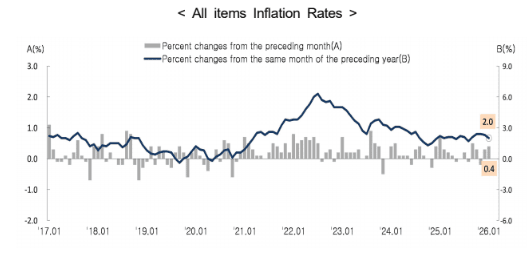
Consumer prices increased 2.0% y/y in January, down from 2.3% in December and the lowest in five months, supporting the central bank’s wait-and-see approach.
The Korea Development Institute recently raised its 2026 GDP forecast to 1.9% from 1.8%, citing improving exports, private demand, and capital investment driven by strong semiconductor performance. The forecast aligns with the International Monetary Fund’s estimate but remains above the Bank of Korea’s 1.8% projection and slightly below the government’s 2.0% target.
WEAK WON
Concerns persist over a weakening Korean won and its potential impact on inflation. President Lee Jae Myung noted on Jan 21 that authorities expect the won to trade around 1,400 per U.S. dollar within one to two months, compared with Monday's 1,445 level.
Minutes from the the last Jan 15 meeting revealed that many board members were wary of a weaker currency’s effect on inflation, high housing prices, and household debt, factors weighing against immediate easing. Some members acknowledged the economy is recovering, though not yet at a sufficient pace, and a few did not rule out future rate cuts should domestic demand remain weak.


