MNI BOK WATCH: Board Likely To Hold, Offer Forward Guidance

The Bank of Korea board is expected to keep its base rate unchanged at 2.50% on Thursday, as policymakers remain cautious about cutting rates amid concerns over household and corporate debt and the potential impact on the currency, observers told MNI.
“Should the economy worsen, the bank could lower the policy rate again. But a rate cut is unlikely as the governor is worried about its effect on the currency and inflation,” a source familiar with the economy and monetary policy said.
Some policymakers see a possible need for a rate reduction but are hesitant to act soon, given risks from higher inflation and rising land prices, the source added.
The BOK has held the base rate steady since it reduced it 25 basis points in April 2025. Board Member Shin Sung Hwan again voted against leaving the rate unchanged at the November meeting, proposing a 25-basis-point cut, a repeat of his stance at October's decision. (See MNI BOK WATCH: Board Holds, Further Cuts Considered Cautiously)
A separate source noted the economy's current performance does not warrant a rate cut, with global demand for semiconductors and memory chips remaining firm amid AI-driven growth in the U.S. and other major economies.
However, market participants are largely expecting a rate cut rather than a hike in the near term, reflecting the BOK’s current focus on inflation and property prices over broader economic growth.
Observers said attention will be on how Governor Rhee Chang-yong frames the outlook for monetary policy, including any forward guidance, although he is likely to maintain an easing bias. The median forecast for the policy rate this year is 2.50%, with the weighted average slightly below that level.
WON WEAKNESS
In his New Year’s speech, Rhee said the recent weakness of the won does not reflect economic fundamentals, echoing comments by the finance ministry on Dec 24. The ministry signaled plans for more decisive intervention to stem depreciation, which has seen the won lose significant ground against the U.S. dollar and other major currencies in recent months.
Housing prices in Seoul remain elevated, clouding the prospect of an imminent rate cut and prompting the BOK to monitor developments carefully.
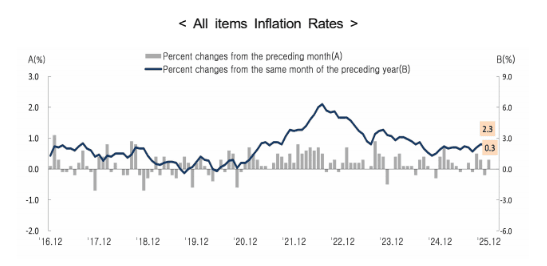
A source added that concerns over financial stability and higher inflation will likely restrain the bank from cutting rates anytime soon. South Korea’s consumer price index rose 2.3% in December, down slightly from 2.4% in November but remaining above 2% for the fourth consecutive month.
Separately, South Korea committed in November 2025 to invest USD350 billion in the U.S., aimed at reducing automobile taxes. The governor noted the importance of monitoring the risk that the investment does not weaken the currency.


