MNI BOK WATCH: Board Likely To Hold, Inflation In Focus

The Bank of Korea Board is likely to keep its base rate unchanged at 2.50% on Friday, as high uncertainty driven by geopolitical issues and elevated crude oi prices drive caution among policymakers, observers told MNI.
“The bank is widely expected to hold the policy rate this week amid high uncertainties over the economy and inflation,” a source familiar with the central bank’s policy said, adding that, while the Bank continues to monitor economic and inflation developments closely, a rate hike is not expected this year.
The Bank has held the base ready steady since May 2025. A hold this week would represent its seventh consecutive pause. (See MNI BOK WATCH: Board On Hold; Ups GDP, CPI Outlook)
ECONOMIC DATA
The economy remains solid on the back of strong exports, but domestic demand continues to lag. Exports rose 48.3% in March for a 10th straight monthly increase, following a 29.0% rise in February, led by semiconductors, which surged 151.4% on continued strong global IT demand. However, the spillover to domestic demand, including private consumption and construction investment, remains limited.
Another observer noted that policymakers are cautious about the risks of a slowing economy amid high interest rates and energy costs. Inflation is expected to remain stable, although consumer prices are projected to rise in the coming months.
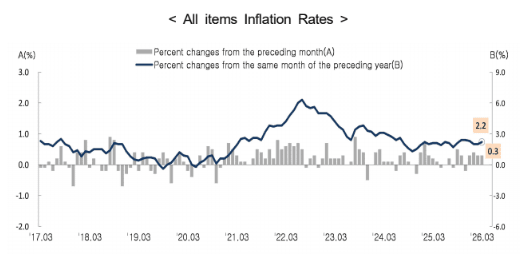
South Korea’s CPI rose 2.2% y/y in March, up from 2.0% in February and January, after 2.3% in December. (See chart) Economists expect CPI to average 2.4% in Q2 and 2.3% in Q3, before slowing to 2% in Q4.
WEAK WON
Minutes from the Feb 26 meeting showed members were concerned about a weaker currency’s impact on prices, with some emphasising the need to consider lowering the policy rate. One member noted the continued need for accommodative monetary policy in real economic terms but highlighted that upward inflationary pressures and housing market uncertainty remain a constraint.
The Korean won traded around KRW1,476 against the U.S. dollar mid-Wednesday, after hitting KRW1,561 on March 10, its lowest level in 17 years.
The BOK’s cautious stance is expected to continue after new governor Shin Hyun-song takes office on April 21. President Lee Jae Myung appointed Shin, currently head of the economic department at the Bank for International Settlements, to replace Rhee Chang-yong.
In a statement, Shin said he would pursue a “balanced” policy approach, weighing inflation, growth, and financial stability.


