US DATA: ISM Manufacturing Follows MNI Chicago PMI With A Sharp Increase
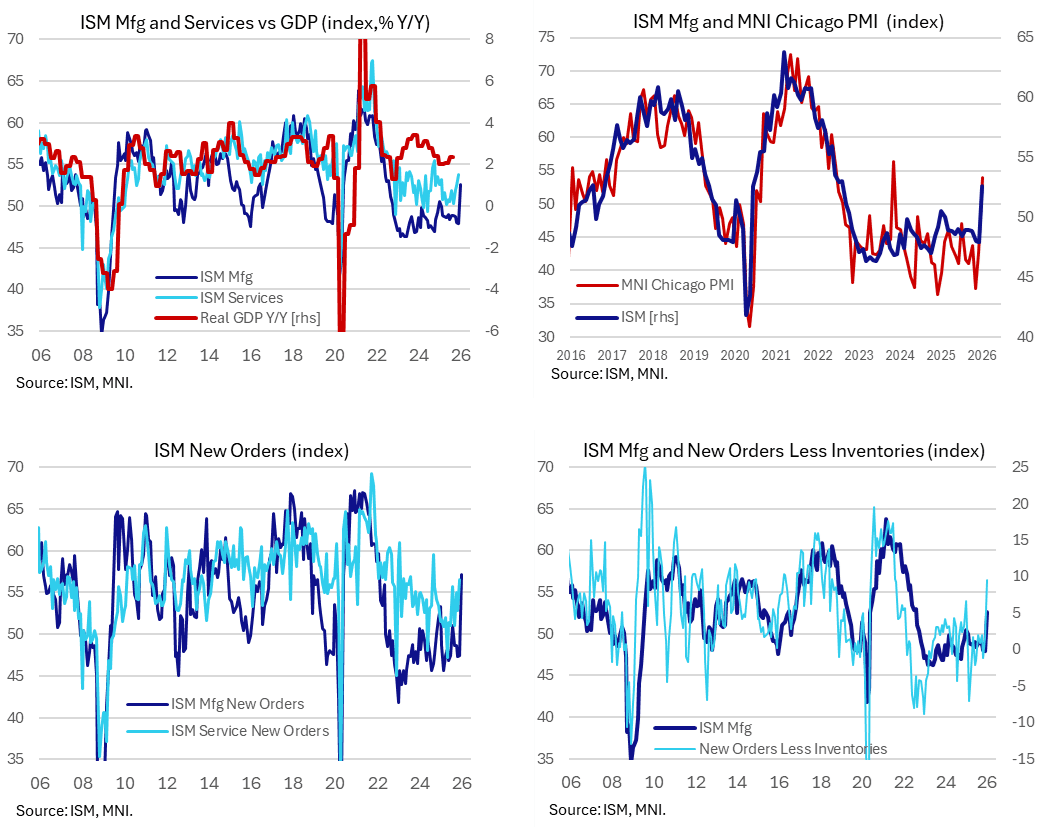
The ISM manufacturing report was far stronger than expected in January as it jumped 4.7pts to 52.6 for its highest since Aug 2022, significantly above even the highest analyst estimate of 51.0. New orders and production both surged to their highest since early 2022 - unlike the final PMI survey released shortly beforehand, it doesn’t look linked to an inventory build. The report chimes with a particularly strong MNI Chicago PMI released last week with added support from most of the regional Fed manufacturing surveys also improving in January.
- ISM mfg: 52.4 (cons 48.5, range 47.9-51.0) in Jan after 47.9 in Dec – highest since Aug 2022
- New orders: 57.1 in Jan after 47.7 in Dec – highest since Feb 2022
- Production: 55.9 in Jan after 50.7 – highest since Feb 2022
- Inventories: 47.6 in Jan after 45.7 – highest since Nov 2025
- Prices paid: 59.0 (cons 59.3, 7 responses) in Jan after 58.5 – highest since Sep 2025
- Employment: 48.1 (cons 46.0, 3 responses) in Jan after 44.9 – highest since Jan 2025
- The marked increase in the overall index follows a particularly strong 11.3pt jump in the MNI Chicago PMI to 54.0 (highest since Nov 2023 although it has recently been a more volatile series than ISM) as well as the average of the five regional Fed manufacturing surveys at the highest since Jan 2025.
- Released shortly beforehand, the final S&P Global US mfg PMI also saw a sizeable upward revision in January to 52.4 (flash 51.9) after 51.8 in Dec for its highest since October.
- In the last 333 months in which there's been a Bloomberg analyst survey, this is the 3rd-largest beat vs the high estimate (Oct 2009 2.6 points, Feb 2007 2.1 points, Dec 2020/Sep 2011/Jan 1999 all 1.7 points...and this was 1.6 points).
- Looking ahead, the new orders less inventories metric had in recent months been pointing to some improvement with a return to positive figures (0.8 av in Q4), but the latest 9.5 in January is particularly impressive at its highest since Aug 2021.
- On the cost side, prices paid nudged a little higher after two months at 58.5 in Nov-Dec and 58.0 in Oct. As such, it doesn’t change the recent narrative and compares with an average of 63.4 in 2025, 53.6 in 2024, a peak of 92 in mid-2021 and a pre-pandemic average in the 49s.
Want to read more?
Find more articles and bullets on these widgets:
Historical bullets
US DATA: Dallas Fed Weekly Index Ends Year Tracking Solid Q4 GDP Growth
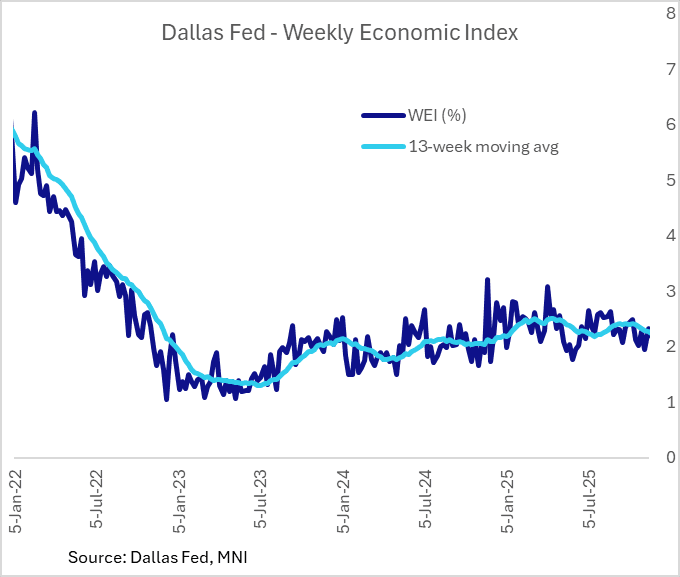
The Dallas Fed's Weekly Economic Index concluded 2026 on a bright note, with the 4-quarter-scaled GDP growth rate ticking up in the Dec 27 week to 2.23% Y/Y from 2.21% prior.
- This should be caveated slightly by the fact that railroad traffic, electricity output, and fuel sales were not released for the latest week due to holidays, but it kept the 13-week (ie quarterly) moving average rate at 2.24% for a 6th consecutive week between 2.24-2.25%.
- The WEI was consistent with real GDP growth of 4+% Q/Q SAAR in Q3, which was closer to the mark than most (the official reading was 4.3%).
- Its final reading of Q4 means it tracked the equivalent of 2.5-3.0% Q/Q SAAR growth for the quarter, a little below the Atlanta Fed GDPNow estimate of 3.0%. We get the next Atlanta Fed reading on Monday after the ISM Manufacturing release for December.
US PREVIEW: Payrolls Seen Steadying Out In December After Noisy Oct/Nov (2/2)
Next Friday's release of the December employment report is the highlight of the week's macro calendar. Our usual preview will be out early next week but early consensus expectations are for relatively steady readings vs November, with 55k nonfarm payroll gains (64k in Nov) and an unemployment rate of 4.5% (4.6% in Nov), with a slight moderation in participation and an uptick in hourly earnings growth.
- This is the last payrolls report before the FOMC's end-January meeting, at which participants would probably require substantially weaker-than-expected NFPs to spur even consideration of a another 25bp cut.
- That said the December data will carry more signal to the market and Fed than the highly unusual November report, which was both delayed and abbreviated (no October Household Report/unemployment rate) due to the federal government shutdown. Additionally, there were apparent distortions blurring the signal from the data, from the shutdown-driven jump in unemployment, to the new historical low for the household survey response rate and higher standard errors.
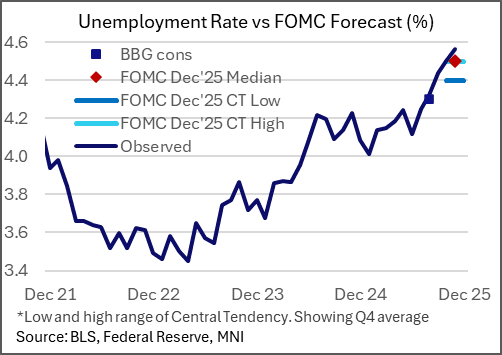
- Note that the FOMC's December 2025 median for the Q4 unemployment rate was 4.5% so a steady rate from November would imply a dovish "miss" to the upside though the significance will be muted by the noise in the household data. That said with Fed Chair Powell stating last month that nonfarm payroll gains are overstated by 60k/month, the consensus expectation will - to the leadership of the FOMC - imply only continued softness in the labor market, keeping further rate cuts in play this year.
- So far, indicators point to a relatively steady labor market overall in December vs November. The Chicago Fed's advance estimate of December's unemployment rate is 4.56% - which would be unchanged from November's unrounded BLS reading.
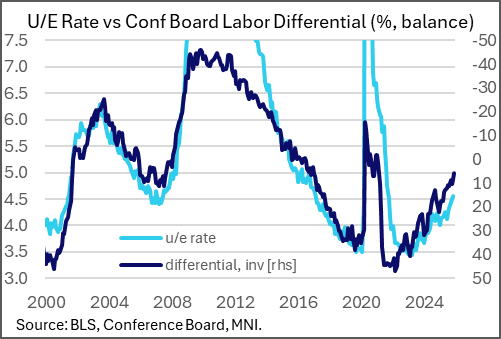
- The "labor differential" in the December Conference Board consumer survey its lowest since February 2021 at 5.9, pointing to a continued pickup in the unemployment rate, while the UMIchigan survey's expected job changes expected during the next year remains at levels consistent with meaningful monthly nonfarm payrolls contractions.
- However, jobless claims data for the reference week were on the lower side of the range seen in recent months' reference periods (initial 224k, continuing 1,913k in Dec 13 week).
EUROZONE ISSUANCE: EGB Supply – W/C 5 January
Germany, Spain, and France are scheduled to kick off auction issuance for the year in the upcoming week. We pencil in issuance of E55.5bln for the week, after this week saw no scheduled operations amid the holiday period. Slovenia will also hold a syndication in the week with syndications also possible from Austria, Belgium, Germany, Ireland, Portugal and the EFSF.
- Slovenia has already announced a mandate for a new 10-year SLOREP. We expect the transaction to take place on Monday 5 January with a E1.5bln size.
- Germany will be looking to kick off EGB auction issuance for the year on Tuesday with E6bln of the 2.00% Dec-27 Schatz (ISIN: DE000BU22114).
- Germany will return to the market on Wednesday with E6bln of the new Feb-36 Bund (ISIN: DE000BU2Z064). The coupon will be announced on Tuesday.
- Spain will come to the market on Thursday with a Bono/Obli/ObliEi auction, with the 2.70% Jan-30 Bono (ISIN: ES0000012O00), the 3.00% Jan-33 Obli (ISIN: ES0000012P74), the 3.45% Jul-43 Obli (ISIN: ES0000012K95) alongside the 1.15% Nov-36 Obli-Ei (ISIN: ES0000012O18) on offer. The combined auction size is to be confirmed on Monday.
- France will come to the market on Thursday to hold a LT OAT auction, selling a combined E11.5-13.5bln of the 3.50% Nov-35 OAT (ISIN: FR0014012II5), the 0.50% May-40 OAT (ISIN: FR0013515806), the 3.60% May-42 OAT (ISIN: FR001400WYO4) and the 3.75% May-56 OAT (ISIN: FR001400XJJ3).
NOMINAL FLOWS: The upcoming week will see no redemptions. Coupon payments for the week total E4.1bln of which E4.0bln are from Germany. This leaves estimated net flows for the week at positive E51.4bln, versus negative E1.4bln this week.


