UK FISCAL: IFS Outlines Options for the Budget
Oct-13 2025 06:45
- There has been a lot of focus in the weekend press on the IFS' "Options for Tax Increases" document that was published in full overnight (full text here)
- Some of the options included an additional tax on income separate to income tax and employee NIC (and hence not technically breaking the manifesto but clearly breaking the spirit). We note that this would be similar to the "Health and Social Care Levy" that was announced in September 2021 under the Johnson/Sunak premiership. In its first year (from April 2022) it was implemented as a 1.25ppt increase to employee NIC with the intention that it would apply to those 65+ from April 2023 when it was collected as the new levy. However, the levy was cancelled in October 2022 before its full implementation with the temporary NIC increase also reversed under the Truss/Kwarteng government.
- The IFS said that restricting tax relief on pension contributions should be avoided and noted that reforming the lump sum or levying some NIC on employers contributions was preferable. We would caution a little here that if firms had to pay some level of employers NICs on pension contributions it would be very unpopular following the employer NIC increase in April, and would likely be passed through to higher output prices and higher inflation once again.
- The IFS also "caution against introducing an annual wealth tax" stating that there are other, better options, such as removing the capital gains death exemption and more closely aligning capital gains taxes with income taxes. We note that larger increases to capital gains taxes were reportedly said to potentially reduce revenue in previous OBR costings.
- The IFS also sums this all up by saying that "It would be difficult, but not impossible, for the Chancellor to raise tens of billions of pounds more revenue without breaking Labour’s manifesto promise... Just because large sums could be raised elsewhere does not mean it would be sensible. Many of the tax-raising options outside the ‘big three’ would have particularly damaging effects on growth and welfare."
Want to read more?
Find more articles and bullets on these widgets:
Historical bullets
AUSSIE 3-YEAR TECHS: (U5) Bounces Further Off Support
Sep-12 2025 21:45
- RES 3: 97.190 - High May 5 2023
- RES 2: 96.932 - 76.4% of Mar-Nov ‘23 bear leg
- RES 1: 96.860 - High Apr 07
- PRICE: 96.550 @ 15:36 BST Sep 12
- SUP 1: 96.430/95.900 - Low Sep 3 / Low Jan 14
- SUP 2: 95.760 - Low 14 Nov ‘24
- SUP 3: 95.480 - Low Jan 11 2023 and a major support
Aussie 3-yr futures are trading off recent lows. A resumption of gains from here would further narrow the gap with resistance at 96.730, the Sep 17 ‘24 high, leaving 96.860 as the next key level. Any continuation lower would instead strengthen a bearish threat. This would refocus attention on 95.760, the 14 Nov ‘24 low. Conversely, a reversal higher would open 96.860, the Apr 7 high.
FED: MNI Fed Preview-September 2025: A Reluctant Return To Easing
Sep-12 2025 21:16
We've published our preview of the upcoming FOMC meeting - Download Full Report Here
- The Federal Reserve is set to resume its easing cycle at the September 16-17 meeting with a 25bp cut to the funds rate range to 4.00-4.25%.
- The decision to cut after a 5-meeting pause was well-telegraphed by Chair Powell, whose Jackson Hole speech described a “shifting balance of risks” toward a weaker labor market that “may warrant adjusting our policy stance”.
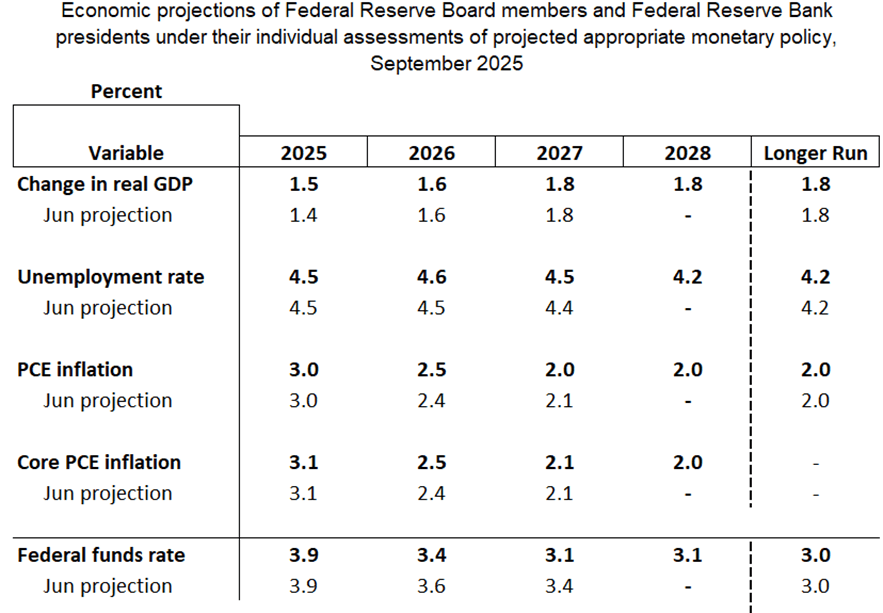
- The updated quarterly projections aren’t likely to bring many changes to the macroeconomic variables, but as usual the signal sent from the Fed rate “Dot Plot” will garner attention. A Committee split between expecting one or two further cuts this year is likely, keeping each of the remaining meetings of 2025 “live”.
- The Statement will downgrade the description of the labor market to reflect a rise in the unemployment rate and poor payrolls growth, and is likely to include at least one dissent to the rate decision.
- But with a Committee that is fairly divided on the way forward, Powell will be noncommittal on future action, reiterating that policy is not on a preset course, and upcoming decisions will be data-dependent.
- A key undercurrent is an increasingly activist approach to Fed personnel management from the White House, which leaves the composition of the FOMC uncertain not just over the medium-term but also at this meeting.
MNI’s separate preview of sell-side analyst summaries to follow on Monday Sep 15
RATINGS: Fitch: France Cut To A+ From AA, Portugal Up To A From A-
Sep-12 2025 21:07
Fitch has downgraded France's sovereign rating to A+ (with stable outlook) from AA-. Release here.
- Among other factors in the decision, Fitch cites "High and Rising Debt Ratio", "Political Fragmentation Hinders Consolidation", "Weak Fiscal Record", "High 2025 Deficit", "Uncertain Fiscal Consolidation Path", and "Fiscal Rigidities".
- In "Factors that Could, Individually or Collectively, Lead to Negative Rating Action/Downgrade", Fitch cites "Public Finances: A sustained increase in government debt/GDP over the medium term, due to failure to implement fiscal consolidation measures and/or a persistent increase in financing costs" and "Macro: Materially lower economic growth prospects and weakened competitiveness." Conversely, potentially leading to positive ratings action would be "Public Finances: Confidence that government debt/GDP will be put on a downward trajectory over the medium term, for example, due to fiscal consolidation and/or stronger economic growth".
- Fitch also raised Portugal to A (stable outlook) from A-, while elsewhere, S&P raised Spain to A+ (stable outlook) from A.
- As MNI wrote earlier, we expected France to be downgraded to A+ and Portugal to be upgraded to A.


