US DATA: Household Survey Shows Slacker Conditions, But Participation Rising
Sep-05 2025 13:31
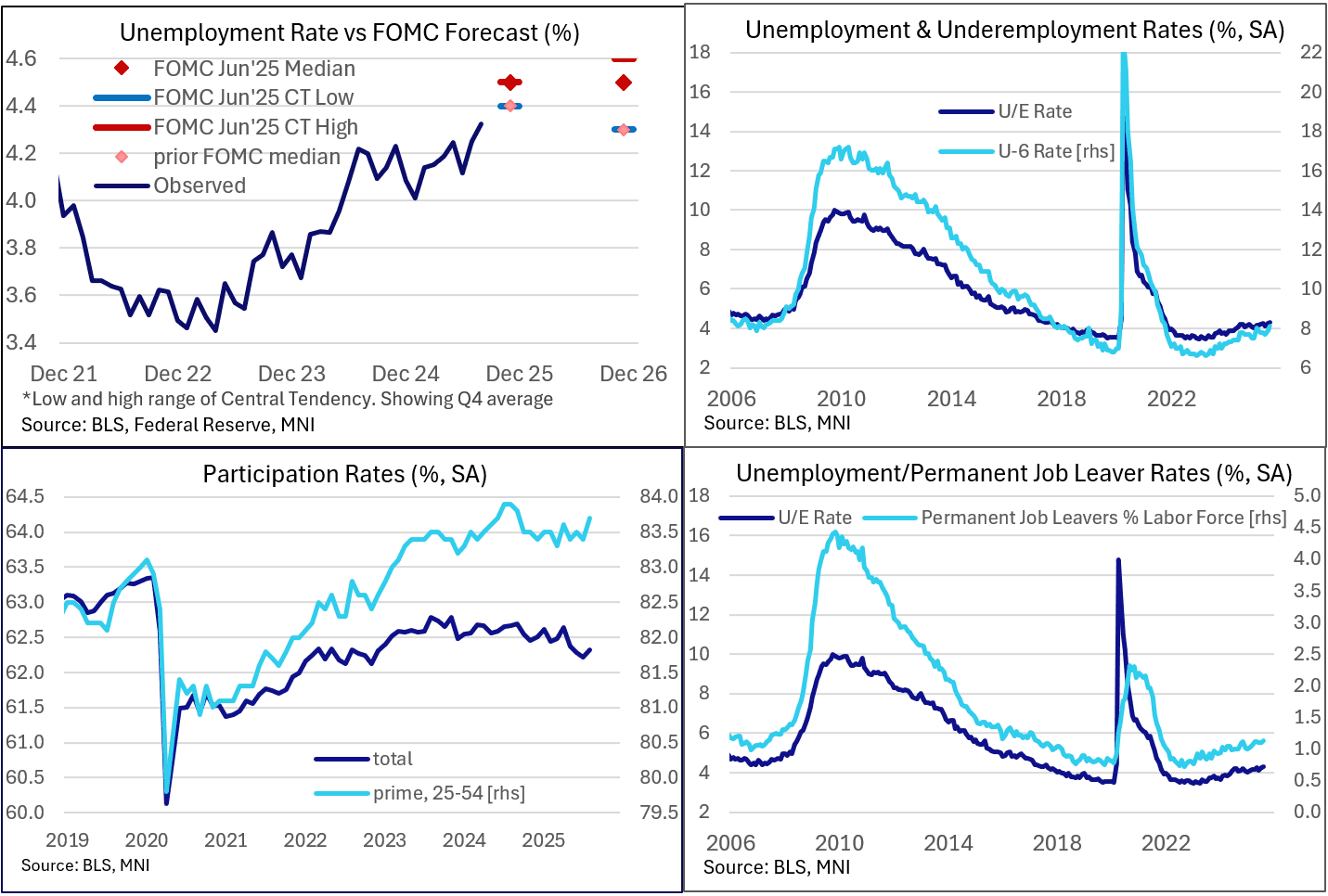
The Household Survey showed an uptick in its main measures of labor market slack. That said, there weren't a lot of major new warning signals in the various Household metrics were mixed aside with continued slow deterioration in some areas, though exceptions included noticeable weakness in some demographic categories (more on which shortly) but surprising strength in prime-age participation.
- The unrounded unemployment rate rose to 4.324% from 4.248% prior, marking the highest (and first above 4.30%) since October 2021. And the U-6 "underemployment" rate rose to 8.1% from 7.9%, likewise a post-October 2021 high.
- Household employment rose 288k, basically reversing July's 260k drop but keeping the level of employment 501k below January's level. The number of unemployed rose 148k after 221k, the highest 2-month rise since Jun-Jul 2024, and up 535k since January.
- A higher participation rate helped keep a lid on the rise in the unemployment rate: it ticked up 0.11pp unrounded to 62.33%, a 3-month high, with the labor force increasing by 436k, after three consecutive declines.
- Those not in the labor force fell 220k, reversing July's rise. That said, the number not in the labor force but currently want a job rose 179k to a post-July 2021 high - if they were added back into the labor force the unemployment rate would have been slightly higher.
- Most notably, prime-age participation hit an 11-month high 83.7% (from 83.4% prior). 16-24 participation dipped slightly (54.3% from 54.8%, good enough for a 60-month low stretching back to the pandemic, suggesting continued pressure on younger labor force participants), while 55+ was steady at 38.1%.
- And the employment-to-population ratio ricked up 0.06pp unrounded to 59.63%.
- Looking at the U-6 uptick, those working part-time for economic reasons ticked only marginally higher (65k), vs a 528k rise in part-time employment for noneconomic reasons.
- In another sign of slowly building labor market stress, permanent job losers as % of the workforce rose 0.01pp to 1.13%, highest since November 2021.
Want to read more?
Find more articles and bullets on these widgets:
Historical bullets
EUR: Weekly FX Exchange traded Option
Aug-06 2025 13:27
EURUSD (22nd Aug) 1.1600p, sold at 0.0052 in ~1.6k (new Position).
EQUITIES: US Cash Opening Calls
Aug-06 2025 13:26
SPX: 6,316.1 (+0.3%); DJIA: 44,265 (+0.3%/+154pts); NDX: 23,077.9 (+0.3%).
USD: Under renewed broader pressure, USDNOK breaks Friday's low
Aug-06 2025 13:15
- The NOK has jumped above the Kiwi as the best performer in G10, there's some downside traction following the break of Friday's low at 10.2000.
- The WTI is now also breaking the intraday high, but the USDNOK moved first.
- Next support in USDNOK comes at 10.1654 (prices are according to Bloomberg).
- New fresh lows for the Dollar vs EUR, CNH, NOK, CZK, COP, MXN, NZD, CAD, CHF, SEK, CNY, SGD.


