AUDUSD TECHS: Fresh Cycle High
* RES 4: 0.7310 1.00 proj of the Mar 30 - May 6 - Jun 30 price swing * RES 3: 0.7278 High May 6 and ...
Want to read more?
Find more articles and bullets on these widgets:
Historical bullets
EURJPY TECHS: Bearish Theme
- RES 4: 187.47 High Jul 29 and a key resistance
- RES 3: 185.21 50-day EMA
- RES 2: 184.32 50.0% retracement of the Jul 23 - Aug 3 bear leg
- RES 1: 182.46 38.2% retracement of the Jul 293 - Aug 3 bear leg
- PRICE: 181.98 @ 16:40 BST Aug 05
- SUP 1: 179.37 Low Aug 3
- SUP 2: 178.82 High Oct 30 2025
- SUP 3: 177.15 Low Nov 10 2025
- SUP 4: 175.29 38.2% retracement of the Feb 28 ‘25 - Apr 17 bull leg
A sharp sell-off in EURJPY last week highlights the end of the recent bull cycle - for now. The cross traded to a fresh short-term cycle low Monday, reinforcing a bear threat. Note that 180.81, the Feb 12 low and a key support, has been cleared. This opens 178.82 next, the Oct 30 2025 high. Initial key resistance is 184.92, the 50-day EMA. First short-term resistance is 182.46, 38.2% of the Jul 29 - Aug 3 bear leg.
CANADA DATA: July Labour Force Preview: Analysts Range From 0 to +50k (1/2)
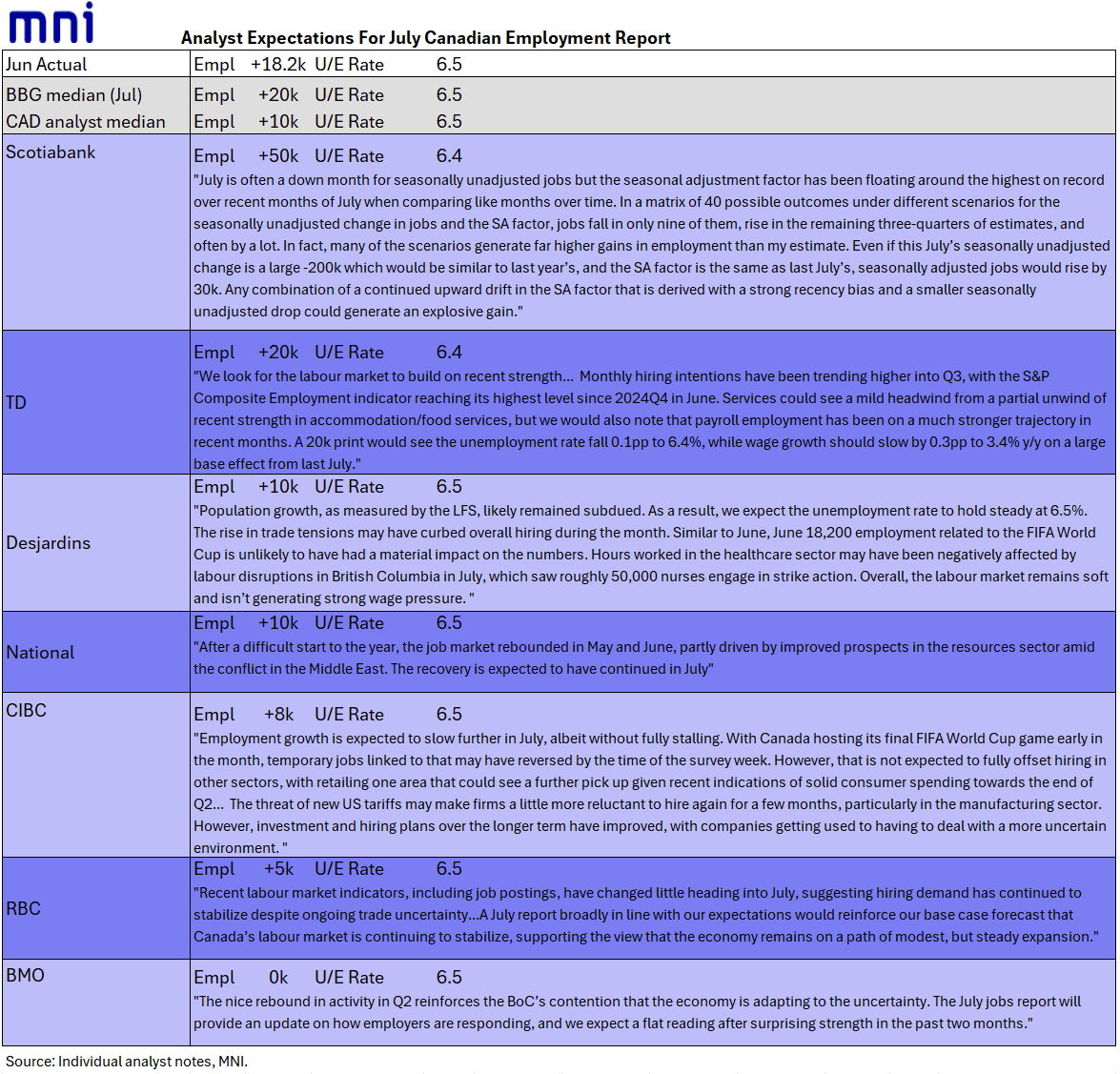
The range of expectations for July's LFS report is relatively wide, from 0k (BMO) to +50k (Scotiabank). See image below for commentary.
CANADA DATA: July Labour Force Preview: Summer Stability (1/2)
Consensus for July's Labour Force Survey (Friday 8:30am ET) per MNI's review of Canada bank analysts' previews is for a 10k gain in employment, slightly lower than the +18.2k in June, with the unemployment rate steady at 6.5%.
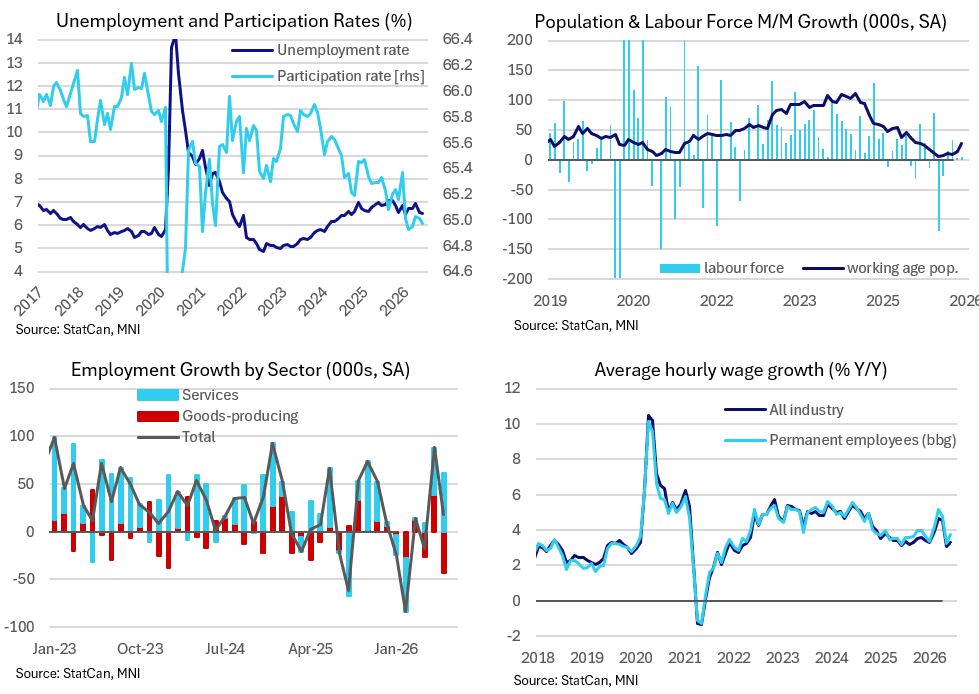
- That would represent a constructive start to the second half of the year, after a remarkably steady H1 for employment on the whole (putting aside month-to-month volatility) that saw a total change in employment of just -6k (in a labour force of over 22 million) and the unemployment rate at 6.5% in both January and June vs a peak of 7.1% in 2025.
- Continued stability albeit with soft demographic inputs and a relatively elevated unemployment would mean the labour market remains a relatively neutral factor for monetary policy, with the Bank of Canada commenting in its July rate hold decision that "labour market conditions have remained soft, reflecting ongoing economic slack." Either way it may be difficult to cleanly discern reaction from a "miss" vs consensus on Friday given the LFS is released simultaneously with the US employment report for July.
- The unemployment rate consensus of 6.5% rounded for July looks biased to the downside with some analysts seeing 6.4%. In June, with participation effectively steady (64.97% vs 65.01%), the unemployment rate dipped to 6.50% from 6.56% prior for the lowest since January. The breakeven for a drop to 6.4% is about +20k.
- Most if not all analysts assume unchanged participation in July. June saw the biggest estimated population gain (27k) since September 2025, though the labour force continued to grow slowly (5k after 4k). The employment to population ratio has picked up the last 2 months to a 5-month high 60.8%.
- From a sectoral basis, after some positive months in leisure/hospitality sectors, there may be a negative World Cup impact in July given that Canada's final hosted game was early in the month (Jul 7). Services jobs gained 62k in June for the best since October 2025, while accommodation and food services (potentially World Cup-related?) rose 15k after 17k prior (3-month gains of 45k now).
- In particular, World Cup employment giveback could affect part-time jobs, after rising 17k in June (vs full-time of 1k).
- We will also be watching goods-producing employment, which fell 44k in June after a surprisingly strong 39k rise in May, as construction (-13k) and manufacturing (-17k) pulled back notably in contrast to solid services gains. In general, the BOC will be wary of further negative effects from trade frictions on manufacturing in particular, but services (80% of employment) looks as though it's holding its own and that trade-related issues aren't spreading to the broader labour market.
- July is typically a negative month for employment from a non-seasonally-adjusted basis, with the most optimistic analyst on the seasonally-adjusted figure, Scotiabank, citing in its +50k estimate that a favorable seasonal adjustment factor could come into play.
- Finally, wage growth is seen pulling back somewhat from 3.7% (permanent hourly) Y/Y due to base effects from the prior year (July 2025 saw the biggest M/M % rise since 2020).