OPTIONS: Expiries for Mar16 NY cut 1000ET (Source DTCC)
- EUR/USD: $1.1500(E1.3bln), $1.1575(E802mln), $1.1600(E1.6bln)
- USD/JPY: Y156.00($1.3bln), Y160.00($796mln)
- EUR/JPY: Y176.50(E510mln)
- GBP/USD: $1.3425(Gbp952mln), $1.3500(Gbp1.1bln)
- AUD/USD: $0.7100(A$1.4bln)
- USD/CAD: C$1.3630-50($1.0bln)
- USD/CNY: Cny6.9250($600mln)
Want to read more?
Find more articles and bullets on these widgets:
Historical bullets
US DATA: Weather, Youth, And Survey Responses Were Sources Of Distortion (2/2)
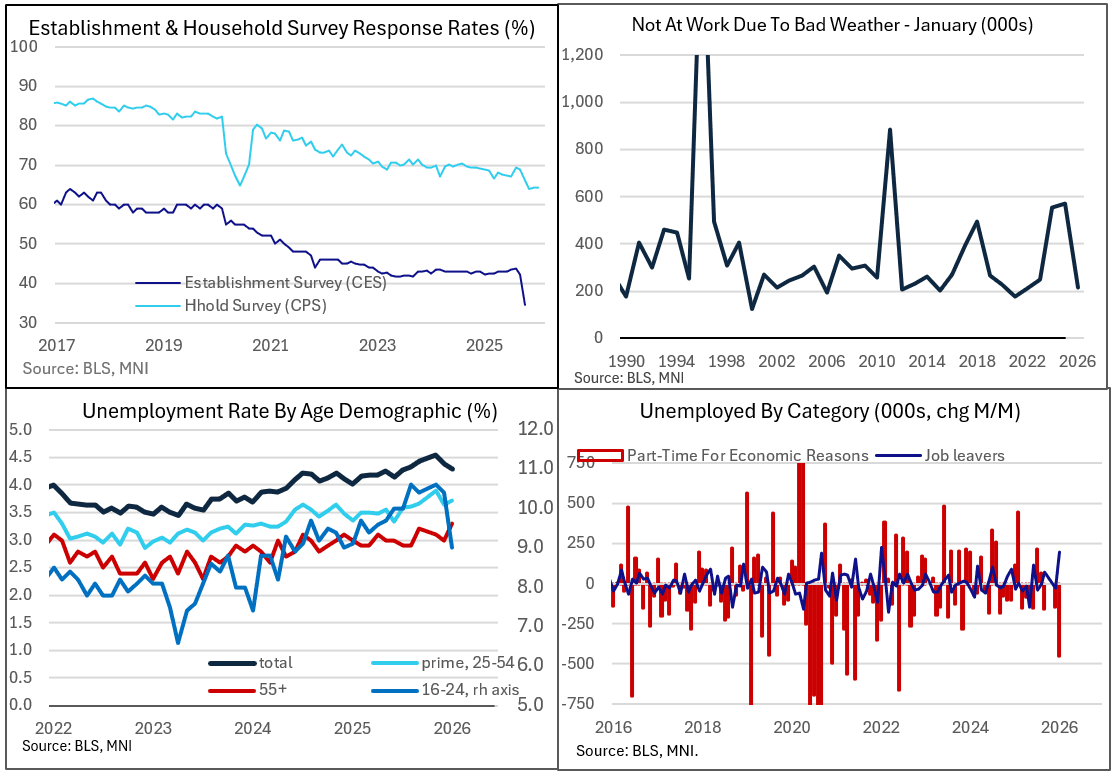
There were clear areas of apparent strength in the Household report, but there were some oddities that must be noted that cast some doubt. We should start by noting that the response rates to the Household survey have been very poor of late: 64.3% in January is the 3rd lowest in history, with only the prior 2 surveys having been lower. Unlike the Establishment survey, the BLS notes, "The severe weather did impact the collection of household survey data", and that is reason enough to take the results with a grain of salt.
- On the topic of weather, it was actually a key reason for January's strong household numbers: just 217k (non-seasonally-adjusted) were not at work due to bad weather, compared to 553k in Jan 2024 and 573k in Jan 2025. It's the lowest for a January since 2021 and a reversion to some of the least weather-hit Januarys in the last couple of decades. Of course, the reference week came just before the massive winter storms in late January could have an effect (as noted by the BLS). So while this category didn't have a "discernable effect" per the BLS, the absence of such an effect vs the prior 2 years was a key reason for the solid overall numbers.
- One apparently encouraging sign was that prime-age (25-54) workers drove the overall increase in the participation rate, within which it increased to 84.1% from 83.8% prior to increase above 84% for the first time since 2001. It offset the 0.5pp drop in 16-24 age participation (55.3% for the lowest since August 2025), with 55+ steady at 37.9%.
- But the composition of the change in the unemployment rate was somewhat puzzling and perhaps a one-off. Prime-age unemployment (25-54) actually rose, to 3.72% from 3.65%. 55+ year old unemployment jumped to 3.3% from 3.0% for the highest since late 2021. It was instead 16-24 year old unemployment that drove the overall decline, falling to 9.0% from 10.4% prior for the lowest since December 2024 and the biggest monthly drop since October 2020. At a guess, the latter looks to be down to survey response issues.
- Looking at the unemployment rate drop, the oddities were mixed. Re-entrants to the workforce - a prime cause of the jump in unemployment in November - fell 180k after 263k, for the lowest total in a year, while new entrants fell 48k and those on temporary layoff fell 83k (after 73k continuing to unwind November's spike that looks related to the government shutdown).
- That offset an astonishing 197k jump in job leavers - one of the highest monthly figures in history in this category of unemployed, with the total exceeding 1 mlilion people for the first time since 2013. It's hard to know what to make of that - a factor that drove the unemployment rate higher, all else equal - but at least the number of permanent job losers remained relatively low (38k after 33k).
EURJPY TECHS: Pierces Key Short-Term Support
- RES 4: 188.93 Bull channel top drawn from the Feb 28 ‘25 low
- RES 3: 187.71 3.000 proj of the Oct 17 - Oct 30 - Nov 5 price swing
- RES 2: 186.87 High Jan 23 and the bull trigger
- RES 1: 184.29/186.36 20-day EMA / High Feb 9
- PRICE: 181.89 @ 15:09 GMT Feb 12
- SUP 1: 181.79/56 Low Jan 26 and a keyS/T support / Intraday low
- SUP 2: 181.57 Low Dec 17
- SUP 3: 180.80 Base of a bull channel drawn from the Feb 28 ‘25 low
- SUP 4: 179.77 Low Nov 21
The sharp sell-off in EURJPY from Monday’s high has resulted in a break of the 20- and 50-day EMAs. Today’s extension has seen the cross pierce key short-term support at 181.79, the Jan 26 low, where a break would strengthen a bearish threat and expose bull channel support at 180.80. The channel is drawn from the Feb 28 ‘25 low and represents an important key M/T support. Key resistance and the bull trigger is at 186.87, the Jan 23 high.
EQUITY TECHS: E-MINI S&P: (H6) Bull Trigger Remains Exposed
- RES 4: 7080.92 0.764 proj of the Nov 21 - Dec 11 - 18 price swing
- RES 3: 7056.95 2.0% Upper Bollinger Band
- RES 2: 7043.00 High Jan 28 and bull trigger
- RES 1: 7022.98 1.0% 10-dma envelope
- PRICE: 6997.50 @ 14:48 GMT Feb 11
- SUP 1: 6923.60 50-day EMA
- SUP 2: 6751.50 Low Feb 6 and key short-term support
- SUP 3: 6691.56 76.4% retracement of the Nov 21 - Jan 28 bull leg
- SUP 4: 6583.00 Low Nov 211 and a key medium-term support
The firm reversal higher on Feb 6 in S&P E-Minis refocuses attention on the primary uptrend and key resistance at 7043.00, the Jan 28 high. Clearance of this level would confirm a resumption of the trend and mark the end of a flat correction in the contract. Key short-term support has been defined at 6751.50, the Feb 6 low, where a break is required to highlight a top and a stronger short-term reversal.


