EUROPEAN PARLIAMENT: EPP Breaks Cordon Sainitare In Green Rules Vote w/Far-Right
A vote on the EU's first omnibus simplification package in the European Parliament plenary session earlier today broke the so-called cordon sanitaire around the far-right political groups. This could represent the first significant step towards a more overt right-wing shift in the EP. The vote concerned plans to exempt more small and medium-sized enterprises from the EU's green reporting rules. Opponents argued that they were too onerous for small firms, and instead, the measures should focus on large polluters.
- As EU Observer reports, "Under the changes, the corporate sustainability reporting directive (CSRD) will only cover companies with at least 1,750 employees and €450m turnover, leaving more than 90 percent of firms out." The package now moves to 'trilogue' talks with the Commission and Council.
- Talks had been underway for months between the four moderate political groups - the centre-right European People's Party (EPP), centre-left Progressive Alliance of Socialists and Democrats (S&D), liberal Renew Europe (RE) and environmentalist/regionalist Greens/EFA - but these broke down earlier in the week.
- This led the EPP to vote with the conservative European Conservatives and Reformists (ECR), right-wing populist Patriots for Europe (PfE) and far-right Europe of Sovereign Nations (ESN). A small number of S&D and RE MEPs broke ranks and also backed the package
- The EPP had voted alongside the far-right in previous non-binding votes related to condemning the Maduro regime (creating the so-called 'Venezuela coalition'). Today marked the first time it has done so on a substantive motion.
- Given that the political processes in the EP have for decades relied on broad cooperation between the centrist groups, if this breaks down in the long term, it could either lead to policy paralysis, or a significant rightward shift as the EPP looks to the PfE and others for backing.
Chart 1. Number of votes per political group in favour of and opposed to the European Parliament's agreement to exempt more companies from green reporting rules
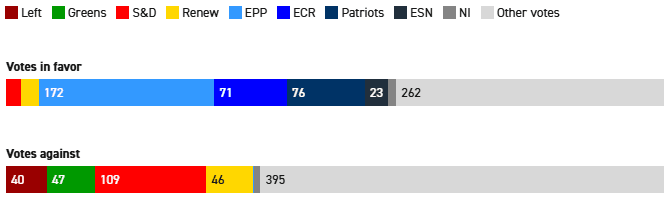
Source: Politico, European Parliament. N.b. For 'votes in favor', 'Other votes' refers to abstentions and votes opposed. For 'Votes against', 'Other votes' refers to abstentions and votes in favour.
Want to read more?
Find more articles and bullets on these widgets:
Historical bullets
MNI: POWELL-FED MAY BE APPROACHING END TO QT 'IN COMING MONTHS'
- MNI: POWELL-FED MAY BE APPROACHING END TO QT 'IN COMING MONTHS'
- POWELL-SOME SIGNS HAVE BEGUN TO EMERGE LIQUIDITY IS TIGHTENING
- LONGTERM BALANCE SHEET TRANSITION WILL BE GRADUAL, PREDICTABLE
- AMPLE RESERVES REGIME HAS PROVEN REMARKABLY EFFECTIVE-POWELL
- ECONOMIC OUTLOOK HAS NOT CHANGED MUCH SINCE SEPT FOMC-POWELL
- DOWNSIDE RISKS TO EMPLOYMENT APPEAR TO HAVE RISEN-POWELL
- GROWTH IN ECONOMIC ACTIVITY MAY BE FIRMER THAN EXPECTED-POWELL
- MONETARY POLICY IS NOT ON A PRE-DETERMINED PATH-POWELL
OPTIONS: Larger FX Option Pipeline
- EUR/USD: Oct16 $1.1500-20(E1.5bln), $1.1580-00(E3.9bln), $1.1700-05(E1.1bln); Oct17 $1.1510-15(E1.9bln), $1.1670-80(E1.2bln); Oct20 $1.1515(E1.0bln), $1.1545-50(E1.0bln)
- USD/JPY: Oct20 Y154.80($2.0bln)
UK DATA: MNI UK Labour Market Insight: Bailey to Keep Q4 Cut Options Open?
- All in all a disappointing UK labour market report - likely increasing the probability that Governor Bailey wants to keep optionality for voting for a Q4 cut and hence eliciting a negative GBP FX reaction and seeing SONIA futures move to price in around a 35% probability of a Q4 cut (up from around 23% as of yesterday’s close).
- The key surprise for us is the soft private regular AWE data as we note that Governor Bailey cited in explaining his decision to vote for an August cut the softer-than-forecast data on this front in Q2 (which undershot the BOE’s forecast by 0.4ppt).
- Assuming the Y/Y single month rate for September remains in line with that seen in today’s August print and no further revisions, we are on track to undershoot by 0.3ppt in Q3 (a forecast that had already been downgraded in the August MPR).
- Aside from the poor private sector wage numbers: the unemployment rate was higher than expected (and higher than the BOE’s Q3 forecast), there was a smaller 3-month LFS employment growth number than consensus expected and vacancies fall.
- The brighter points were that public sector bonuses were higher than expected (bringing up the total whole economy pay number) while there were some upward revisions to payroll growth so the 3-month fall in payrolls is only 0.2k (from a 38k fall to the 3-months of Aug that was revised to -12.6k).


