US DATA: Continuing Claims Pick Up As Federal Jobless Claims Jump
Nov-20 14:27
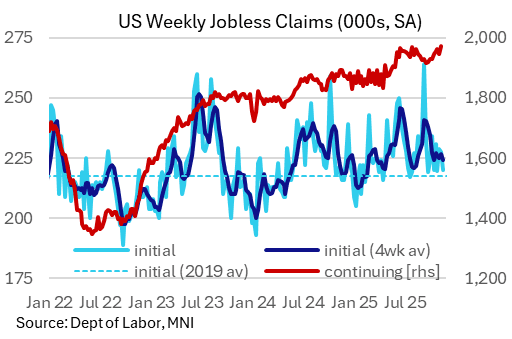
The latest weekly jobless claims data - and the first official Department of Labor release since the federal government shutdown started on Oct 1 - showed a continuation of the "low-firing" labor market trend in the initial column, though a slightly concerning "low-hiring" dynamic evident in continuing claims. However, it should also be noted that the government shutdown - and potentially federal cuts - boosted federal government worker claims substantially through early November.
- The 220k (SA) initial claims in the week of Nov 15 were the joint-lowest (seen also in the Oct 11 and Oct 25 weeks) since Sep 20, and a fall from 228k prior. This was also below the 227k consensus and suggests relative stability in this November payrolls reference week. The 224k 4-week average was the lowest in 5 weeks and this metric has been in a tight range (224-227k) since the end of September.
- More concerning were continuing claims which jumped 28k in the Nov 1 week to 1,974k (1,950k expected). That was the biggest one-week rise in 15 weeks and represents the highest figure since November 2021. We always take such moves with a bit of caution as continuing claims have a tendency to be revised down in future, but obviously we will be watching to see if there is confirmation of a shift out of the recent range.
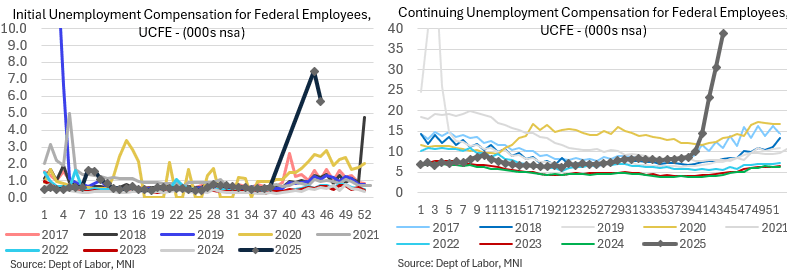
- As the chart below shows, a jump in claims from federal workers - they jumped 5,719 in the Nov 8 week, which was a decrease from 7,482k the prior week (data from mid-Sept to late Oct was not available). And there were 38,867 continued claims filed by ex-federal workers in the Nov 1 week.
- These are not seasonally adjusted series but in any case they were easily the highest readings since 2018-19, again potentially reflecting federal layoffs - and we did see a notable tickup in continuing claims in the DC area as well for the latest week.
- The back-filling of claims data didn't show much deviation from analysts' estimates based on state-by-state data that were still available through the pandemic.
Want to read more?
Find more articles and bullets on these widgets:
Historical bullets
OPTIONS: Expiries for Oct22 NY cut 1000ET (Source DTCC)
Oct-21 14:09
- EUR/USD: $1.1525(E732mln), $1.1595-00(E1.1bln), $1.1620-25(E586mln), $1.1640-50(E750mln) $1.1810-30(E1.1bln)
- USD/JPY: Y149.90-00($1.5bln), Y151.00($876mln), Y152.00($1.1bln)
- EUR/GBP: Gbp0.8740(E498mln)
- AUD/USD: $0.6535(A$516mln)
- NZD/USD: $0.5700(N$1.2bln)
- USD/CAD: C$1.3800($1.9bln), C$1.4085($551mln), C$1.4200($1.1bln)
- USD/CNY: Cny7.3000($749mln)
EUR: More EUR upside buyer via CME Option
Oct-21 14:02
EURUSD (6th Mar) 1.1800c, bought for 0.01410 in ~2.2k.
EUR: FX Exchange traded Option is trading for more
Oct-21 13:59
EURUSD (4th Sep) 1.1700c, bought for 0.3430 in 3.22k total (new position).


