ASIA: Coming Up In Asia Pac Markets On Friday
--------------------------------------------------------------------------- 2130BST 0530HKT 0830...
Want to read more?
Find more articles and bullets on these widgets:
Historical bullets
USDCAD TECHS: Fades Fast Off Resistance
- RES 4: 1.3929 High Jan 16 and a reversal trigger
- RES 3: 1.3879 High Jan 20
- RES 2: 1.3768 50-day EMA
- RES 1: 1.3725 High Feb 02
- PRICE: 1.3535 @ 16:29 GMT Feb 10
- SUP 1: 1.3523/3482 Low Feb 10 / Low Jan 30 and the bear trigger
- SUP 2: 1.3473 Low Oct 2 ‘24
- SUP 3: 1.3400 50.0% retracement of the 2021 - 2025 uptrend
- SUP 4: 1.3359 Low Jan 31 2024
USDCAD price faded Monday in response to the generally softer USD theme, and that momentum has spilled over into Tuesday trade. Market focus is on whether the recovery from the Jan 30 low has now concluded and the broader downside theme can resume. The trend had been oversold, and the recent bounce has allowed this condition to fully unwind - making for a more attractive entry point for shorts. Key support and the bear trigger lies at 1.3482, the Jan 30 low. Resistance to watch is 1.3693, the 20-day EMA.
AUD: AUD/USD - Stalls Toward 0.7100 As Market Awaits NFP Data
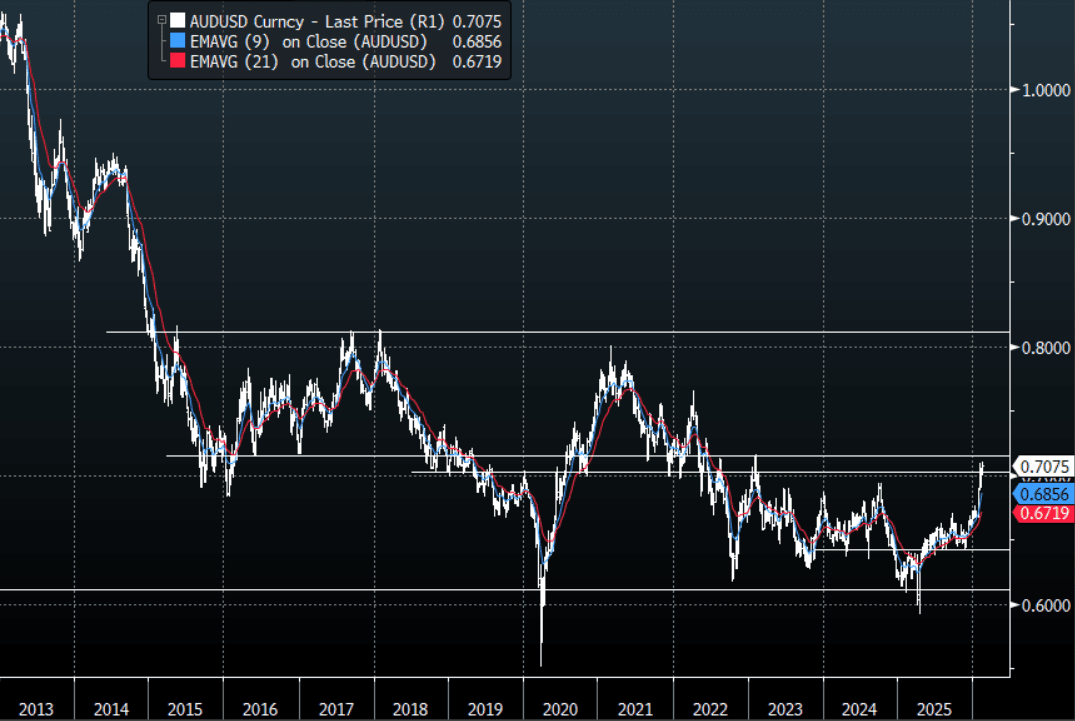
The AUD/USD had a range overnight of 0.7065-0.7091, Asia is currently trading around 0.7080. The AUD’s momentum has stalled toward 0.7100 as the market awaits the US labour data tonight. The USD is again back under pressure and the move lower in yields is just adding to its headwinds, the AUD remains a favourite to express a long against it. The AUD has been outperforming across the board as leveraged funds continue to add to their longs as further hikes are potentially priced in. On the day, the first support is back toward the 0.7010–0.7040 area, and the important 0.6950 area. The bulls will be looking for dips to remain supported in order to regain the momentum to rechallenge the pivotal 0.7100-0.7200 area.
- MNI - US January Labour Market Report. Monthly payroll growth is currently expected at 70k in January for a slight acceleration from the 50k in December and 56k in November. The market likely currently views that to be on the high side considering a swathe of soft labor indicators recently. We’ll finally see these annual benchmark revisions to the level of employment back in March 2025 with this release, with the preliminary estimate of -911k but -700-800k more likely in our view.
- Options : Closest significant option expiries for NY cut, based on DTCC data: 0.7010(AUD560m). Upcoming Close Strikes : 0.6800(AUD1.55b Feb 13), 0.6850(AUD933m Feb 12) - BBG
- The AUD/USD Average True Range for the last 10 Trading days: 80 Points
- Data/Event: RBA Deputy Governor Andrew Hauser participates in a fireside chat in Sydney, Home Loans Value
Fig 1: AUD/USD spot Weekly Chart
Source: MNI - Market News/Bloomberg Finance L.P
US LABOR MARKET: A Heavy Layoff Month In A “Low Hire, Low Fire” Market
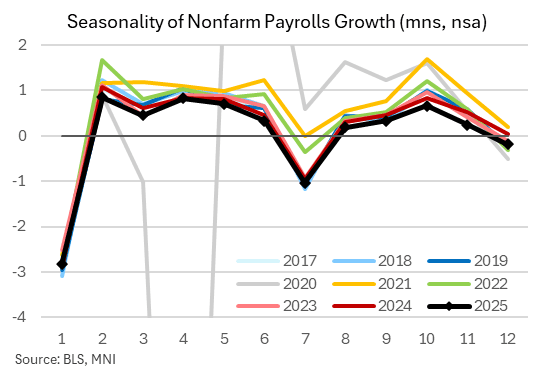
- Along with considerations needed to be made for annual benchmark revisions and a new birth/death model coming with Wednesday's NFP report, bear in mind that January's bring specific seasonal adjustment needs.
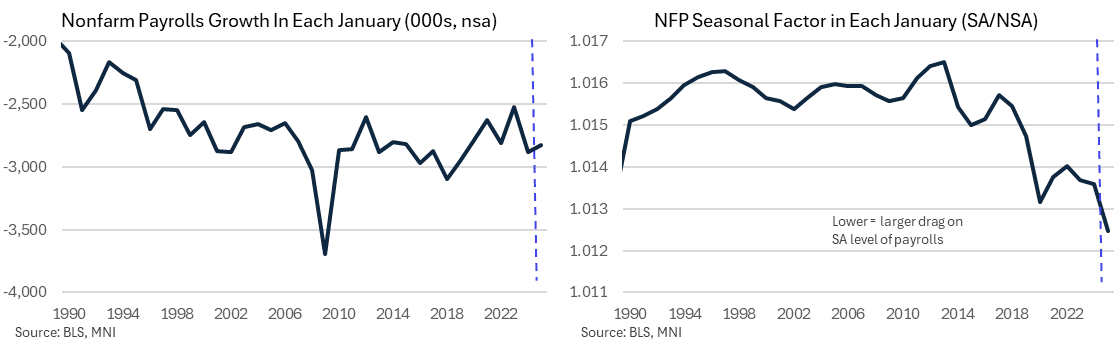
- January typically sees by far the most pronounced pattern of the year with large declines in the non-seasonally adjusted number of payrolls after the holidays. Indeed, payrolls fell by 2.8mln in Jan 2025 and 2.9mln in Jan 2024, both closer to the 2.94mln averaged in 2015-19 for a crude pre-pandemic trend after the 2.5mln in Jan 2023 (a period of particularly labor tightness), was its smallest decline since 1995.
- With the labor market softening but still seemingly in a “low fire, low hire” state, this month’s update could see fewer layoffs than would historically be the case although that’s increasingly being normalized by the growing weight on the post-pandemic sample.
- Going against this, seasonal factors have been increasingly penal for January readings in recent years, with the 2025 factors boosting the seasonally adjusted level of nonfarm payrolls by its least in at least thirty-five years.
- The past five years of seasonal factors will be revised with this release.