EM ASIA CREDIT: Cikarang Listrindo (CIKLIS, Ba1/BBB-/NR) 10y $350m Mandate - FV
Cikarang Listrindo (CIKLIS, Ba1/BBB-/NR)
"*MANDATE: CIKARANG LISTRINDO UP TO $350M 144A/REGS SENIOR NOTES" - BBG
Mandate: 10yr $300m
FV: z+205bp, T+165bp
The Indonesian power company, Cikarang Listrindo, has mandated banks on a new 10y $350m deal, which is expected to launch next week. The proceeds, along with cash on hand, will be used to refinance the $500m 9/26 bond which is callable in march.
Cikarang Listrindo was upgraded to investment grade by S&P (BBB-) last week, and the expectation is that Moody's will do the same soon after the refinancing is complete. The rating at Moody's is currently Ba1, watch positive. The Moody's upgrade will make the new deal IG index eligible.
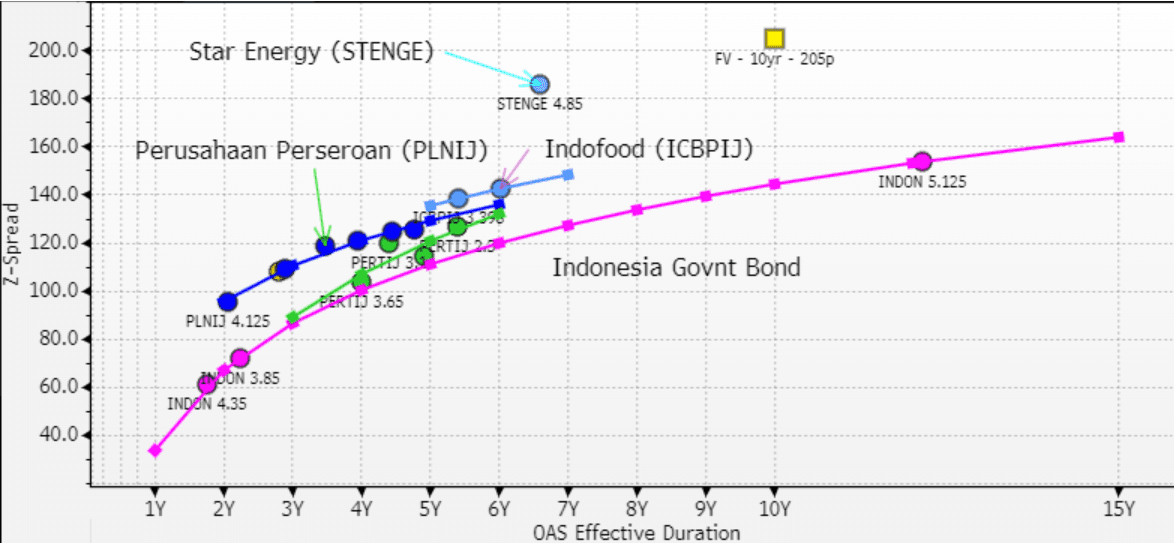
In terms of fair value for the mandate, we take into consideration Indonesian state owned electricity producer, Perusahaan Perseroan (PLNIJ Baa2/BBB); Star Energy Geothermal (STENGE, Baa3/BBB-), Indonesia's largest geothermal energy producer; and Indofoods (Baa2/BBB- pos.), Indonesia's largest food processing company. We also include the Indonesia (INDON, Baa2/BBB/BBB) $ government bonds to confirm the shape of the curve.
We think that Cikarang Listrindoa, a low BBB, privately owned company, will trade around 60bp wide of the Indonesia curve at the 10yr point, more or less in line with STENGE, also a low BBB energy producer. FV therefore Z+205bp, T+165bp.
Want to read more?
Find more articles and bullets on these widgets:
Historical bullets
BONDS: NZGBS: Richer But Well Off Bests, Fin Min In Parliament Tomorrow
NZGBs closed 3-6bps richer, with a flatter 2/10 curve, but well off session bests. The local market was 7-8bps richer early after yesterday’s strong lead-in for US tsys. Cash US tsys are ~2bps cheaper in today’s Asia-Pac session.
- NZGBs slightly outperformed their $-bloc counterparts, with the NZ-US and NZ-AU 10-year yield differentials narrowing by 1-2bps. The NZ-US 10-year yield differential, now at -7bps, is edging closer to the cyclical low of -15bps recorded in December 2022—the lowest since late 2020.
- Swap rates closed 2-3bps lower.
- RBNZ dated OIS pricing closed 1-4bps softer across meetings, with late 2025 leading. 48bps of easing is priced for February, with a cumulative 113bps by November 2025.
- Tomorrow, Finance Min Willis speaks to the Select Committee on the Budget Policy Statement and Half-Year Economic and Fiscal Update. RBNZ Chief Economist Paul Conway will also present a speech titled: Beyond the Cycle: Growth and interest rates in the long run.
- On Thursday, the NZ Treasury plans to sell NZ$200mn of the 1.50% May-31 bond, NZ$200mn of the 4.25% May-36 bond and NZ$100mn of the 1.75% May-41 bond.
EQUITIES: HK Equities Slightly Higher, Chinese Semiconductor Stocks Struggle
BOJ: Japan Government Nominates Junko Koeda To BoJ Board
Per BBG headlines, the Japan Government has nominated Junko Koeda to the BoJ board. She will replace Seiji Adachi.
- Per the new board member's website from Waseda Univsersity: "Ms. Junko Koeda previously held positions as a chief economist at the Ministry of Finance of Japan, an assistant professor at the University of Tokyo, and a staff economist at the International Monetary Fund. She has a Ph.D. degree in economics from UCLA and a bachelor’s degree from the University of Tokyo." (See this link for more details).


