INDONESIA: BI Holds & Refocuses On IDR Stability Given Fed Policy Uncertainty
Bank Indonesia (BI) held rates at 4.75% as was widely expected. Its near-term focus returned to “maintaining Rupiah exchange rate stability and attracting portfolio inflows” after focusing on growth through Q3. Ahead of the November meeting USDIDR rose a percent from the October decision and around 0.6% m/m, the fourth consecutive monthly increase. The rupiah also weakened against Indonesia’s trading partners. USDIDR moderated 0.25% to 16,702 on Wednesday but BI is forecasting it to average 16,430 in 2026, signalling it would like it to appreciate.
- BI reiterated the need for strengthening the transmission mechanism so that rates come down in the banking sector. It notes in its statement that while it has cut rates 125bp in 2025, lending rates are down only 20bp. It is forecasting 2026 loan growth of 8-12%.
- Also yesterday, US 10 December Fed rate cut pricing fell to 37% from 50% after the October payroll data was officially cancelled adding to opacity around economic conditions and the October FOMC meeting minutes showed that at the time there was only minority support for another cut in December. This drove a USD BBDXY rise of 0.5%, which mainly occurred after IDR stopped trading.
- BI’s hold allows it to watch US and FX developments and any changes to the outlook for the December Fed meeting as delayed US data begins to be released following the government shutdown.
- A Fed hold with comments suggesting a high bar for further easing may drive BI to hold again on 17 December and wait until Q1 for further cuts, especially if Indonesia’s transmission mechanism remains slow. The outlook will be highly dependent on rupiah moves though.
Want to read more?
Find more articles and bullets on these widgets:
Historical bullets
JAPAN: Proposed New Japan FinMin Saw Yen Undervalued In Earlier 2025 Remarks
Headlines have crossed that Japan's new PM will appoint Satsuki Katayama as the new Japan FinMin. Katayama is the former regional revitalization minister. She was elected in July 2010 as a candidate for the LDP. Earlier this year (March 25) she gave an interview with Reuters, where she stated that the yen was undervalued. Some key quotes are outlined below. Viewpoints from the new government will around the yen will be eyed closely, as Takaichi, as the new PM, has generally been seen as a negative yen development (pushing back on BoJ rate hikes etc). USD/JPY is down slightly so far today, dipping a little on the new FinMin headlines, but follow through has not been evident, we were last 150.65/70 (session lows at 150.51, highs at 150.85)
- "Japan's economic fundamentals suggest the yen's real value is closer to 120-130 per dollar rather than the current 150 levels, senior lawmaker told Reuters, as the ruling party considers steps to help reverse capital outflows. I believe 120 to 130 levels to the dollar are seen as the value reflecting Japan's economic strength," Satsuki Katayama, who chairs the ruling Liberal Democratic Party's (LDP) research commission on the finance and banking systems, said in an interview on Tuesday." (via CNA from March 25 this year).
- It was also announced that Kimi Onoda would serve as economic security minister. via Wikipedia: "She served as Parliamentary Vice-Minister of Defense from 2022 to 2023 and is a member of the House of Councillors representing Okayama. She previously served as Parliamentary Vice-Minister of Justice from 2020 to 2021 under the Suga Cabinet."
- Ryosei Akazawa is set to be the METI/Trade Minister.
JGBS: Richer, 10Y Outperforms Future-Linked 7Y
In Tokyo morning trade, JGB futures are stronger, +18 compared to settlement levels, after adding to overnight gains.
- (Bloomberg) -- The head of Japan’s ruling Liberal Democratic Party Sanae Takaichi is set to name former regional revitalization minister Satsuki Katayama as finance minister if she is elected as the prime minister, broadcaster FNN reports.
- Cash US tsys are slightly mixed, with a flattening bias, in today’s Asia-Pac session after yesterday’s gains.
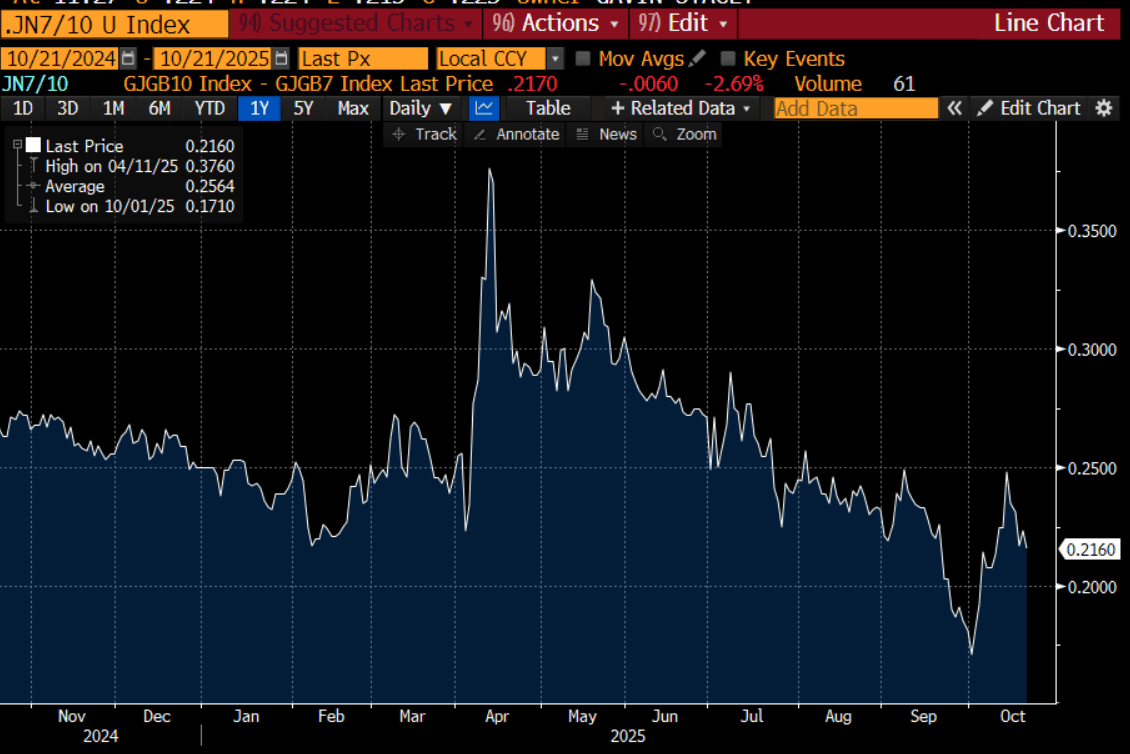
- Cash JGBs are slightly richer across benchmarks, with a slight flattening bias. The benchmark 10-year yield is 1.4bps lower at 1.660%, outperforming the futures-linked 7-year. This continued the recent trend which has unwound the relative cheapening of the 10-year earlier in the year.
- Swap rates are flat to 1bp lower. Swap spreads are mixed.
Bloomberg Finance LP
AUSSIE BONDS: Jun-54 Auction Goes Well With Very Strong Demand
Today’s auction result extended the recent trend of firm pricing for ACGBs, with the weighted average yield printing 0.92bps through prevailing mids, according to Yieldbroker. Moreover, demand improved dramatically, as reflected by a cover ratio of 4.0533x up from 3.3500x from the previous auction.
- The strong demand came despite the bond’s outright yield being 20-25bps lower than the previous auction and around 30bps below the peak reached in May.
- However, the 10s/30s yield curve was back near its steepest level since 2021 — a potentially supportive technical factor.
- Sentiment toward longer-dated global bonds had improved, which may have assisted demand.
- In the wake of the auction, the ACGB Jun-54 has traded ~1.5bps richer in the secondary market.


