US: Bessent Downplays Impact Of Iran War On Global Oil Supplies
Mar-26 16:00
Speaking at a White House Cabinet meeting, Treasury Secretary Scott Bessent has downplayed the impac...
Want to read more?
Find more articles and bullets on these widgets:
Historical bullets
SECURITY: Iran's Deputy FM Says Iran Ready For Deal w/US "As Soon As Possible"
Feb-24 15:53
Iran’s Deputy Foreign Minister Majid Takht-Ravanchi said Tehran is “ready to take any necessary step to reach a deal with US as soon as possible,” but warned that a potential US strike is a “real gamble,” ahead of a third round of nuclear talks with the United States, per Reuters.
- Earlier, Takht-Ravanchi told NPR that Iran will enter talks with “sincerity” and “goodwill.” Takht-Ravanchi confirmed to NPR that Thursday’s talks will be confined to Iran’s nuclear file, appearing to rule out the prospect of a broader deal that covers Iran’s ballistic missile programme and support for regional proxies. Takht-Ravanchi declined to outline the shape of a potential deal.
- US President Donald Trump is likely to address tensions during his State of the Union Address this evening. Based on recent public statements, Trump is likely to impress on Tehran the importance of reaching a nuclear deal and warn of dire consequences absent an agreement. Trump issued a statement on Truth Social yesterday denying reports that Gen. Dan Caine, the chairman of the Joint Chiefs of Staff, warned against a strike on Iran.
- Earlier, White House Press Secretary Karoline Leavitt told reporters that last year's US strikes on Iranian nuclear sites were “overwhelmingly successful” but that “does not mean that Iran may never try again to establish a nuclear program that could directly threaten the United States."
- The ISIS think tank’s latest report assesses that, “In the five-to-six-month timeframe, the overall probability is 34 to 42 percent,” that Iran builds a nuclear weapon. The report notes that absent US strikes or a robust nuclear deal, "the chance of Israeli or US military actions will grow rather than diminish.”
TARIFFS: The Latest In US Tariff Developments
Feb-24 15:46
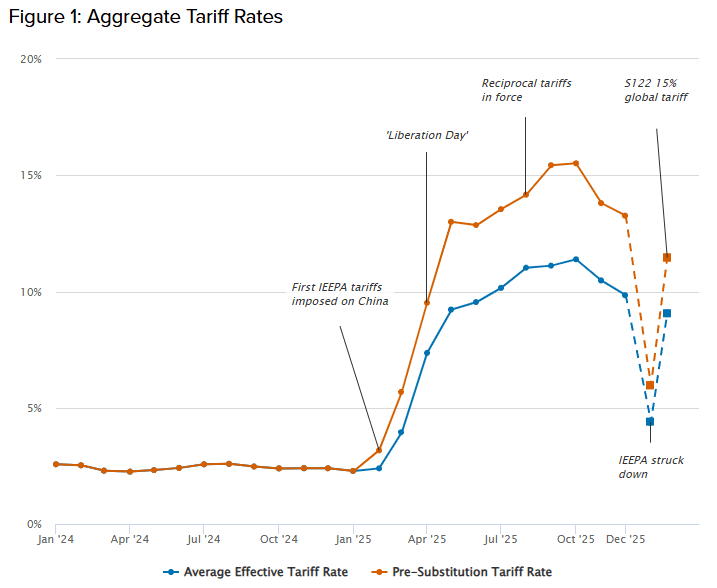
- Section 122 in for IEEPA: 10% global tariffs came into effect today under Section 122 (BoP grounds, not used before), as announced by President Trump following the Supreme Court’s ruling against IEEPA tariffs on Feb 20.
- Trump has also said this will be raised to 15% - the maximum permitted under Section 122 - but no formal order has been given yet. Various newswires have reported that the Trump administration is currently working to change it to 15%, with Reuters adding there has been “no change of heart” after only moving ahead with 10% today but with timing unclear.
- These Section 122 tariffs will apply broadly to all imports although with some key exceptions. Products already subject to Section 232 duties – such as steel, aluminium, copper, lumber, and automobiles – are excluded to the extent that existing 232 tariffs remain in force.
- Section 122 tariffs can be in place for 150 days (Jul 24) until requiring congressional approval to be extended.
- Effective tariff rate: Assuming the 15% option is used, the effective tariff rate should only fall from 9.8% seen through December to 9.1% on a consistent concept basis per Penn Wharton Budget Model analysis (link).
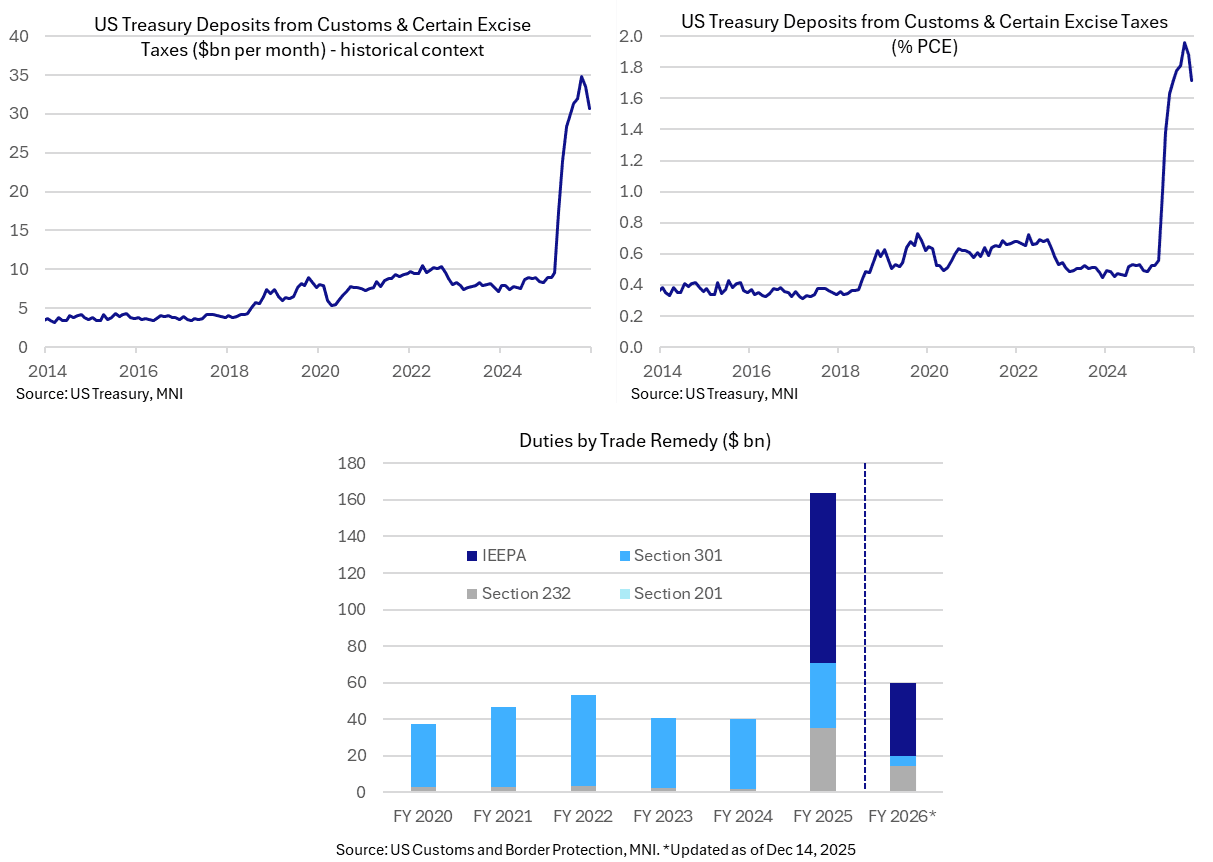
- Fiscal impact: IIEPA revenues were worth up to $175bn per Penn Wharton Budget Model analysis (link). Bessent on Friday after the tariff ruling noted that using alternative methods like Section 232 (a national security justification) or Section 301 (unfair trade practices) means tariff revenue generation won’t drop or slow.
- Since then, the WSJ has reported that the Trump administration is also considering new Section 232 tariffs on a half-dozen industries, potentially covering large-scale batteries, cast iron and iron fittings, plastic piping, industrial chemicals and power grid and telecom equipment.
- IEEPA refunds: The decision is being pushed back to international trade courts after the Supreme Court’s ruling didn’t specify what should happen to funds generated under IEEPA. Bessent on Friday: “My sense is that could be dragged out for weeks, months, years, so … we’ll see what happens there. […] I got a feeling the American people won’t see it.” USTR's Greer: “So it’s a matter for the courts. They created the situation, and we’ll follow whatever they say to do.”
- Importers generally have 180 days after goods are 'liquidated' to protest and request refunds from U.S. Customs and Border Protection.
GBP: Sterling Breaks Out of Earlier Contained Range
Feb-24 15:45
- GBP strength is garnering some attention as the BOE MPC members continue to testify in front of the TSC. We note there has been nothing new on the monetary policy front, keeping the drivers behind the latest sterling bid unclear.
- It is also worth noting that while the breakouts appear notable on the charts, the extremely tight intra-day ranges for GBP crosses are perhaps exacerbating the latest momentum.
- Most notably, EURGBP has come under some pressure, slipping around 20 pips to 0.8712 lows. Downside momentum certainly looks to have accelerated below a collection of daily low prints over the past few sessions, prompting a one-week low for the cross and a narrowing of the gap to initial support at 0.8708, the 20-day EMA.
- Overall, we see EURGBP in consolidation mode and trading closer to its recent highs. Last week’s gains resulted in a brief print above a key short-term resistance at 0.8746, the Jan 21 high. A clear breach of this hurdle would highlight a potential trend reversal.


