MACRO UPDATE: Analyst German GDP Growth Expectations Ease For Both 2026 and 2027
Private sector German short-to-medium-term GDP forecasts dipped lower over the past month on the back of higher energy prices amid the Iran war. In terms of longer term growth prospects, markets anticipate the outcome of the government's structural reforms which indeed seem to be in the pipeline now.
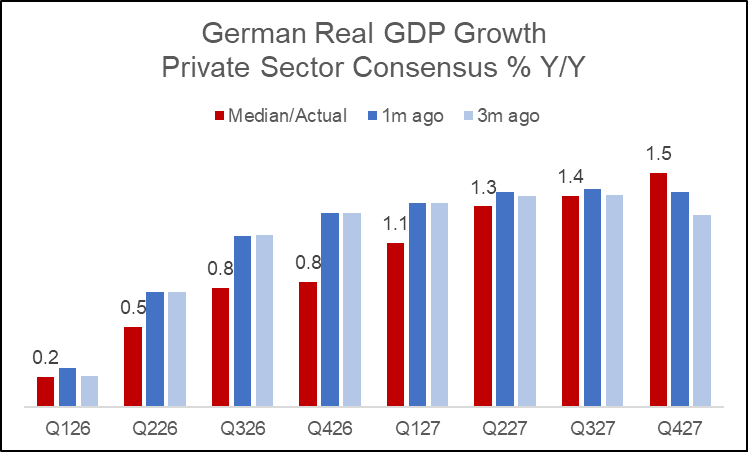
- Updating a median estimate from seven sellside analysts that we track, Y/Y growth is seen at 0.6% in 2026, -0.4pp vs a month ago. Growth should pick up somewhat over the course of the year but less than previously seen, from a very subdued 0.2% Y/Y in Q1 (little changed from a month ago) to 0.8% Y/Y in H2 (roughly 1.2% Y/Y a month ago).
- For 2027, analysts remain a little more optimistic, with the median forecast for the year now standing at 1.2% (vs 1.4% a month ago). Growth is seen more back-loaded next year, peaking at 1.5% in Q4.
- These figures are within ranges of recently published forecasts from the public sector: The IMF sees German 2026 growth at 0.8% (-0.3pp since January) and 2027 growth at 1.2% (also -0.3pp), while German institutes have revised their joint view for 2026 and 2027 growth to 0.6% and 0.9% (from 1.3% and 1.4% seen last autumn).
Looking at domestic drivers of these forecasts, government measures are under scrutiny currently:
- The governing coalition's recent attempts to counter higher pump prices with a 2-month cut to energy taxes by 17ct/litre as well as a E1000 allowance for a one-time tax-free bonus payment to employees are being perceived rather critically domestically, with commentators questioning the efficiency of the measures.
- Longer term, the long-touted structural reforms indeed seem to be in the pipeline now. Income tax reform details are set to be announced in the next weeks, with relief supposed to be targeted around low- and mid-incomes while Chancellor Merz did not exclude a higher peak marginal tax rate. A pension reform commission is presenting their results late June and the government plans to use these as soon as possible. Meanwhile last week, German health minister Warken has presented a E20bln/year healthcare savings package to limit non-tax levy growth in Germany.
- Commentators including sellside analysts widely agree that Germany's fate in terms of economic performance over the longer term hinges crucially on the outcome of these reforms.
Want to read more?
Find more articles and bullets on these widgets:
Historical bullets
USDCAD TECHS: Key Resistance Remains Intact For Now
- RES 4: 1.3845 High Jan 22
- RES 3: 1.3800 High Jan 23
- RES 2: 1.3753 High Mar 03 and key resistance
- RES 1: 1.3748 High Mar 19
- PRICE: 1.3714 @ 17:00 GMT Mar 20
- SUP 1: 1.3670/3526 20-day EMA / Low Mar 09
- SUP 2: 1.3482 Low Jan 30 and the bear trigger
- SUP 3: 1.3420 Low Sep 25 ‘24
- SUP 4: 1.3400 50.0% retracement of the 2021 - 2025 uptrend
Attention in USDCAD is on key near-term resistance and a bull trigger at 1.3753, the Mar 3 high. A clear break of this hurdle would confirm a range breakout, highlight a stronger bull cycle and confirm a clear breach of the 20- and 50-day EMAs. This would open 1.3800 initially, the Jan 23 high. For bears, a reversal would refocus attention on 1.3482, the Jan 30 low and bear trigger.
AUDUSD TECHS: Trend Needle Points North
- RES 4: 0.7284 High Jun’22
- RES 3: 0.7256 2.500 proj of the Nov 21 - Dec 10 - 18 price swing
- RES 2: 0.7208 61.8% of the Feb 25 ‘21 - Apr 9 ‘25 bear leg
- RES 1: 0.7187 High Mar 11 and the bull trigger
- PRICE: 0.7039 @ 16:59 GMT Mar 20
- SUP 1: 0.6979 50-day EMA and key support
- SUP 2: 0.6944 Low Mar 3
- SUP 3: 0.6897 Low Feb 6
- SUP 4: 0.6834 Low Jan 23
The trend condition in AUDUSD is unchanged, it remains bullish and the pair continues to trade above key support at 0.6979, the 50-day EMA. A clear break of this average would undermine the current bullish theme. The moving average set-up is in a bull mode position and this continues to highlight a dominant medium-term uptrend. A resumption of the trend would open 0.7208 next, a Fibonacci retracement point.
BOE: Summary of Analyst Views
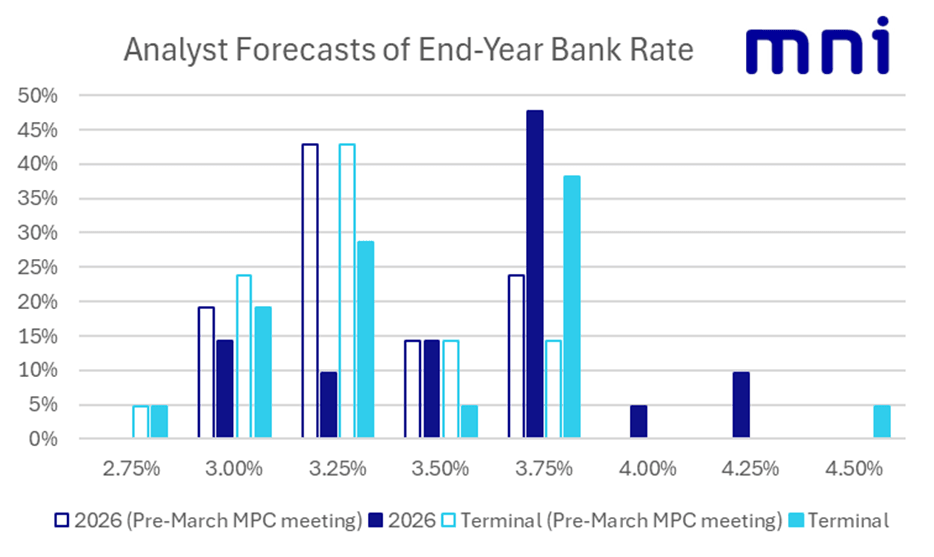
- Just over half (11/21) of the analyst reviews that we have read still look for the next move from the MPC to be a cut. 4/21 look for a hike while 6/21 look for the Bank to remain on hold for their forecast horizon.
- In terms of those expecting hikes Daiwa, JP Morgan and Rabobank all look for the first hike in April with the former two looking for a 4.25% peak and Rabobank looking for a one-and-done. NatWest Markets look for the first hike in Q4-26 but then expect two further hikes in Spring 2027 to the highest peak of 4.50% seen in any analyst base case that we have seen.
- Note that of these analysts, 3/4 (all except NatWest Markets) expect cuts back to a least current levels within their forecast horizon.
- In terms of those looking for the next move to be a cut, none look for a move in April with 5 analysts expecting a June cut, 1 for July, 2 for November and the remaining 3 looking for cuts to begin in 2027.
- UniCredit has the lowest terminal rate, continuing to look for 2.75% while 4/21 analysts look for 3.00% terminal, 6/21 analysts look for 3.25% and 1/21 analyst looks for 3.50%. As noted above, NatWest Markets looks for hikes with no reversal but the remaining 8/21 analysts look for no moves from 3.75% throughout the forecast horizon.