EU FINANCIALS: ABN AMRO Bank: S&P to Pos. Outlook
Dec-05 16:57
(ABNANV; Aa3/A Pos/A+)
#MNI #Banks
Want to read more?
Find more articles and bullets on these widgets:
Historical bullets
US DATA: Student Loan Delinquencies Jump Again, Other Categories Steadier
Nov-05 16:53
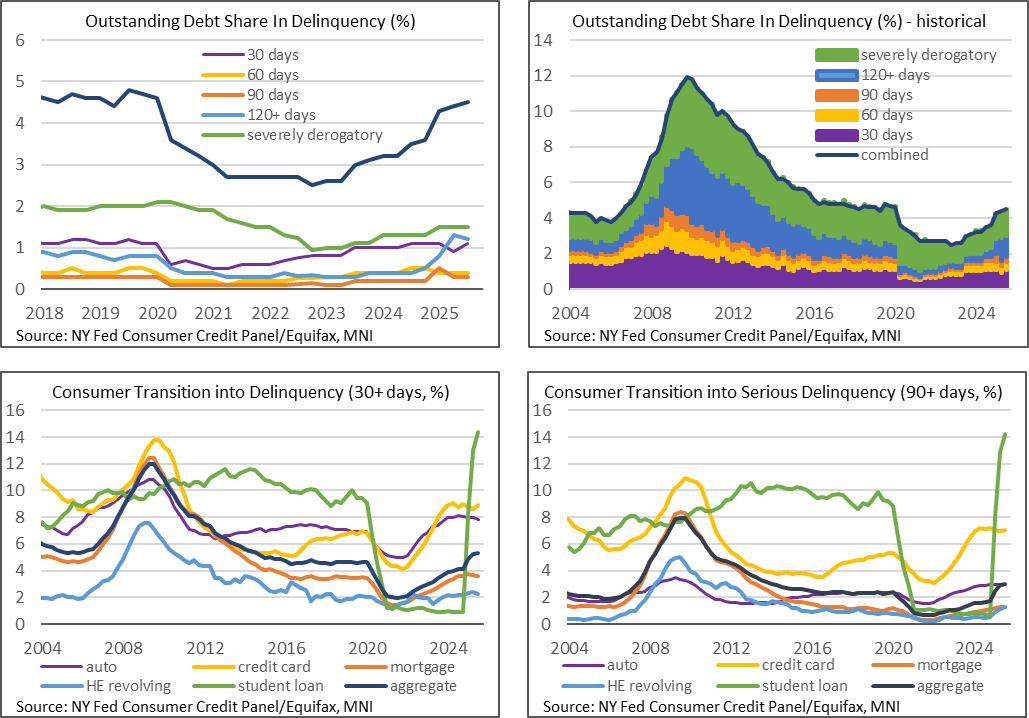
The NY Fed household debt report (link) saw another jump in student loan delinquencies. Transition rates were steadier for other debt products and whilst there was a slight increase for those heading into serious delinquencies, NY Fed researchers note broad stabilization.
- The share of outstanding consumer debt in some form of delinquency increased a tenth to 4.5% in Q3 for a fresh high since 1Q20 according to the NY Fed household debt report.
- It was driven by the 30 days late category bouncing 0.2pp to 1.1% to reverse a drop in Q2, offsetting a 0.1pp drop in the 120+day late category to 1.2% after the 1.3% in Q3 was its highest since 1Q16.
- Transition rates into delinquency were dominated by student loans in a third quarter where missed payments can be reported again. The delinquency of student loans into delinquency increased from 13.0% to 14.4% for a new record high since the data started to be collected in 2004.
- Elsewhere, most categories increased although there was a higher rate of credit card loans falling into delinquency, +0.3pps to 8.9% for the highest since 4Q24.
- There is however a slightly broader drift higher in transition rates into serious delinquency (90+ days). Student loans obviously dominate, jumping from 12.9% to 14.3%, although auto loans, credit cars and HELOCs also all saw small rises on the quarter.
- “Credit card and auto loan delinquencies are elevated but it looks to us like they have stabilized. When you look at the monthly data it looks like it might be turning around a bit but we have to see how that evolves,” New York Fed researchers said.
- “Overall, household balance sheets in the aggregate look pretty good, pretty strong, but there are segments of the population where we are seeing stress.”
- “Household debt balances are growing at a moderate pace, with delinquency rates stabilizing,” said Donghoon Lee, economic research advisor at the New York Fed in a statement. “The relatively low mortgage delinquency rates reflect the housing market’s resilience, driven by ample home equity and tight underwriting standards.”
TARIFFS: Conservative SCOTUS Justices Sceptical Of Trump's Tariff Defence
Nov-05 16:41
Conservative Supreme Court justices Amy Coney Barrett, Neil Gorsuch, and Chief Justice John Roberts all appeared sceptical of President Donald Trump’s reciprocal tariffs, during questions to Trump’s lawyer during today’s hearing.
- Igor Bobic at HuffPost reports Gorsuch noted whatever powers Congress delegates to the president, no president will want to give back: “Congress can’t take that back without a supermajority. What president is going to give that power back?”
- Gorsuch added: “Congress as a practical matter can’t get this power back once it’s handed it over. The president is a one way rachet to the gradual but continual excretion of power in the executive branch and away from the people’s elected representatives.”
- MNI’s Political Risk team noted in the US Daily Brief this morning, “Ultimately, the Supreme Court’s decision is likely to come down to whether justices determine the tariffs are a national security issue, as framed by the administration, or an economic issue, which would fall under the purview of Congress.”
- Bobic notes that both Roberts and Barrett seemed sceptical of Trump’s national security justification for tariffs, “I mean, Spain? France? I could see it with some countries but…” Barrett said.
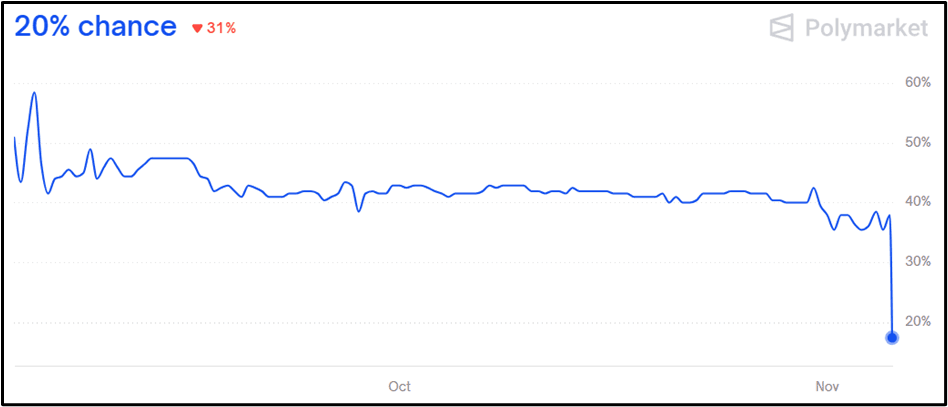
- The implied probability of Trump winning the case has dropped to 20%, per Polymarket. “A loss wouldn’t completely unwind the Trump agenda. IEEPA tariffs account for roughly half of the tariff revenue that the government has so far collected in the 2025 fiscal year,” NYT reported yesterday.
Figure 1: Supreme Court Rules in Favour of Trump’s Tariffs
Source: Polymarket
OPTIONS: Larger FX Option Pipeline
Nov-05 16:41
- EUR/USD: Nov07 $1.1700(E1.0bln); Nov10 $1.1475(E1.8bln), $1.1750(E1.1bln), $1.1770(E1.2bln)
- AUD/USD: Nov07 $0.6500(A$1.0bln); Nov10 $0.6610-20(A$1.3bln)
- USD/CAD: Nov07 C$1.3900($2.3bln)


