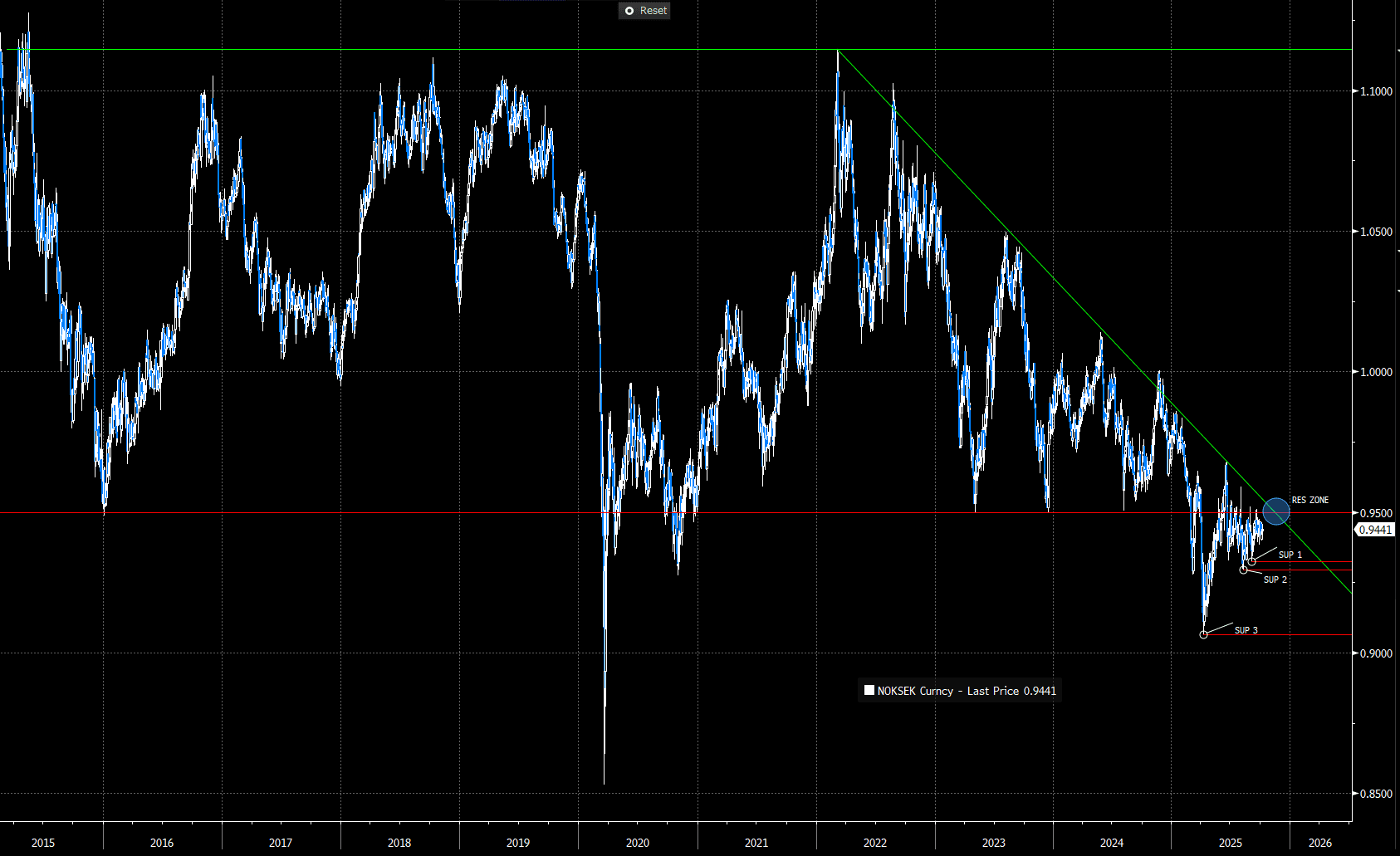
SCANDIS: Trendline Resistance May Set The Tone For NOKSEK In Coming Months
The sideways trend in NOKSEK since the start of July has narrowed the gap to medium-term trendline resistance drawn from the March 2022 high. Interaction with this trendline will be key for the direction of the cross over the next few months, particularly as it now closely aligns with 0.9500. The cross has failed to close above this level for three months, and 0.9500 has historically been an important pivot support going back to 2016.
- Relative growth arguments may support SEK outperformance versus NOK in the coming months: The monetary policy stance in Sweden is more accommodative than in Norway, the Government’s expansionary 2026 budget is focused on stimulating household consumption, and Sweden may stand to benefit more from German/European defence spending spillovers (i.e. perform as a high beta Euro).
- However, Norwegian growth has held up well this year, and next week’s 2026 budget announcement is likely to reaffirm an expansionary fiscal stance. There’s not yet a clear consensus around the policies expected, but PM Store’s reliance on more left-leaning parties following September’s election may set the stage for higher taxes on high earnings to fund increased welfare spending. Nominal rate differentials should also remain in favour of NOK for the foreseeable future following Norges Bank’s hawkish September cut. Friday's inflation reports presents the immediate risk event for NOK.
- In Sweden, some analysts also caution that the recycling of persistent current account surpluses into foreign assets are a structural net negative for the currency. We have sympathy with this argument, and note that in recent months the reallocation/repatriation of domestic equity fund flows back into Sweden has stalled.
- Initial support in NOKSEK is the September 5 low at 0.9324 (SUP 1 on chart), which shields the August 11 low of 0.9295 (SUP 2). Clearance of these levels would expose the April low of 0.9065 (SUP 3).
- SEB believe Q4 weakness may present a buying opportunity in NOK. They think the krone is likely weaken into year-end “on falling oil prices, negative seasonal patterns, and shifting drivers from domestic to global factors”. However, they see next year’s outlook as more supportive owing to “rebound in oil prices, a weaker USD, seasonal strength, and potentially larger NOK purchases”
Figure 1: NOKSEK Since 2015 (Source: Bloomberg Finance L.P.)
Want to read more?
Find more articles and bullets on these widgets:
Historical bullets
EURGBP: BoE Pricing Could Spell Difficulties for Consensus EURGBP Long View
While broader G10 FX ranges are muted, GBP/USD has improved to the best levels of the session, hitting 1.3536 to narrow the gap with the post-payrolls highs of 1.3555. Clearance here would put the price at new monthly highs and within range of 1.3595 - clustered horizontal resistance.
- Currency markets have proven more sensitive to volatility in the longer-end in recent weeks - of particular relevance to GBP given the uptrend in 30y UK Gilt yields - a recent triangle breakout on the daily chart reinforces this theme. Sensitivity here
- As such, politics and the near-term fiscal trajectory of the UK are to remain a key driver for markets here. Keir Starmer's reshuffle will likely be ineffectual for markets given Chancellor Reeves remains in place headed into the November 26th Autumn Budget, although recent appointments of economic advisers to No. 10 have raised some speculation that Reeves' influence over economic policy may have waned.
- As a result, sell-side remain cautious on GBP - however the vast majority prefer long EUR/GBP exposure over exposure to USD given the building pricing of a Fed Sept cut of potentially more than 25bps. This is despite sell-side pushing out expectations of BoE rate cuts this year (see Deutsche Bank, HSBC earlier today) - an extension of which could work against the consensus view of EURGBP higher. Key support to watch lies at 0.8597, the Aug 14 low. Clearance of this level would reinstate the recent bearish threat for the cross.
SPAIN T-BILL AUCTION PREVIEW: On offer this week
Spain has announced it will be looking to sell a combined E2.0-3.0bln of the following letras at its auction tomorrow, September 9:
- the 3-month Dec 5, 2025 letras
- the 9-month Jun 5, 2026 letras
GERMAN DATA: Exports To US and China Continue Decline While Trade W/ EU Firmer
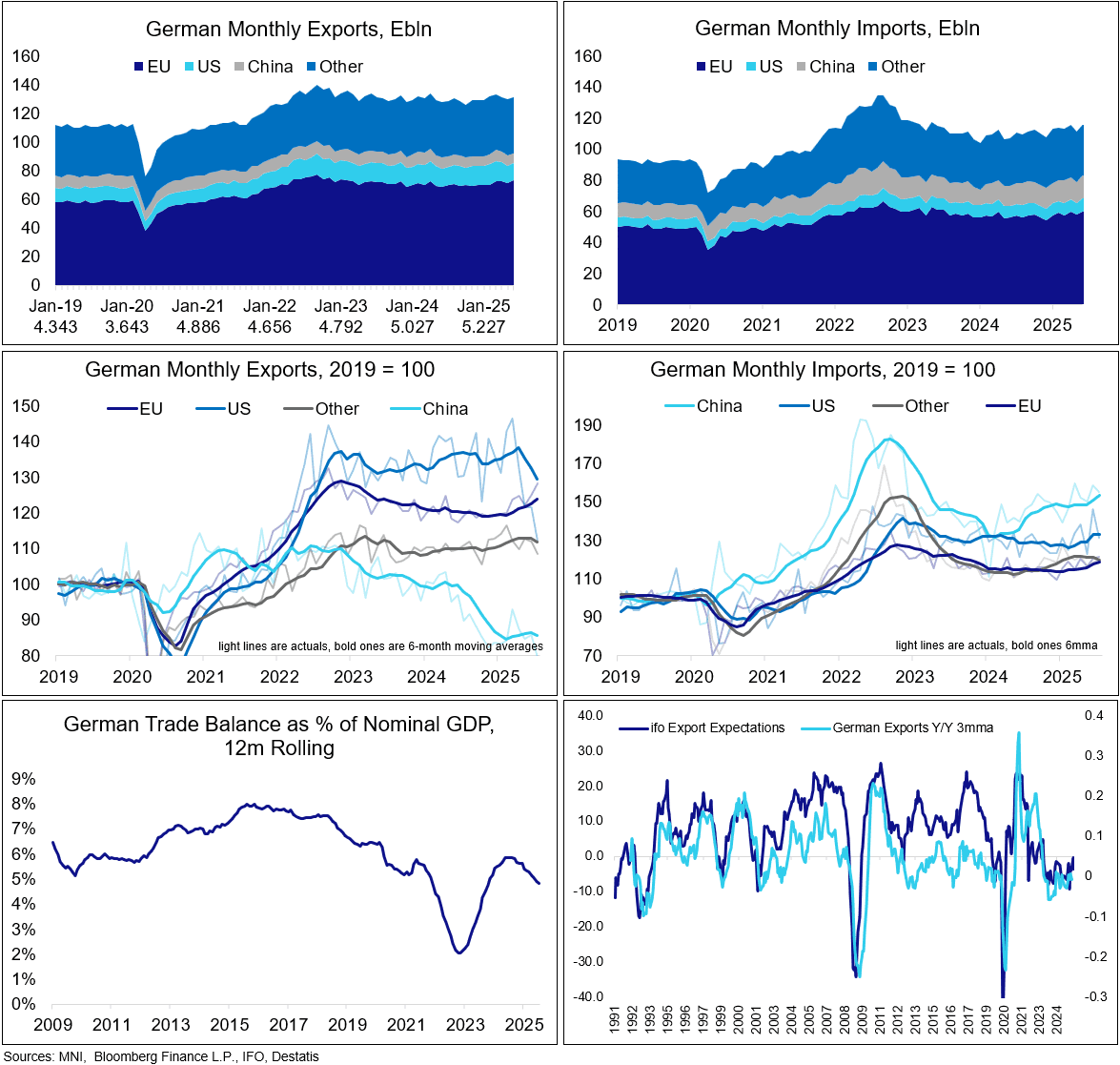
The German trade surplus, contrary to expectations for an uptick, decreased to E14.7bln in July (seasonally-adjusted, vs E15.5bln cons, E15.4bln prior, revised from E14.9bln), the second lowest since May 2023. The decrease came as an exports decline (-0.6% M/M vs 0.1% cons, 1.1% prior, revised from 0.8%) outpaced marginally lower imports (-0.1% M/M vs -1.0% cons, 4.2% prior, revised from 4.1%). Recent trends in the data suggest that German trade is becoming more EU-centric.
- As a % of nominal GDP on a 12-month rolling basis, the trade surplus extended its current downtrend, at 4.8% as of July, 1.1pp below levels seen around a year ago. That compares with a 2015 high of 8.0% and 2022 low of 2.1% (see bottom left chart).
- Across countries and back on a nominal basis, the US continues to stand out with exports to the country collapsing, sitting at their lowest since December 2021 after four consecutive sequential declines (23.5% decline vs March which was underpinned by tariff-front running).
- Exports to China also screen weak, printing the lowest since August 2016 and having declined 26.5% if comparing the last three months to the series' highs. This decline comes against the backdrop of reports (1,2) suggesting China has built significant manufacturing overcapacity in recent years, indicated by domestic supply rising faster global demand, rising numbers of lossmaking industrial firms in the country, as well as declining capacity utilization, which may weigh on demand for German products.
- Exports to and imports to other EU countries both appear to be on a solid uptrend, meanwhile, confidently standing above cycle lows seen around a year ago.
- IFO export expectations deteriorated in August, falling to -3.6 points, from -0.3 points in July. “Disillusionment is spreading in export business [...] although a tariff rate of 15 percent from the US is less than feared, it will nevertheless weaken export momentum”, IFO comments.