MNI US MARKETS ANALYSIS - US-Iran MoU Still in the Balance
Highlights:
- Fed path modestly softer as markets look to reports that US-Iran still working toward MoU, but evidence is lacking
- USD trades softer as markets pullback on sharp NFP dollar rally
- Markets gearing for US inflation print, BoC rate decision
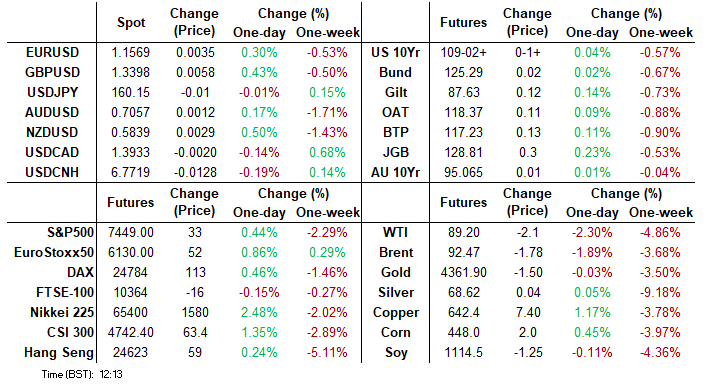
US TSYS: Modest Rally Aided By Further Oil Declines, Within Yesterday's Range
Treasuries are modestly firmer across the curve with a tailwind from lower crude oil futures (WTI -2.4%). Today sees data including weekly ADP, a full trade release and existing home sales – with CPI looming tomorrow – before 3Y supply. President Trump’s schedule doesn’t see any public facing appearances today.
- Cash yields are 0.7-2.5bp lower on the day, with declines led by the front end.
- Steepening continues to only pare Friday’s post-NFP flattening, with 2s10s for instance at 40.7bp vs 42-43bp pre-data via a low of 37bp later on Friday.
- TYU6 trades at 109-02+ (+01+) on lighter cumulative volumes of 265k, comfortably within yesterday’s range throughout.
- Resistance remains intact at 109-18 (20-day EMA) after which lies 110-00+ (May 29 high). Prior weakness has reinforced a medium-term bearish theme with support at 108-25 (Jun 8 low) before the bear trigger at 108-08+ (May 19 low).
- Data: Weekly ADP (0815ET), Trade balance Apr (0830ET), Existing home sales May (1000ET), Wholesale trade sales/inventories Apr/Apr F (1000ET)
- Coupon issuance: US Tsy $58B 3Y Note auction - 91282CQV6 (1300ET). Last month’s 3Y tailed by 0.5bp and the bid-to-cover slipped from 2.68x to 2.58x, whilst last week’s 5Y offering registered a twelfth consecutive auction without a trade-through (albeit just a 0.1bp tail last week).
- Bill issuance: US Tsy $65B 6W & $50B 52W bill auctions (1130ET)
- Politics: Trump in policy meetings (1400ET, 1530ET, 1730ET – all closed press)
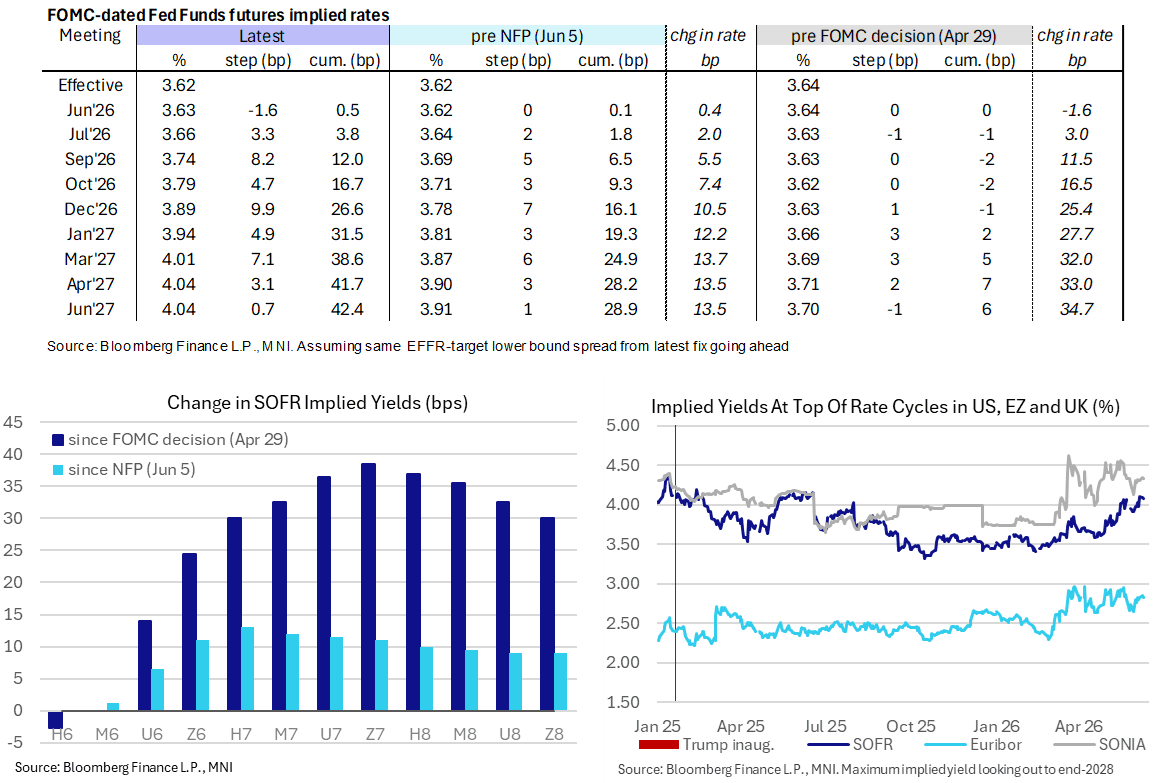
STIR: Fed Rate Path A Touch Softer But 2026 Hike Still Fully Priced
- US rates are slightly firmer overnight as they sit back towards yesterday's highs. Gains are helped by crude oil declines although with rates only back to yesterday’s more dovish levels vs crude easily through those lows.
- A 25bp hike remains fully priced for the Dec FOMC and whilst data picks up slightly today, attention on that front is firmly on tomorrow’s CPI report. A jump in NFIB price plans added support to this backdrop although didn't have an impact on market pricing.
- MNI US CPI Preview: https://mni.marketnews.com/4unpjNy
- FF cumulative hikes from 3.62% effective: 0.5bp Jun, 4bp Jul, 12bp Sep, 16.5bp Oct, 26.5bp Dec, building to 38.5bp Mar 2027 and 42.5bp Jun 2027.
- SOFR futures up to 2 ticks firmer on the day in the M7, with the implied peak yield of 4.075% (M7, -2bp) holding close to Friday’s post-NFP fresh highest close for the Middle East conflict of 4.105%.
US INFLATION: MNI US CPI Preview: Monthly Moderation But Still Too High
We have published our preview of the upcoming US CPI Report, found here: Hidden PDF
Refer to the publication for:
- Analyst unrounded estimates for headline and core
- Detailed analyst estimates by component level plus initial core PCE tracking
- MNI analysis of key areas to watch including supply chain pressures
- Pertinent MNI policy team pieces
US DATA: Small Business Price Plans Jump In May
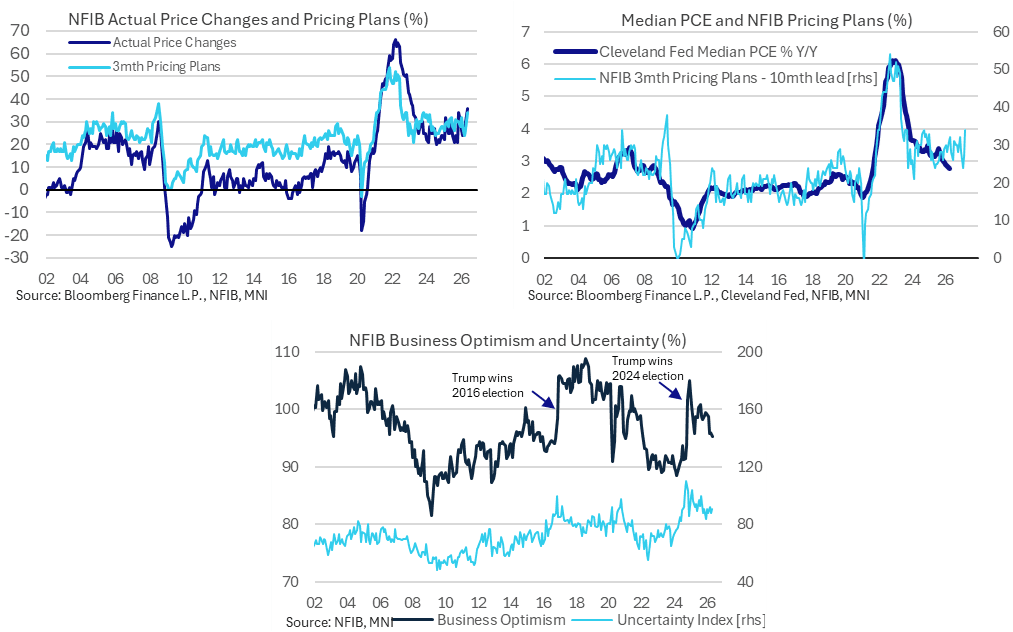
The NFIB small business survey saw a small further decline in May to a fresh low since Oct 2024. However, the more notable findings were strong increases in both realized and expected price components to their highest since 2023, continuing to bounce from recent lows in Feb or March.
- Actual price changes: A net 36% of firms increased prices compared to three months ago, the highest since Mar 2023, having extended a bounce from 24/25% in Feb/Mar via 30% in April.
- It shows much wider breadth of price increases than the 11-12% seen pre-pandemic although doesn’t give a sense of the magnitude of price changes.
- Planned price changes: A net 34% of firms expect to increase prices over the next three months, the joint highest with Nov 2023, as it extended a bounce from 24% in March via 27% in April.
- Some recent swings in this series warrant caution when looking at a single month, with this notable upturn following March’s joint low with Jul 2024 for the lowest since Apr 2023. This latest high exceeds the 32% in Jan 2026 and 32% in Jun 2025, findings that interestingly matched the two strongest months in our calculation of median core goods inflation.
- For context, it averaged 21-22% in 2017-19 pre-pandemic.
- Small business optimism: 95.3 (cons 96.0) in May for a little lower than the 95.9 in April and 95.8 in May. It’s a fresh low since Oct 2024 and nudges a little further below a very long-term average of 98 but is comfortably within recent year ranges - see chart.
US: Senate GOP Cancels FY27 Markups, Risk Of Govt Shutdown Ticks Up
The risk of a US government shutdown in October has ticked up after Senate Appropriations Committee Chair Susan Collins (R-ME) confirmed Monday that the panel has cancelled FY2027 markups for a second week in a row, amid a dispute with Democrat counterparts over topline spending numbers.
- Collins said in a statement, “We are not proceeding with the Senate Appropriations Committee markup this week because Democratic committee leaders have made clear they are not willing to work with us to pass fiscal year 2027 Appropriations bills. Our subcommittees have made good progress on their bills and will continue their important work.”
- Top Senate Democrat appropriator Susan Collins (D-WA) said in response, “At every turn, I’ve worked in good faith to advance a bipartisan process… I cannot accept a lopsided topline that helps defense CEOs while families get left behind.”
- Punchbowl News reports, “Senate Democrats are unlikely to support any appropriations bills without an agreement on FY2027 toplines. [Murray said] she and Collins were still “miles apart” on a topline spending agreement despite trading offers over the weekend,” adding that, “Democrats won’t go along with President Donald Trump’s massive $1.5 trillion defense spending request without an increase for non-defense spending.”
- Senator John Kennedy (R-LA) warned that Democrats' belief that they will Congress next year is likely to trigger a shutdown: “They do not want appropriation bills. They do want to shut down the government, and they think they’re going to take the House and maybe the Senate and get a better deal.”
IRAN: Al Hadath-Pakistani Source: Contacts Ongoing To Reach MoU This Week
Saudi state-run Al Hadath posts on X: "Pakistani source to Al-Hadath: Ongoing contacts with all parties to reach a memorandum of understanding during this week." It should be noted that during the course of the Middle East conflict to date, there have been numerous occasions where unnamed Pakistani sources have been quoted in regional outlets claiming that a deal is just around the corner, only for no such agreement to materialise. US President Donald Trump has also (frequently) claimed that a deal between the US and Iran is in the offing.
- US-based The Media Line reports "Speaking at JFK Airport, President Trump described the negotiations as being in their “final throes” and said there were no major unresolved issues preventing an agreement. He reiterated that any deal would prevent Iran from acquiring nuclear weapons: “We are very close to having a very, very good strong, powerful deal,” he said."
- However, Al Jazeera reported comments from an Iranian official claiming “Washington changed the draft of the memorandum of understanding, and this is unacceptable. Iran will not tolerate such violations and will treat them with great seriousness...An agreement cannot be reached if our frozen funds are not released and sanctions are not lifted.”
GILTS: /SWAPS: Downside Risks To Swap Spreads Remain
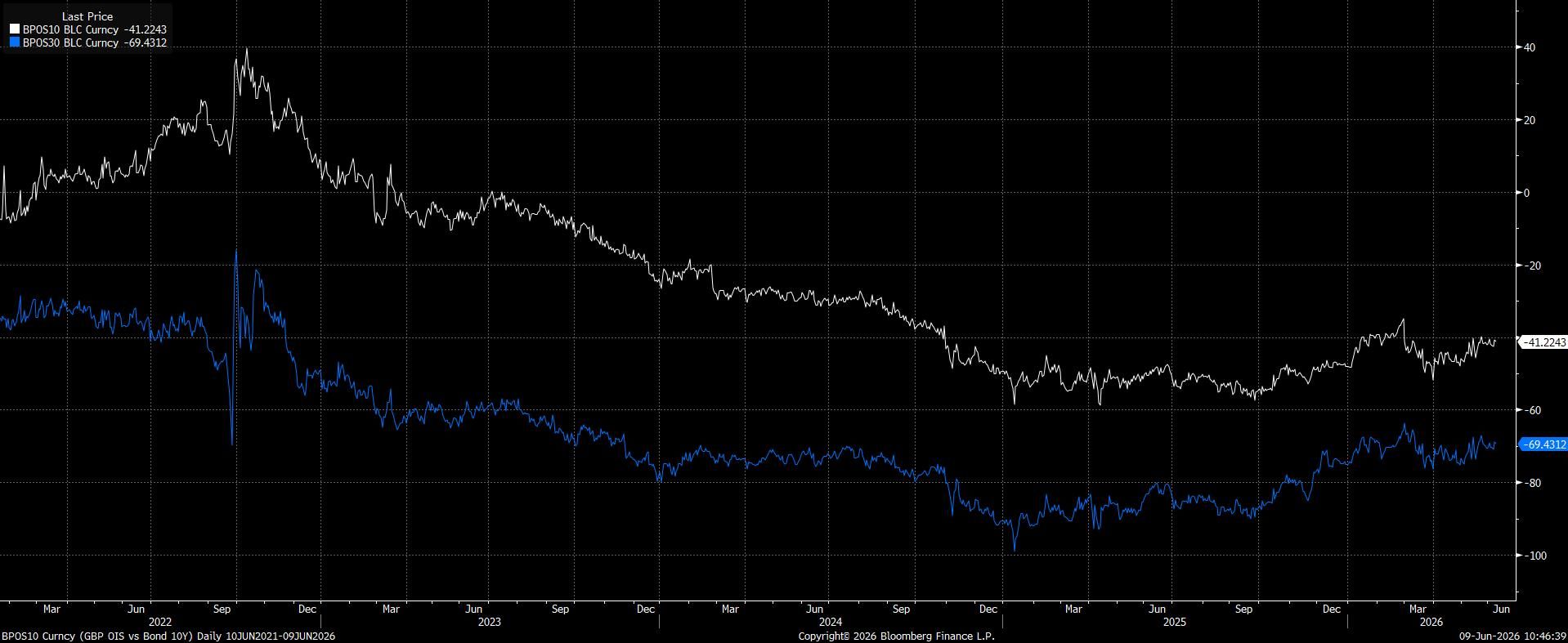
Medium-term risks remain evident, even after long end UK swap spreads have recovered for their late March lows.
- Downside risks to spreads stem from more expansionary fiscal policy, the supply backdrop and the future of BoE asset sales.
- In short, one or more of the following inputs is likely required to promote a break of late February highs in long end spreads:
- Lower energy prices, presumably on the back of a more durable U.S.-Iran ceasefire agreement. This would help remove some of the inflation risk premium embedded in gilts at present, promoting outperformance of gilts against swaps.
- Mayor of Manchester Burnham not becoming PM/losing the June 18 Makerfield by-election/adopting a more conciliatory fiscal stance if he does win a Labour leadership contest.
- A reduction in BoE APF sales (more relevant for the 10-Year spread with no further long bucket sales scheduled at present). The BoE will decide on its APF sales covering the October ’26-September ’27 period at the September ’26 MPC.
- Ongoing skew shorter in the WAM of the DMO’s issuance profile (possibly by combining the medium/long syndication baskets or continuing to cancel long auctions).
Fig. 1: UK 10- & 30-Year Swaps Spreads (bp)
Source: MNI - Market News/Bloomberg Finance L.P.
FOREX: USD Index Only Modestly Lower, Holding Bulk of Post-NFP Advance
- The Dollar index sits moderately lower on Tuesday, reflective of President Donald Trump saying on Tuesday that he was in the "final throes" of reaching a peace deal in the Middle East. While the cross-asset impact is displaying this renewed cautious optimism, the greenback adjustment has been relatively small. The DXY remains within 30 pips of yesterday’s recovery high as the market continues to digest the strong US data and increased chances of a fed hike this year.
- Lower energy prices and higher equities have assisted NZD back firmly above 0.5800 following the aggressive reversal last week that saw NZDUSD erode the entirety of the post RBNZ advance.
- Sterling also outperforms today after yesterday’s GBPUSD low print came within 3 pips of the key support at 1.3303, the May 18 low. The pair has drifted back to 1.3380 ahead of the NY crossover.1.33 will remain in focus ahead of June 18 which remains a pivotal date for GBP, given it is the BOE meeting and the Makerfield by-election, with added potential to stoke political and fiscal uncertainty in the UK.
- USDJPY has traded in a tight overnight range, consolidating above the 160.00 mark. Despite last month’s intervention, spot remain uncomfortably close to pre-intervention highs of 160.72. Positioning and price action signals the market's doubts around the ultimate feedthrough of the MOF’s efforts.
- Separately, the BOJ will consider halting its quarterly reductions in bond buying from April 2027 according to matching overnight sources reports, with an updated plan to be laid out at next week's meeting alongside an expected rate hike.
- ADP Weekly Employment Change, trade data, existing home sales, and wholesale trade are scheduled in terms of data. ECB's Moulin is scheduled to appear but is unlikely to speak on monetary policy as per the ECB's pre-decision quiet period; the FOMC also remains in blackout.
OPTIONS: Expiries for Jun09 NY cut 1000ET (Source DTCC)
- EUR/USD: $1.1505-10(E1.0bln), $1.1570(E1.0bln), $1.1620-25(E1.1bln)
- USD/JPY: Y159.00($1.1bln), Y160.00($501mln), Y160.25($599mln), Y160.50($540mln)
- AUD/USD: $0.7040-50(A$1.2bln)
EQUITIES: Trend Signals in EuroStoxx Futures Continue to Point North
Trend signals in EuroStoxx 50 futures are pointing north, highlighted by moving average studies that remain in a bull-mode position. The recent pause appears to be a flag formation - a bullish continuation pattern. A resumption of gains would pave the way for a climb towards 6200.00 next. Firm support lies at 5922.78, the 50-day EMA. A clear break of the average would undermine the bull theme. The trend in S&P E-Minis is bullish and short-term pullback’s appear corrective. Friday’s move down resulted in the break of an important short-term support at 7467.60, the 20-day EMA. The clear breach of this average suggests scope for a deeper short-term retracement towards 7285.93, the 50-day EMA. Note that the 50-day EMA is considered a key support. Key resistance and the bull trigger is 7632.25, the Jun 1 high.
- Japan's NIKKEI closed higher by 1392.03 pts or +2.17% at 65416.63 and the TOPIX ended 43.73 pts higher or +1.14% at 3896.11.
- Elsewhere, in China the SHANGHAI closed higher by 50.693 pts or +1.28% at 4010.031 and the HANG SENG ended 91.16 pts lower or -0.37% at 24565.9.
- Across Europe, Germany's DAX trades higher by 127.06 pts or +0.52% at 24744.12, FTSE 100 lower by 28.99 pts or -0.28% at 10345.21, CAC 40 up 68.57 pts or +0.84% at 8267.38 and Euro Stoxx 50 up 54.75 pts or +0.9% at 6116.91.
- Dow Jones mini up 70 pts or +0.14% at 50926, S&P 500 mini up 25.25 pts or +0.34% at 7441.5, NASDAQ mini up 190.75 pts or +0.65% at 29644.25.
COMMODITIES: WTI Futures Back Below 50-Day EMA Support
The trend condition in WTI futures is unchanged, it remains bullish and recent weakness appears corrective. A key area of support to watch is $90.59, the 50-day EMA. The contract has traded through it, a clear breach is required to highlight a top and the start of a stronger correction. This would open $77.22, the Apr 17 low. For bulls, key resistance has been defined at $105.21, the May 18 high. Clearance of this hurdle would resume the primary uptrend. A bear theme in Gold remains intact - moving average studies are in a bearish mode position, and this continues to highlight a dominant downtrend. A sharp sell-off on Friday reinforces this condition and signals scope for an extension towards the next key support at $4099.2, the Mar 23 low. A clear break of this level would highlight an important medium-term bearish development. Initial resistance is seen at $4501.0, the 20-day EMA.
- WTI Crude down $2.05 or -2.25% at $89.27
- Natural Gas up $0.04 or +1.11% at $3.182
- Gold spot down $1.54 or -0.04% at $4328.59
- Copper up $6.85 or +1.08% at $641.75
- Silver up $0.26 or +0.39% at $68.4419
- Platinum up $4.57 or +0.26% at $1763.35
| Date | GMT/Local | Impact | Country | Event |
| 09/06/2026 | 1215/0815 | *** |  US US | ADP Employment Report |
| 09/06/2026 | 1230/0830 | ** | US | Trade Balance |
| 09/06/2026 | 1230/0830 | ** |  CA CA | International Merchandise Trade (Trade Balance) |
| 09/06/2026 | 1255/0855 | ** | US | Redbook Retail Sales Index |
| 09/06/2026 | 1400/1000 | *** | US | NAR existing home sales |
| 09/06/2026 | 1400/1000 | ** | US | Wholesale Trade |
| 09/06/2026 | 1530/1130 | ** | US | US Treasury Auction Result for 52 Week Bill |
| 09/06/2026 | 1700/1300 | *** | US | US Note 03 Year Treasury Auction Result |
| 10/06/2026 | 0130/0930 | *** |  CN CN | CPI |
| 10/06/2026 | 0130/0930 | *** | CN | Producer Price Index |
| 10/06/2026 | 0600/0800 | ** |  SE SE | Private Sector Production m/m |
| 10/06/2026 | 0600/0800 | *** |  NO NO | CPI Norway |
| 10/06/2026 | 0700/0300 | *** |  CZ CZ | Czech Republic Final CPI |
| 10/06/2026 | 0800/1000 | * |  IT IT | Industrial Production |
| 10/06/2026 | 1100/0700 | ** | US | MBA Weekly Applications Index |
| 10/06/2026 | - | *** | CN | Money Supply |
| 10/06/2026 | - | *** | CN | New Loans |
| 10/06/2026 | - | *** | CN | Social Financing |
| 10/06/2026 | 1200/0800 | * | US | NY Fed SOFR |
| 10/06/2026 | 1230/0830 | *** | US | CPI |
| 10/06/2026 | 1345/0945 | *** | CA | Bank of Canada Policy Decision |
| 10/06/2026 | 1430/1030 | ** | US | US DOE Petroleum Supply |
| 10/06/2026 | 1700/1300 | ** | US | US Note 10 Year Treasury Auction Result |
| 10/06/2026 | 1800/1400 | ** | US | Treasury Budget |


