MNI US MARKETS ANALYSIS - Israel, Iran Defy Trump's Calls
Highlights:
- Iran and Israel continue to exchange strikes, shrugging off Trump's calls to "stop shooting"
- USD remains firmer, building on the post-NFP rally
- Analysts converge on 0.5% M/M, 4.2% Y/Y for this week's CPI print
US TSYS: Net Losses On Israel-Iran Strikes, Bearish Theme Reinforced
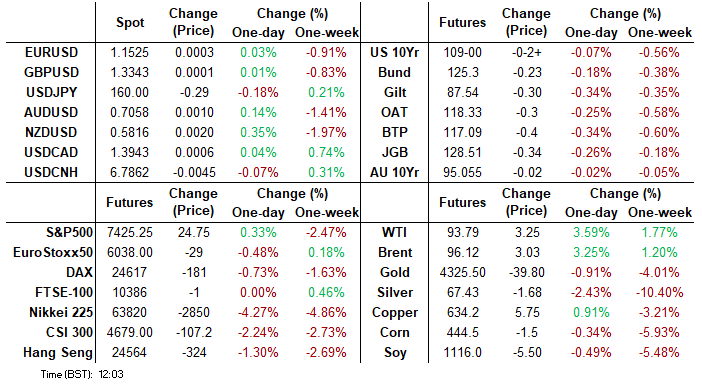
Treasuries are off overnight lows but still see net losses on strong increases for crude oil futures on Israel and Iran trading missile attacks, in moves that on net build on the significant hawkish impulse from Friday's strong payrolls report. Much of the paring came earlier but it has since been supported by President Trump recently saying Israel and Iran are looking to do an immediate ceasefire. Expect geopol headlines to remain in focus, especially with a particularly light docket today, but with scope for US data to become more important again with Wednesday’s CPI report.
- Cash yields are 1.3-2.2bp higher on the day, with increases led by 7s.
- The 30Y yield is currently at 5.016% off an earlier high of 5.033%, still close to the next notable resistance at 5.05%. A clear break through would open to 5.10% followed by 5.15%. The latter was the Head & Shoulder formation after the 30% Yield was capped at the 5.20% Psychological level on the 20th May. Today’s futures equivalent levels: 5.05% = 110.31, 5.10% = 110.11, 5.15% = 109.21 and 5.20% = 109.00.
- Curves at 38.8bp (2s10s) and 72.6bp (5s30s) have steepened from overnight lows but only back to levels seen after Friday's NFP report.
- TYU6 trades at 109-00 (-2+) on strong cumulative volumes nearing 600k, off an earlier low of 108-25.
- The latest move down reinforces a M/T bearish theme and also potentially provides an early signal that the corrective cycle that started May 19, is over.
- The bear trigger lies at 108-08+ (May 19 low), clearance of which would confirm a resumption of the downtrend. Alternatively, resistance to watch is 110-05+ (50-day EMA).
- Data: NY Fed consumer survey May (1100ET)
- Bill issuance: US Tsy $89B 13W & $77B 26W bill auctions (1130ET)
- Politics: Trump in tele-rally (1730ET, closed press), Trump attends NBA Finals (2030ET)
STIR: US Rates Near Hawkish Extremes As Crude Rally Adds To NFP Impulse
- US rates are a little off overnight lows but still see net losses as a strong increase in crude oil futures on Israel and Iran trading missile attacks has seen an additional hawkish impulse after Friday’s strong payrolls report.
- President Trump recently saying both Israel and Iran are looking to do an immediate ceasefire prompted small net gains, with more than half the snap reaction reversed.
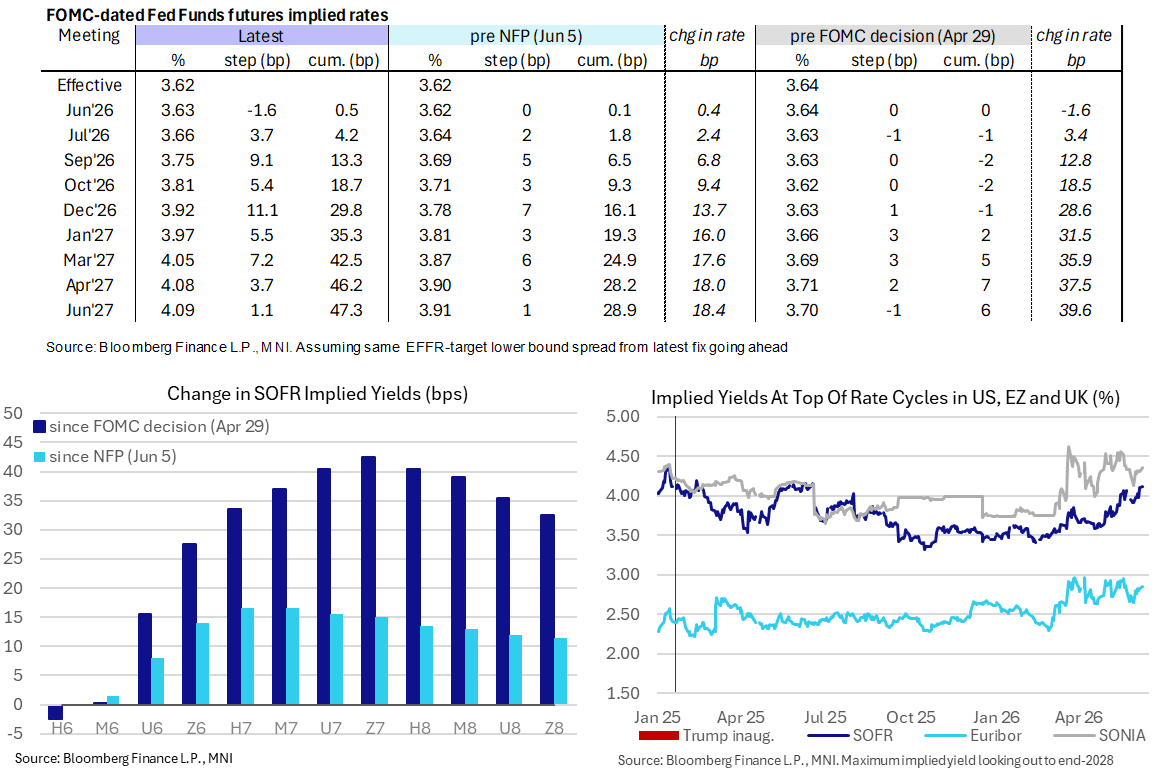
- Fed Funds implied rates are 0.5bp higher for next week’s meeting, 2bp higher for Sep and then 4bp higher for the Dec meeting and onwards. It now sees the Dec 2026 rate 13.5bp higher than before Friday’s NFP report.
- FF cumulative hikes from 3.62% effective: 0.5bp Jun, 5bp Jul, 13bp Sep, 18.5bp Oct, 30bp Dec building to 42.5bp Mar 2027 and 47.5bp Jun 2027.
- SOFR futures are mostly 1-2 ticks lower across the curve. The implied yield is seen peaking at 4.115% (M7, +2bp) for what would be a fresh highest close of the Middle East conflict - it earlier today touched 4.155% for intraday highs of the conflict.
- The FOMC is now in media blackout whilst data is light today before building up to Wednesday’s CPI release.
US TSY FUTURES: Positioning Across Funds & Asset Managers Swells In Latest CFTC
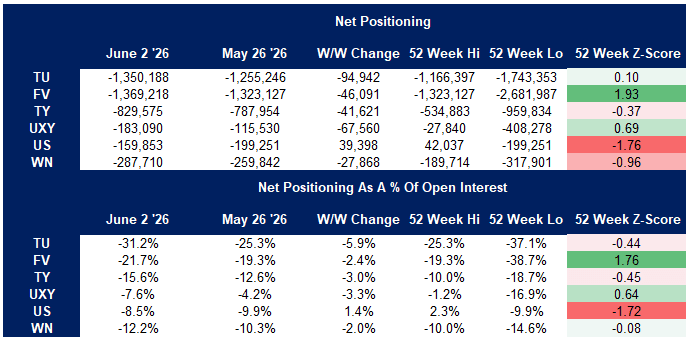
The latest CFTC CoT report showed broader net positioning in Tsy futures swelling across the major cohorts that we monitor:
- Asset managers added just under $35mln of fresh net long exposure across the curve, with the only exception to the wider theme coming via a modest reduction in net longs in TU futures. The cohort remains net long across the curve.
- Meanwhile, leveraged funds boosted their curve-wide net short exposure by ~$12mln DV01, as net short setting in TU, FV, UXY & WN comfortably outweighed short cover in TY & US futures. The cohort remains net short across the curve.
- Wider non-commercial positioning saw net shorts increased across all contracts outside of US futures, where the net short position was trimmed. The cohort’s curve-wide net short increased by ~$13.5mln in DV01 terms and they remain net short across the curve. See table below for me details on the positioning adjustments for this cohort.
Source: MNI - Market News/CFTC
US INFLATION: Unrounded Analyst Estimates Dovish On Core CPI
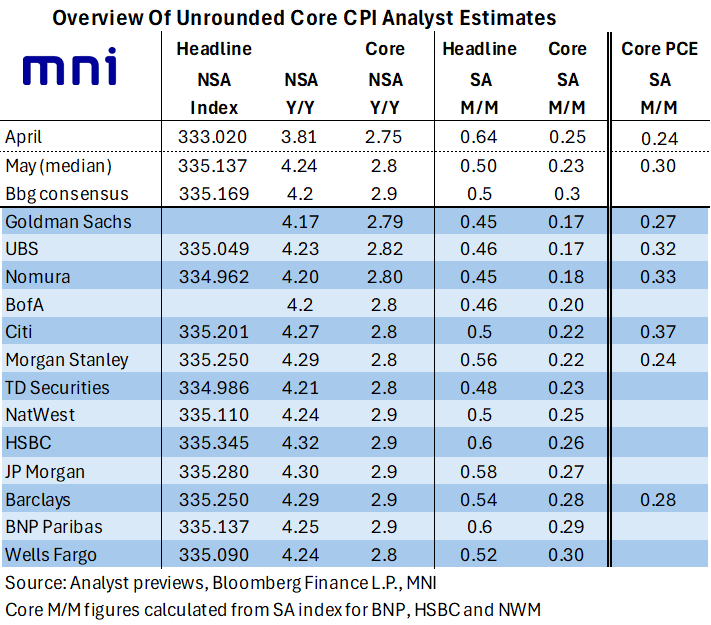
- Unrounded analyst estimates are in line with the broader Bloomberg survey for monthly headline CPI in May (median 0.50% vs BBG consensus 0.5) but are clearly more dovish when it comes to core (median 0.23% vs BBG consensus 0.3).
- This is the opposite to the set-up for April when the unrounded estimates correctly called a hotter figure (0.38% realized vs 0.36% median unrounded and 0.3 consensus).
- These thirteen analysts suggest it's a close call between 4.2 or 4.3% Y/Y (median 4.24) for headline CPI in May as it accelerates further from 3.81% Y/Y in April, 3.26% in March and two months at 2.4% in Jan-Feb.
- Core CPI Y/Y figures are generally quoted on a rounded basis although roughly suggest this could also be a close call between a 2.8-2.9% Y/Y print for a more modest acceleration after the 2.75% Y/Y in April, 2.60% in March and an average 2.5% in Jan-Feb.
- Limited estimates for core PCE currently look for another month where it exceeds core CPI, eyeing an acceleration from 0.24% M/M in April to ~0.30% M/M in May (range 0.24-0.37%). These estimates will be firmed up after CPI on Wednesday and then PPI on Thursday.
EUROPE ISSUANCE UPDATE
EU-BOND SYNDICATION: 2.50% Oct-30 / 3.625% Dec-40 EU-bond dual-tranche mandate
"The EU has mandated Barclays (DM/B&D), BNP Paribas, BofA Securities, Santander and UBS as Joint Lead Managers for its upcoming EUR Fixed Rate RegS Bearer dual tranche transaction, comprising a TAP of the EU 2.500% Benchmark Oct-2030 (EU000A4EG021) and a TAP of the EU 3.625% Benchmark Dec-2040 (EU000A4EJF17). No further group. The transaction will be launched in the near future, subject to market conditions."
- We expect the transaction to take place tomorrow.
- We look for E4-6bln for each line with a E9-11bln combined transaction size.
SOUTH KOREA: NPS Conducting FX Hedging Ops to Support KRW
"SOUTH KOREA PENSION FUND CONDUCTING FX HEDGING OPERATIONS TO SUPPORT WON - SOURCES" - Reuters
SOUTH KOREA: KRW Still Firmer as Authorities Signal More Activist Approach
- As mentioned above, that Reuters headline detailing a process that's likely already underway after the stock rout noted on Monday (the KOSPI's sharp downtick triggered a trading halt mid-session). Offshore KRW still trades stronger on the day - 1-month USDKRW outrights are off near 2% on the day after hitting multi-decade highs on Friday.
- We noted last week that scope remains for foreign selling of Korean assets, but further KRW losses could be slower due to stretched options market positioning and signals from Korean authorities for a more activist approach to market management: https://www.mnimarkets.com/articles/scope-remains-for-foreign-selling-but-further-krw-losses-could-be-slower-1780578066794
Iran Is Prepared For A Long-Term War - Tasnim
A military source speaking to Tasnim notes that "Iran is prepared for a long-term war with the Zionist regime and to strike American interests, and sufficient and necessary measures have been fully considered for this matter."
- "He emphasized: If the Israelis and Americans think they can make Iran and the Resistance Front predictable or limit Iran's response through "controlled tension" in the face of their crimes, they are making a foolish mistake."
- "This military source noted: Iran will raise the level of tension and the scale of punishment against the Israelis to such an extent that they will regret continuing their crimes. The coming days will show that the calculations of the Israelis and Americans are always wrong."
- "He stressed that Iran has always shown it does not abandon its friends in the Resistance Front, and said: Americans must also realize that they cannot shirk the burden of the crimes of their rabid dog, Israel. Americans will pay a price in this regard, and theatrics like the separation of Israeli fronts from America are merely propaganda and deceptive, and Iran will not allow America to stage such a show."
GILTS: /SWAPS/STIR: Some Favour 2s10s Steepeners
Amongst the sell-side notes that we have read some favour 2s10s steepeners, with little in the way of meaningful view changes surrounding the BoE and outlook for gilts apparent in the latest round of weekly publications.
- BofA: A hike from the ECB could up the pressure for the BoE the following week. We remain paid June MPC OIS.
- J.P.Morgan: We take profit on paid Sep ‘26 MPC OIS. 1Yx1Y SONIA has risen to 4.30% but is broadly in line with our ‘Strait of Hormuz Limbo’ scenario. We stay neutral. However, in the event Burnham wins the Makerfield by-election and launches a leadership challenge we continue to expect limited visibility on any potential fiscal policy changes until much closer to the Budget. We stay neutral 10-Year gilts with yields 30bp below our ‘energy shock’ scenario. The 2s/10s gilt curve looks modestly too steep vs. high frequency drivers but we don’t fade given ongoing strong negative directionality vs. front end yields. We maintain a flattening bias on 10s/30s gilts
- BMO: We expect the BoE to keep Bank Rate on hold all year. If we are right a buy-and-hold strategy in 2s will outperform cash, although near term 2s’ performance will be decided by oil. Medium- and long-term gilts will continue to suffer from a combination of weak inflation credibility, political policy risk and high supply. We recommend a 2s10s steepener, with a longish time horizon. Carry is positive in both gilts and swaps. We target at least 15-20bp steepening. A wide stop-loss is necessary, given 2s’ high correlation with oil prices.
- Goldman Sachs: Despite a strong narrative around political and supply risks for the UK bond market, 10-Year gilts have quietly performed quite well on ASW over recent weeks. Gilt risks have relaxed since mid-May with our term premium estimate declining by around 25bp. We think the relative stability - if not strength - of gilts on ASW is supporting evidence for the view that risk premium in the curve is currently more macro-driven rather than supply-driven. Given that fiscal uncertainty is likely to linger through any potential Labour leadership contest, we think that further macro relief is required for gilt outperformance, namely additional certainty around the path for inflation, and confirmation that the inflation path is consistent with the BoE on hold. We prefer 2s10s curve steepeners given its compatibility with both macro relief and a sticky fiscal risk premium into the Makerfield by-election.
- Societe Generale: Receive UK 2Y swaps vs U.S. Relative policy expectations remain too hawkish in the UK vs the US. Target 15bp spread.
- UBS: UK rates remain exposed to spillovers from the U.S. and this has been the case for the past three decades. At the margin, we expect UK rates to be relatively more sensitive than euro area rates to US rates developments. Ultimately a weakening economy should outweigh inflationary pressures and we like receiving September vs. July BoE.
FOREX: USD Index Extending Post Payrolls Surge
- The USD index has spent Monday’s session consolidating above the 100 mark following Friday’s highest daily close since March 30. Markets continue to digest last week’s stellar US employment data which has placed further upward pressure on Fed hiking odds in 2026.
- Combined with this, equities remain comfortably off their recent record highs as the lack of ceasefire details and renewed conflict in the Middle East broadly weighs on risk sentiment, underscoring the renewed dollar optimism. This brings the focus back on a key cluster of resistance for the DXY between 100.50/65, which will remain the key obstacle to a further extension north for the greenback.
- Latest weakness for EURUSD has confirmed the recent underlying bearish trend, and the pair is now trading below the bear channel base, which intersects at 1.1541. Spot is hovering just above 1.1500 as we approach the NY crossover, with the focus turning to 1.1411 which remains the key support, the March 13 and 16 lows.
- Overnight highs in USDJPY of 160.39 mean the pair has further narrowed the gap to key resistance of 160.72, the pre-intervention highs reached on April 30. Spot has subsequently drifted back to 160 as intervention worries remain present.
- The backdrop of cyclical USD strength could also target attention to USDCHF as an attractive long for participants looking for a carry position, with the intervention angle more favourable for the pair amid the SNB's continued verbal push in favour of a weaker franc. USDCHF extends fresh 2-month highs in recent trade, continuing to narrow the gap to the year’s highs at 0.8042 with the SNB meeting to follow the FOMC next week.
- Both the data calendar and central bank speak remain light today amid the Fed's and ECB's blackout / quiet periods, and just NY Fed inflation expectations being scheduled.
EQUITIES: Friday's Sharp E-Mini S&P Pullback Considered Corrective
- Trend signals in EuroStoxx 50 futures continue to highlight a dominant bull cycle, highlighted by moving average studies that remain in a bull-mode position. The recent pause appears to be a flag formation - a bullish continuation pattern. A resumption of gains would pave the way for a climb towards 6200.00 next. Firm support lies at 5916.20, the 50-day EMA. The latest move lower is considered corrective.
- The trend in S&P E-Minis is bullish and pullback’s appear corrective. Friday’s move down resulted in the break of an important short-term support at 7473.03, the 20-day EMA. The clear breach of this average suggests scope for a deeper short-term retracement towards 7280.56, the 50-day EMA. Note that the 50-day EMA is considered a key support. Key resistance and the bull trigger is 7632.25, the Jun 1 high.
COMMODITIES: WTI Rises Close to 5% Following Latest Israel-Iran Escalation
- The primary trend condition in WTI futures remains bullish and recent weakness appears corrective. Key support to watch is $90.57, the 50-day EMA. The contract has traded through it, a clear breach is required to highlight a top and the start of a stronger correction. This would open $77.22, the Apr 17 low. For bulls, key resistance has been defined at $105.21, the May 18 high. Clearance of this hurdle would resume the primary uptrend.
- Moving average studies in Gold remain bearish and this continues to highlight a dominant downtrend. A sharp sell-off on Friday reinforces the bearish theme. This signals scope for an extension towards the next key support at $4099.2, the Mar 23 low. A clear break of this level would highlight an important medium-term bearish development. Initial resistance is seen at $4519.0, the 20-day EMA.
| Date | GMT/Local | Impact | Country | Event |
| 08/06/2026 | 1500/1100 | ** |  US US | NY Fed Survey of Consumer Expectations |
| 09/06/2026 | 2301/0001 | * |  GB GB | BRC-KPMG Shop Sales Monitor |
| 09/06/2026 | 0600/0800 | ** |  DE DE | Trade Balance |
| 09/06/2026 | 0600/0800 | ** | DE | Industrial Production |
| 09/06/2026 | 1000/0600 | ** | US | NFIB Small Business Optimism Index |
| 09/06/2026 | - | *** |  CN CN | Trade |
| 09/06/2026 | 1200/0800 | * | US | NY Fed SOFR |
| 09/06/2026 | 1215/0815 | *** | US | ADP Employment Report |
| 09/06/2026 | 1230/0830 | ** | US | Trade Balance |
| 09/06/2026 | 1230/0830 | ** |  CA CA | International Merchandise Trade (Trade Balance) |
| 09/06/2026 | 1255/0855 | ** | US | Redbook Retail Sales Index |
| 09/06/2026 | 1400/1000 | *** | US | NAR existing home sales |
| 09/06/2026 | 1400/1000 | ** | US | Wholesale Trade |
| 09/06/2026 | 1700/1300 | *** | US | US Note 03 Year Treasury Auction Result |


