MNI RBA WATCH: Board To Hold, Maintain Tightening Bias

The Reserve Bank of Australia is expected to leave the cash rate unchanged at 4.35% at next Tuesday’s policy meeting as it assesses the impact of the 75 basis points of tightening delivered so far this year, though it is likely to maintain a tightening bias amid persistent inflation pressures.
A hold would mark the Board’s first pause in 2026 following three consecutive 25bp rate increases that fully unwound the easing cycle implemented last year and returned policy settings to a more restrictive stance. (See MNI RBA WATCH: 8-1 To Hike; Inflation-Growth Equation Worsens) Financial markets see little chance of a move next week and have priced in only around 10bp of additional tightening by year-end, suggesting investors broadly expect the current tightening cycle to be nearing completion.
However, several former RBA economists have told MNI that further rate increases are likely to be required if inflation is to return sustainably to the midpoint of the Bank’s 2-3% target band in a reasonable timeframe, arguing underlying price pressures remain too persistent to justify an extended pause at current levels.
ECONOMIC DATA
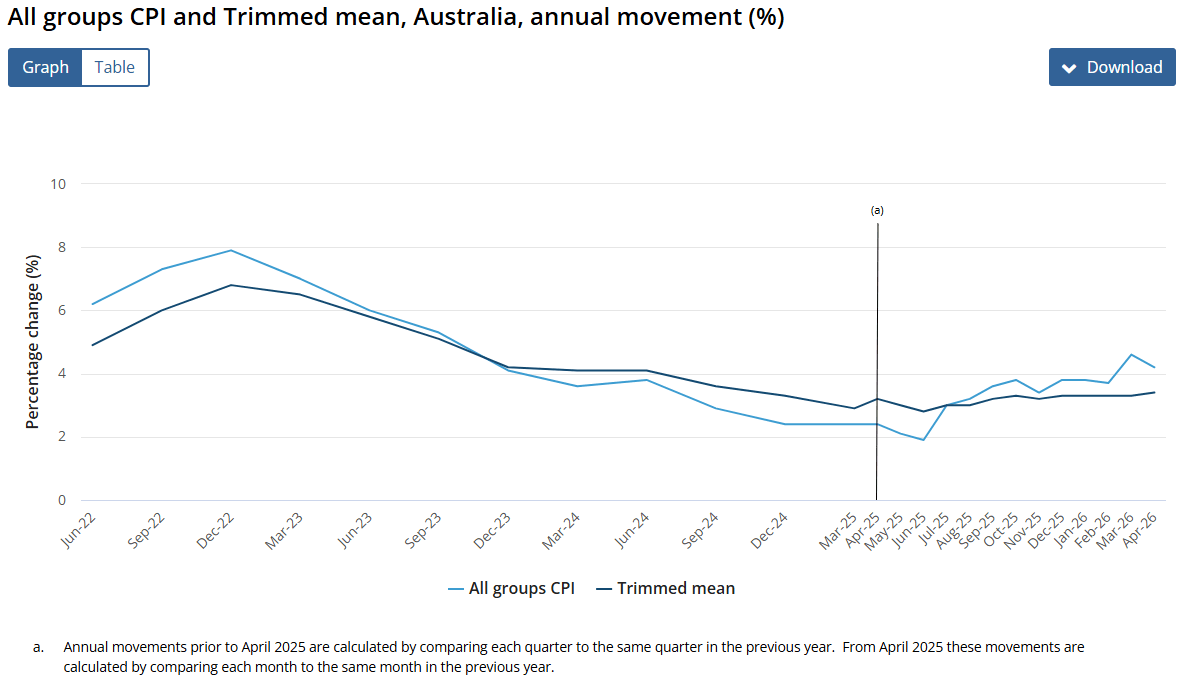
Persistent inflation remains at the centre of policymakers’ concerns, particularly signs that medium-term inflation expectations are becoming less firmly anchored.
While headline inflation has moderated from its peak, the Bank’s preferred trimmed-mean measure rose 3.4% y/y in April, up from 3.3% in March. The Board is closely watching whether this progress will be sustained or whether price pressures prove more entrenched.
Strong wages continue to be a key factor, with the Bank seeking to cool the rate of expansion of the Wage Price Index, last recorded at 3.3% y/y in Q2, toward a more sustainable 2.5%. (See MNI POLICY: RBA Eyes 2.5% Sustainable Wage Growth Level) Recent increases in award and minimum wages, alongside ongoing labour market tightness, are expected to feed through to services inflation over time. At the same time, weak productivity growth is limiting the economy’s ability to absorb higher labour costs without further price increases.
Taken together, these dynamics are expected to support the case for further tightening in the months ahead.
EXPERT OPINION
For now, the RBA is likely to frame the expected pause as an opportunity to assess incoming data rather than as a signal that the tightening cycle has ended. However, market pricing and commentary from former policymakers point to growing divergence over how much further interest rates may need to rise.
Former RBA staff interviewed by MNI since the May rate hike have generally agreed that further tightening is still likely this year, with August emerging as the next plausible window for an additional increase.
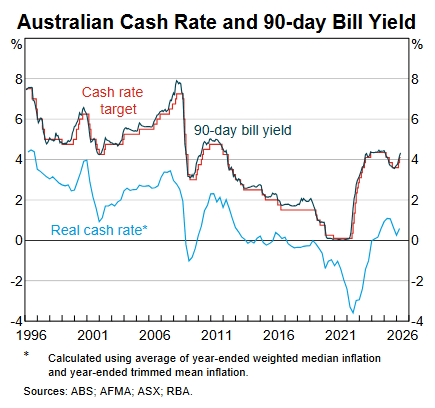
Real interest rates remain too low to return inflation sustainably to target within a reasonable timeframe, and the Bank may ultimately need to raise the cash rate above 5% from its current 4.35%, former senior RBA economist Mariano Kulish told MNI this month. "If I couple the path of the cash rate with inflation, the real interest rate is still too low, so I don't know what is going to bring inflation down," he said.
Separately, Justin Fabo, founder of Antipodean Macro and former head of international financial markets at the RBA, said services inflation remains the key risk to the outlook for underlying price pressures and that this will need to ease to bring trimmed mean back toward target, and reduce the likelihood of additional rate increases. He added that, absent a clearer slowdown in services inflation, the Bank could still deliver two further 25bp increases, potentially taking the cash rate to around 4.85%.


