MNI INTERVIEW: Ex-RBA Economist Sees Cash Rate Above 5%

Australian real interest rates remain too low to return inflation to target in a reasonable timeframe and the Reserve Bank of Australia is likely to need to raise the cash rate above 5% from its current 4.35%, though policymakers are still set to leave rates unchanged at next week's meeting, former senior RBA economist Mariano Kulish told MNI.
Kulish, now a professor at the University of Sydney, welcomed the RBA's more hawkish tone this year but argued its latest forecasts still fail to explain how inflation will return to target without substantially tighter monetary policy. (See MNI RBA WATCH: 8-1 To Hike; Inflation-Growth Equation Worsens)
Markets currently expect at least one more rate increase this cycle, with a 43% probability of a hike at the Aug 11 meeting. However, Kulish said investors are underestimating the degree of tightening required to return inflation to the midpoint of the RBA's 2-3% target band, despite agreeing with the market's view that the board will hold at next week's meeting.
"If I couple the path of the cash rate with inflation, the real interest rate is still too low, so I don't know what is going to bring inflation down," he said. (See chart) "Maybe fiscal policy becomes a bit more contractionary and helps, but I think they're on the wrong side of 5%."
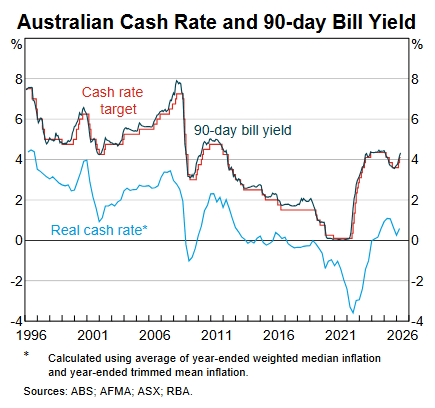
Kulish said the Bank's own projections imply only a modestly positive real cash rate over coming years despite inflation remaining elevated. He questioned how inflation could fall back to around 2.5% under such settings. "I don't know what magic sauce they have there," he said. "To me, the story is that you need the real cash rate to do the work of bringing inflation down."
The RBA's latest forecasts see headline inflation returning to target in by mid 2027, with underlying inflation following in December, assuming a 4.7% cash rate peak.
PRODUCTIVITY CHALLENGE
Poor productivity growth and robust wage gains will continue to complicate the RBA's task, Kulish said, noting that inflation is unlikely to return sustainably to target without a source of disinflation emerging elsewhere in the economy.
While changes to tax policies could moderate house-price growth, he said they may do little to reduce rental inflation if they discourage investment and constrain housing supply.
A stronger Australian dollar and lower oil prices could also assist disinflation, particularly if tensions in the Middle East ease, but he argued the Bank was relying too heavily on favourable external developments. "I think they're still chasing behind the car," he said. "Maybe they get lucky and inflation comes down because of some favourable shock, but in the absence of shocks I don't see why the current settings will bring inflation down."
TOO DOVISH
Kulish has consistently argued the RBA should continue raising rates until inflation is firmly inside the target band rather than pausing once it merely begins to slow, given that it has remained above target for so long. (See MNI: Behind-Curve RBA To Wait Till May Before Hike-Ex Staffers)
He criticised what he sees as an excessive focus on the near-term economic costs of higher interest rates, arguing that fiscal policy, rather than monetary policy, should be used to support households facing financial stress. "The objective is to keep inflation between 2-3%," he said. "If people are doing it tough, fiscal policy can address that through transfers. The central bank's job is to control inflation."
Kulish said the RBA's cautious approach partly reflects an institutional reluctance to be seen as the cause of slower economic growth. Australia has experienced relatively few periods in which the central bank was forced to aggressively combat inflation since inflation targeting was adopted in the early 1990s, he noted. Combined with political sensitivity around mortgage rates, that may have contributed to a higher hurdle for raising rates than for cutting them. "There is a lot of political pressure around interest-rate increases," he said. "That makes it harder to raise rates than to lower them, and I think that is showing up now in more persistent inflation."


