MNI EUROPEAN MARKETS ANALYSIS: Surprise BI Hike To Defend IDR
- Bank Indonesia surprised with a 25bp rate hike inter-meeting to defend the rupiah after USDIDR reached a record high Monday. It also increased the rate structure of SRBI notes to attract foreign inflows.
- After yesterday's declines Asia's major bourses have had a better Tuesday, with most major indexes delivering positive gains.
- RBA-dated OIS pricing shows tightening across all meetings, with the probability of a 25bp hike rising from 6% for June to 66% by September and 98% by December 2026.
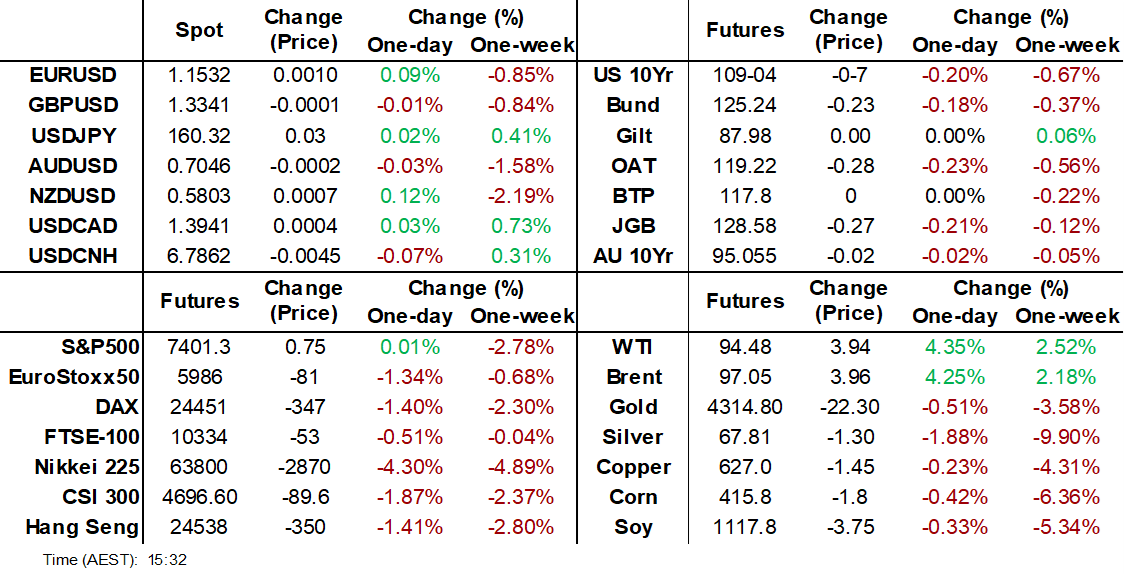
MARKETS
US TSYS: Nudge Richer As Markets Monitor Peace Deal Progress
TYU6 is dealing at 109-00, 0-00+ from closing levels in today's Asia-Pac session.
- Cash US tsys are ~1bp richer in today's Asia-Pac session after finishing Monday's session showing a modest bear-steepener, with benchmark yields 1-4bps higher. Markets are monitoring progress of an agreement between Iran and Israel.
- Traders have resumed pricing in a quarter-point Fed hike by year-end due to a stronger-than-expected labour market and higher inflation. The focus is on May CPI data on Wednesday.
- Hidden PDF: Monthly Moderation But Still Too High. Monthly inflation is expected to moderate to a still elevated pace in May, with MNI unrounded consensus pointing to 0.51% M/M for headline CPI and 0.23% M/M for core CPI. It should see headline CPI jump further to 4.2% Y/Y with a risk of 4.3% (either strongest since Apr 2023) whilst core CPI would see a more modest acceleration to 2.8-2.9% Y/Y (strongest since Sep 2025).
- MNI Techs: Treasuries reverse course to largely weaker again, low end of session range: TYU6 trades -2 at 109-00.5 vs. 108-25 overnight low - initial technical support. The bear trigger lies at 108-08+, the May 19 low. Clearance of this level would confirm a assumption of the downtrend.
JGBS: Modestly Richer Ahead Of Tomorrow's PPI Data & 30Y Supply
JGB futures are stronger and at session bests, +9 compared to settlement levels.
- Robin Brooks on X: "Japan is running out of fiscal space. It's tried everything from financial repression to using its central bank to cap yields. Both of these keep yields artificially low, which just leads to currency debasement. That's the story of the Yen in recent years."
- Cash US tsys are ~1bp richer in today's Asia-Pac session. Traders have resumed pricing in a quarter-point Fed hike by year-end due to a stronger-than-expected labour market and higher inflation. The focus is on May CPI data on Wednesday.
- Hidden PDF: Monthly Moderation But Still Too High. Monthly inflation is expected to moderate to a still elevated pace in May, with MNI unrounded consensus pointing to 0.51% M/M for headline CPI and 0.23% M/M for core CPI. It should see headline CPI jump further to 4.2% Y/Y with a risk of 4.3% (either strongest since Apr 2023) whilst core CPI would see a more modest acceleration to 2.8-2.9% Y/Y (strongest since Sep 2025).
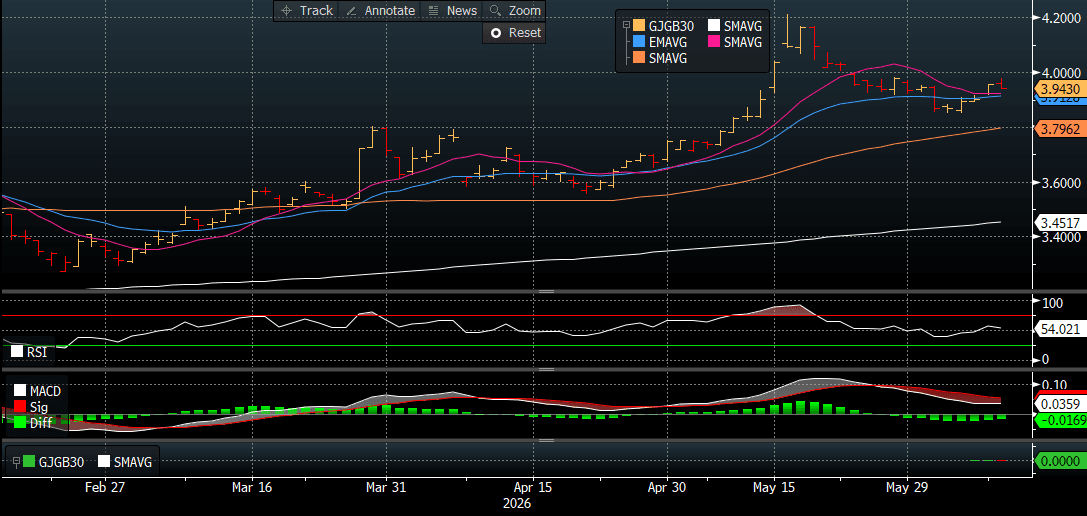
- Cash JGBs are flat to 2bps richer, with the futures linked 7-year leading.
- The benchmark 30-year yield is 1.3bps lower at 3.942% versus the cycle high of 4.214%.
- Tomorrow, the local calendar will see PPI data alongside 30-year supply.
Bloomberg Finance LP
AUSSIE BONDS: Modestly Richer Despite Stabilisation In Bus Conf
ACGBs (YM +2.5 & XM flat) are slightly stronger.
- There seemed some stabilisation in the private sector in May with NAB business conditions stable at +3 and confidence improving substantially to -14 from -23. However, Q2 averages are signalling growth slowed in the quarter. Price/cost increases moderated from April but remained elevated compared to pre-Iran War rates and are signalling upside risks to Q2 CPI. The RBA remains alert to signs of a greater or faster pass through of higher costs to consumers and while the NAB survey shows some easing in the size of price rises they remain inconsistent with the inflation target.
- Cash US tsys are ~1bp richer in today's Asia-Pac session after finishing Monday's session showing a modest bear-steepener. The focus is on Wednesday's CPI data.
- Cash ACGBs are flat to 2bps richer with the AU-US 10-year yield differential at +37bps, around lowest this year.
- The bills strip has bull-flattened, with pricing +1 to +4 across contracts.
- RBA-dated OIS pricing shows tightening across all meetings, with the probability of a 25bp hike rising from 6% for June to 66% by September and 98% by December 2026.
- Tomorrow, the local calendar will be empty.
- The AOFM plans to sell A$1000mn of the 4.75% 21 October 2037 bond tomorrow.
AUSTRALIA DATA: Economic Outlook Pressuring Households
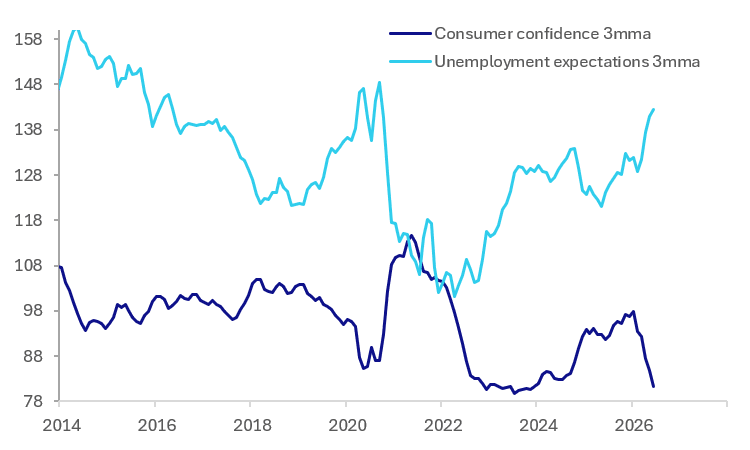
Westpac consumer sentiment for June fell 2.9% to 80.6, only slightly above April’s recent low, as cost-of-living concerns remain at the fore. Concern about the medium-term economic outlook also weighed on confidence and house price expectations moderated given the budget’s tax changes. Opinion polls are showing a growing discontent with governance and Australia’s direction. The RBA is monitoring surveys closely but is also very aware that often what consumers say and what they do are different.
- Westpac expects the RBA to pause in June but given underlying inflation remains above the top of the 2-3% band, it continues to project further tightening.
- Westpac notes inflation pressures are weighing on households’ assessments of family finances. Compared to a year ago the assessment fell 7.5% and the outlook a year ahead is -8.5%.
- Consumers are significantly more concerned about their financial future than usual and it is not just a rates story as the RBA’s observation that it now has “space” to monitor events drove mortgage rate expectations down 4.8%. Around two thirds of respondents now expect higher rates over the coming year down from 74% in May.
- There was high recall of news on inflation and budget & taxation and 85% reported the former as negative and around 70% the latter.
- Unemployment expectations were steady above the historical average but below April’s recent high.
Australia Westpac consumer confidence vs unemployment expectations 3-mth ma
Source: MNI - Market News/LSEG
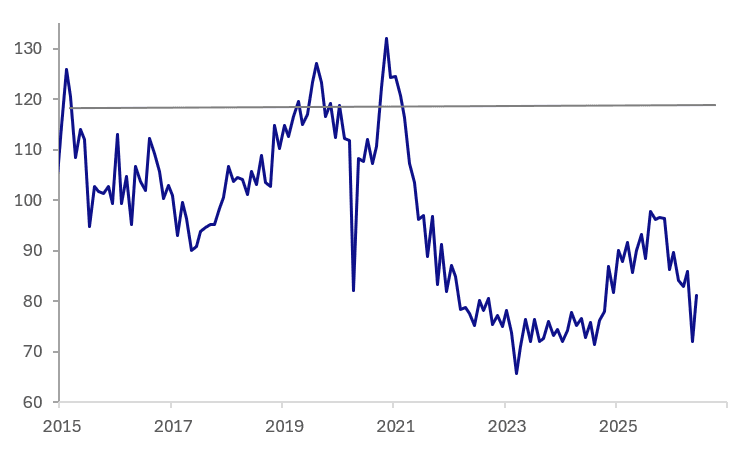
- While house price expectations fell 14.9% in June, time to buy jumped 12.6%, likely as a result of more favourable price outlook. Housing seen as an investment at 4.5% is now its lowest since the series began in 1974.
Australia Westpac time to buy a dwelling
Source: MNI - Market News/LSEG
AUSTRALIA: Inflation & Unemployment Fears Keeping Confidence Depressed
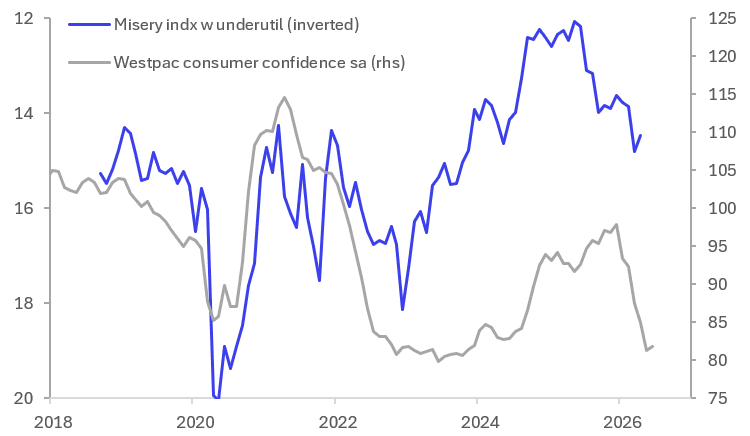
Australia’s “misery index” began to improve in 2023 and continued until mid-2025 but it then began to deteriorate with the pickup in inflation, which was partly due to base effects from the expiry of government electricity rebates but also rising price pressures as demand exceeded supply. How consumers perceive labour market conditions and inflation impacts their overall sentiment even though it can sometimes be with a lag. Therefore, it was unsurprising that seasonally-adjusted Westpac consumer confidence began to deteriorate even though it wasn’t until January but before the onset of the Iran War and associated fuel price rise. Labour underutilisation had also started trending higher. In June Westpac noted that cost-of-living concerns remain at the fore and so confidence also remained lacklustre. Unemployment expectations were stable but above the historical average.
Australia misery index vs consumer confidence
Source: MNI - Market News/LSEG
AUSTRALIA DATA: NAB Business Survey - Upside Inflation, Downside Growth Risks
There seemed some stabilisation in the private sector in May with NAB business conditions stable at +3 and confidence improving substantially to -14 from -23. However, Q2 averages are signalling growth slowed in the quarter. Price/cost increases moderated from April but remained elevated compared to pre-Iran War rates and are signalling upside risks to Q2 CPI. The RBA remains alert to signs of a greater or faster pass through of higher costs to consumers and while the NAB survey shows some easing in the size of price rises they remain inconsistent with the inflation target.
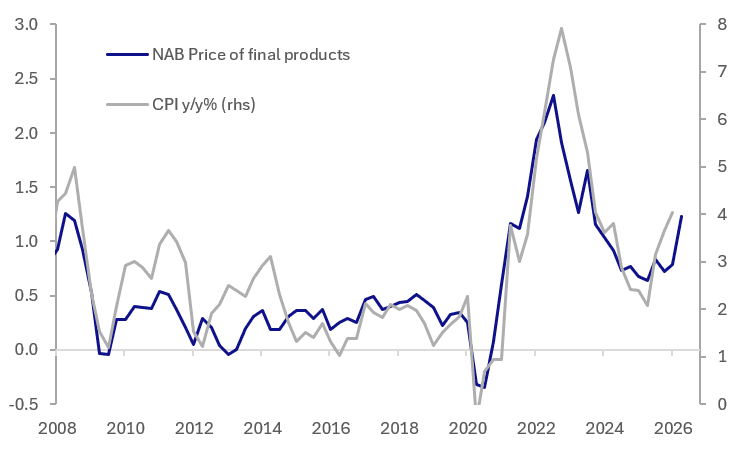
- In terms of costs, labour costs moderated to 1.5% 3m/3m from 1.7%, while purchase costs were still strong at 2.6% 3m/3m but down from April’s 4.5%. Retail price rises remained elevated at 1.5% 3m/3m compared with the Q1 average at 0.6% and final product prices at 0.9% compared to Q1’s 0.8%.
Australia NAB final product prices vs CPI y/y%
Source: MNI - Market News/LSEG
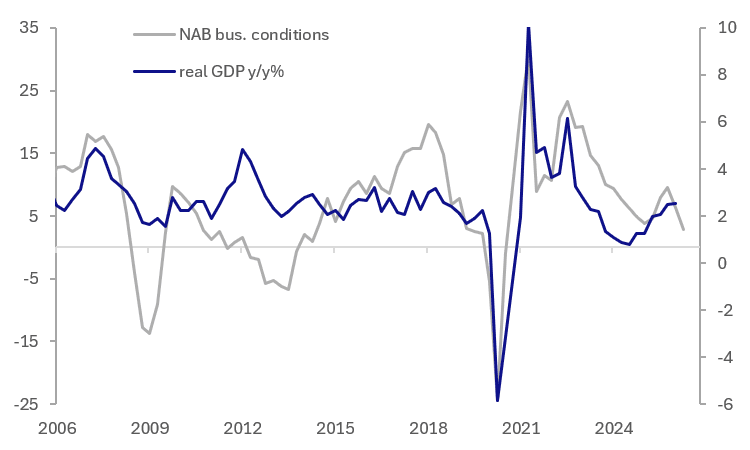
- Business conditions rose slightly to 3.0 from 2.8 helped by better trading conditions (+0.7pp to 7.9) and employment (+0.4pp to 1.6) while profitability deteriorated (-0.7pp to -0.7 – the first negative in a year). The survey suggests hiring slowed in Q2.
- The outlook remained negative with forward orders at -0.4 but that was better than both March and April. Export sales improved to +3.2 from April’s -10.3, the best since January and suggesting some global economic resilience. Exports were also positive at +0.7 after -1.8.
Australia NAB business conditions vs GDP y/y%
Source: MNI - Market News/LSEG
NEW ZEALAND: Strong Q1 Manufacturing Growth, RBNZ Forecasting 1% q/q Q1 GDP
There was a strong rise in Q1 manufacturing volumes, which with a solid rise in real retail sales and export volumes in the quarter should support GDP growth which is released 18 June. The RBNZ has a 1% q/q Q1 increase in its May forecasts as most of the quarter occurred before the onset of the Iran War. It is likely to be felt in Q2 though with the RBNZ expecting growth to be flat on the quarter.
- Manufacturing volumes rose 3.6% q/q after falling 0.4% q/q in Q4. The volume of inventories in the sector increased 3.0% q/q.
- Total business sales values rose 5.3% y/y in Q1 with 11 of the 14 sectors posting rises but manufacturing (+2.8% q/q & 3.9% y/y), retail & accommodation (+2.2% & 5.9%) and wholesale trade (+3.8% & 8.8%) drove the improvement. Profits were up 11% y/y while salaries and wages increased 2.9% y/y.
BONDS: NZGBS: Closed Richer At Session Bests Despite Strong Mfg Data
NZGBs closed richer and session bests, with benchmark yields 4bps lower.
- MNI - There was a strong rise in Q1 manufacturing volumes, which with a solid rise in real retail sales and export volumes in the quarter should support GDP growth which is released 18 June. The RBNZ has a 1% q/q Q1 increase in its May forecasts as most of the quarter occurred before the onset of the Iran War. It is likely to be felt in Q2 though with the RBNZ expecting growth to be flat on the quarter.
- The NZ-US 10-year yield differential is flat, the lowest since November.
- Cash US tsys are ~1bp richer in today's Asia-Pac session after finishing Monday's session showing a modest bear-steepener, with benchmark yields 1-4bps higher. Traders have resumed pricing in a quarter-point Fed hike by year-end due to a stronger-than-expected labour market and higher inflation. The focus is on May CPI data on Wednesday.
- RBNZ-dated OIS pricing is little changed across meetings. 22bps of tightening is priced for July, while February 2027 assigns 88bps.
- Tomorrow, the local calendar will be empty until Friday’s release of BusinessNZ Manufacturing PMI and Net Migration data.
- On Thursday, the NZ Treasury plans to sell NZ$225mn of the 3.00% Apr-29 bond and NZ$225mn of the 3.50% Apr-33 bond.
FOREX: USD - BBDXY Needs To Hold Break Above 1205 To Build For A Move Higher
The BBDXY has had a range today of 1209.81 - 1211.72 in the Asia-Pac session; it is currently trading around 1209, -0.15%. The USD is looking to consolidate and then build on its break back above 1205 from last week. The market is much more comfortable selling US dollars, but with a rate hike now being priced in and red flags appearing in the stock market the Bears are being forced to reduce exposure. On the day, the break above 1205 looks meaningful and could keep the USD supported on dips in the short-term. The first support is back toward the 1205-1207 and then the 1200 area, should this break higher be sustained then I would look for momentum to build for a test back toward the 1220-1230 area at some point.
- EUR/USD - Asian range 1.1527-1.1548, Asia is currently trading 1.1545. The pair has broken the support seen just below the 1.1600 area as the USD breaks its trend lower. The market continues to be more comfortable selling US dollars, but this break lower will not be sitting comfortably with them for the moment. The USD will need to sustain and build this break higher for the move lower in the Euro to extend. On the day, the first resistance is back toward the 1.1570-1.1600 area, while the price holds below 1.1650-1.1700 I would be skewed toward another test of the 1.1400-1.1500 support area.
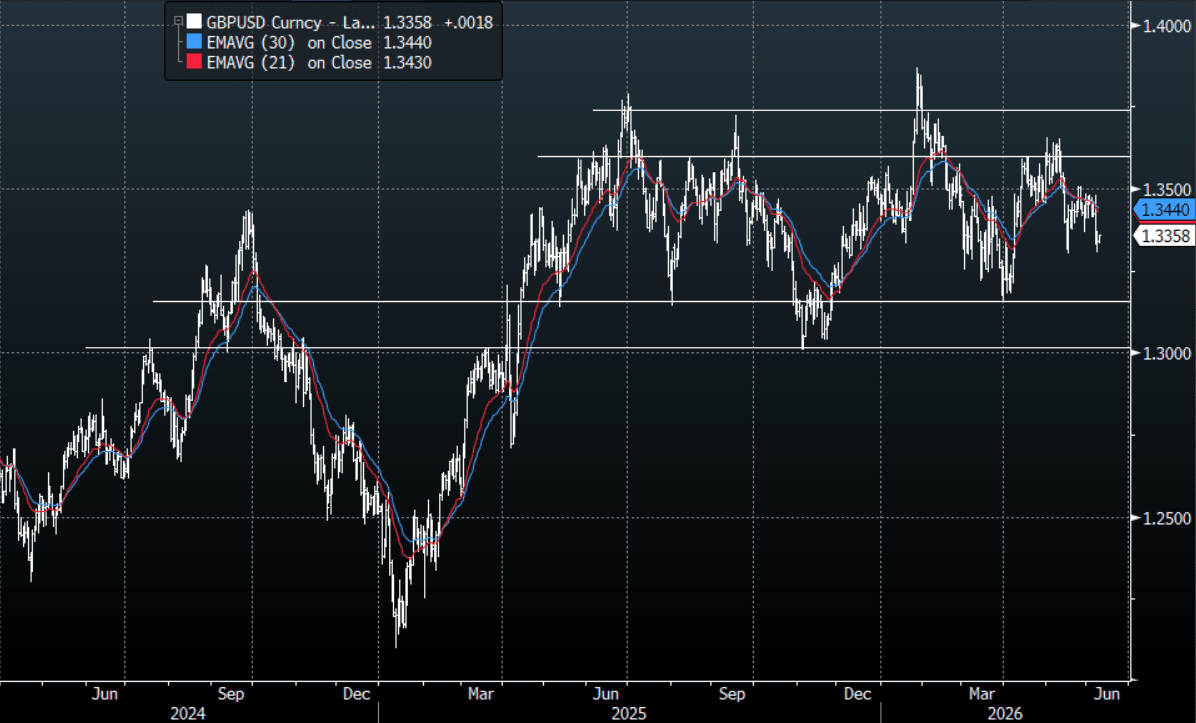
- GBP/USD - Asian range 1.3331-1.3361, Asia is currently dealing around 1.3360. The pair has rejected the 1.3500 area again and is looking to test the previous lows toward 1.3300. On the day, I would continue to be skewed toward fading rallies. The first resistance is toward 1.3390-1.3420 and then the 1.3500 area. Sterling Bears will be looking for this to top out again somewhere up here and have another test of the 1.3300 support. A sustained break below here implies a move back toward the 1.3000-1.3150 area.
- Data/Events: Germany April Industrial Production, US April Trade Balance
Fig 1: GBP/USD Spot Daily Chart
Source: MNI - Market News/Bloomberg Finance L.P
JPY: USD/JPY - Looking For A Foothold Above 160
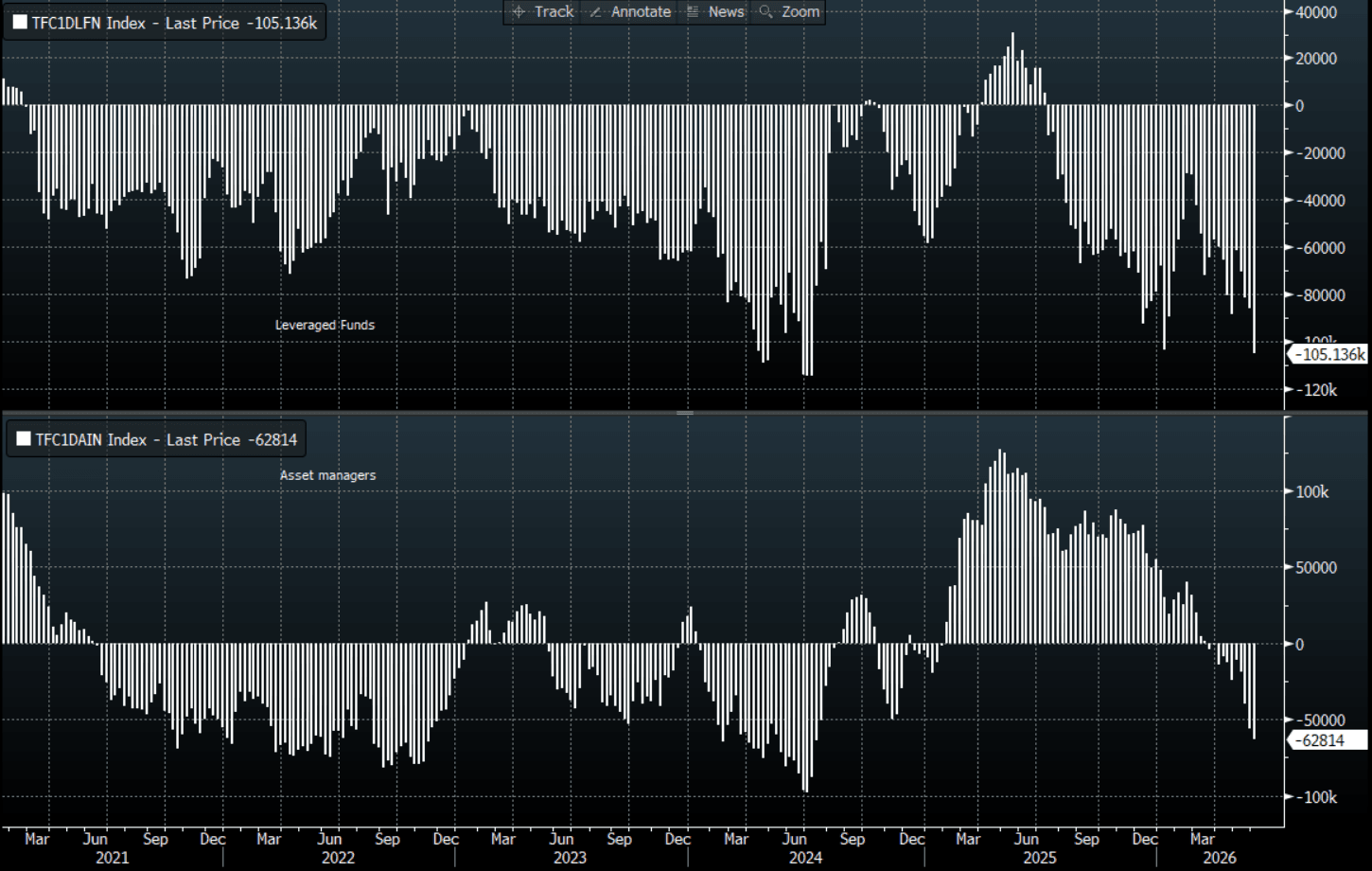
The USD/JPY range today has been 160.13-160.28 in the Asia-Pac session, it is currently trading around 160.20. The pair remains well supported on dips and is now attempting to get a foothold above the MOF/BOJ “line in the sand”, almost taunting them to come back in. The MOF/BOJ have shown they are willing to back up their previous selling and have seemingly drawn a line in the sand above 160 which is keeping the Yen bears at bay for the moment. A move back above 160-161 would be problematic for them as it could see the pair begin to accelerate higher if they are not around to stop it. On the day, the first support is toward 159.50-159.00 and then the 158.00 area. The pullbacks have been few and far between and CFTC positioning shows the market is again sitting very short Yen as they continue to press the Japanese officials resolve. The underlying story regarding Yen weakness remains the same though and core positions are reflecting that.
- Robin Brooks on X: “Japan is running out of fiscal space. It's tried everything from financial repression to using its central bank to cap yields. Both of these keep yields artificially low, which just leads to currency debasement. That's the story of the Yen in recent years.”
- CFTC Data up to 02/06/2026 shows Asset Managers continuing to add to their very newly built short Yen position, -62 814(Last -56 276). The Leveraged community did the same, adding to their already own larger core shorts, –105 136(Last -86 249).
- Options : Close significant option expiries for NY cut, based on DTCC data: 157.00($1.01b), 158.00($681m), 159.00($1.305b). Upcoming Close Strikes : 157.15($901m June 11), 160.00($1.2b June 10), 160.25($936m June 11) - BBG.
- The USD/JPY Average True Range(ATR) for the last 10 Trading days: 45 Points
Fig 1 :JPY CFTC Data
Source: MNI - Market News/Bloomberg Finance L.P
AUD/USD - Look For A Bounce Back Toward 0.7100-0.7150 To Be Faded Initially
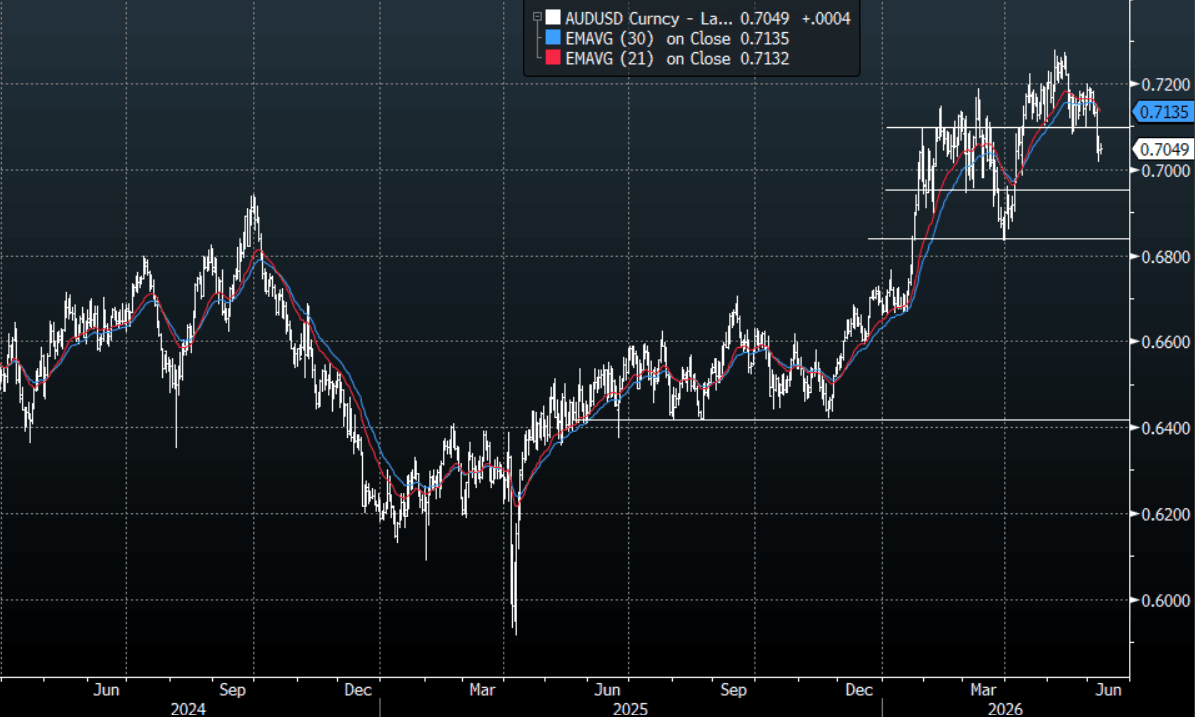
The AUD/USD has had a range today of 0.7034-0.7059 in the Asia- Pac session, it is currently trading around 0.7050, +0.05%. The AUD made a weak attempt yesterday to retrace some of Friday's break lower but remains heavy below 0.7100 for now. The Middle-East backdrop remains as fluid as ever, with Israel and Iran apparently agreeing to ease strikes against each other, though a report from the local TV station N12 stating that strikes in Lebanon would continue at full force makes you wonder how long that will last. On the day, I suspect this break below 0.7080-0.7100 should now see rallies faded in the short-term at least. The first resistance is back toward the 0.7085-0.7115 area and a leveraged market that is still long might use that area to lighten up initially. The US Dollar has broken its downtrend therefore while below 0.7100-0.7150 I would now be looking for the pair to drift back toward the 0.6850-0.6950 support where I think we could see some demand return.
- "NAB: NO LONGER EXPECT RBA TO HIKE BY 25BP IN AUG. NEXT MOVE IN CASH RATE LIKELY TO BE DOWN, TIMING UNCERTAIN. NOW SEE CASH RATE ENDING 2027 AT 3.6%" - BBG
- MNI - NAB Business Survey Signals Upside Inflation, Downside Growth Risks: There seemed some stabilisation in the private sector in May with NAB business conditions stable at +3 and confidence improving substantially to -14 from -23. However, Q2 averages are signalling growth slowed in the quarter. Price/cost increases moderated from April but remained elevated compared to pre-Iran War rates and are signalling upside risks to Q2 CPI. The RBA remains alert to signs of a greater or faster pass through of higher costs to consumers and while the NAB survey shows some easing in the size of price rises they remain inconsistent with the inflation target.
- Options : Closest significant option expiries for NY cut, based on DTCC data: 0.7050(AUD712m). Upcoming Close Strikes : 0.7050(AUD651m May 29), 0.7250(AUD655m June 11) - BBG
- The AUD/USD Average True Range for the last 10 Trading days: 51 Points
Fig 1: AUD/USD spot Daily Chart
Source: MNI - Market News/Bloomberg Finance L.P
NZD/USD - Bounces Back Above 0.5800 As Risk Gets Some Relief In Asia
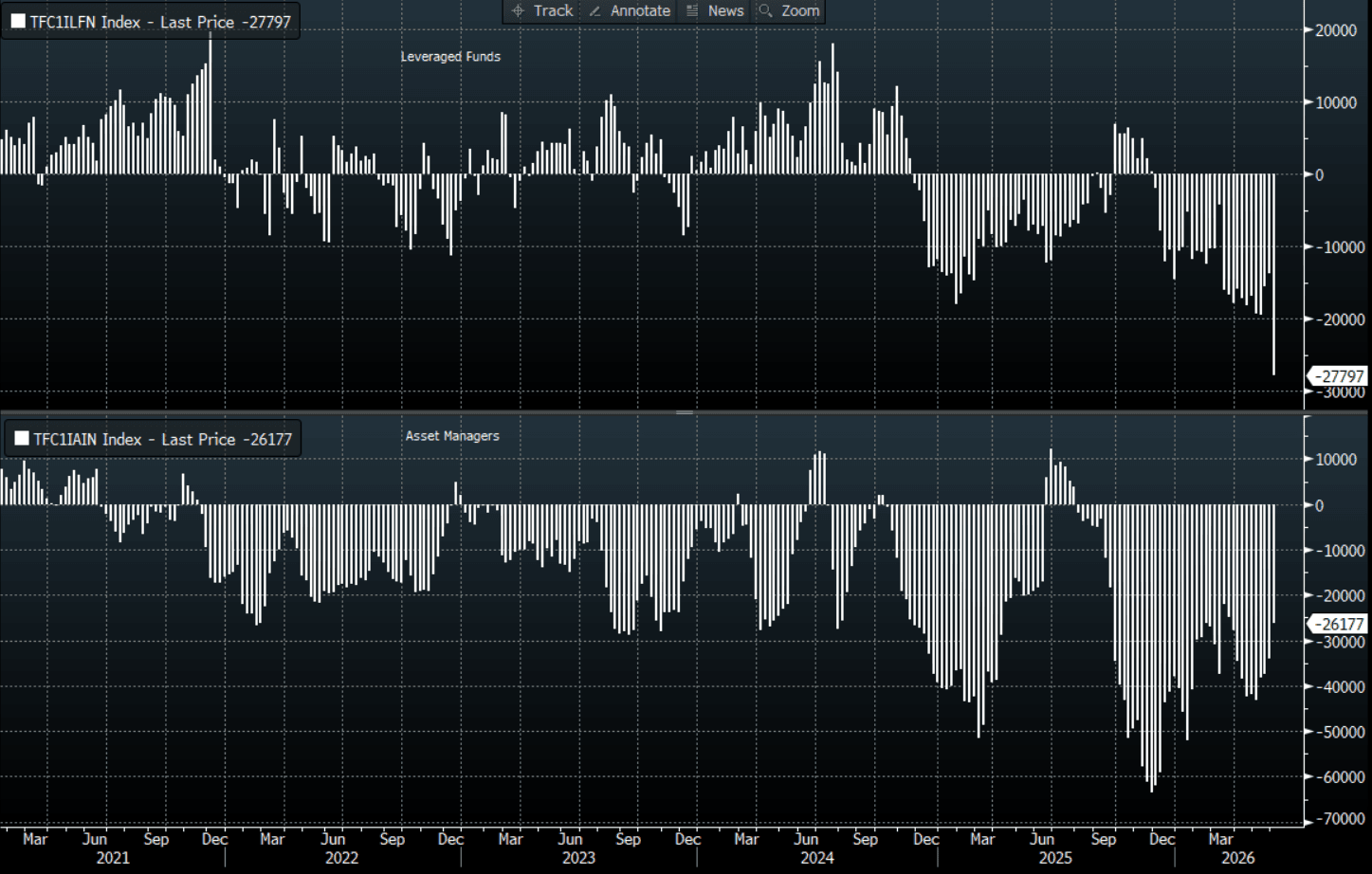
The NZD/USD had a range today of 0.5799-0.5822 in the Asia-Pac session; it is currently trading around 0.5820, +0.15%. The NZD has drifted higher as risk outperforms in Asia, looking to pare back some of the losses triggered by last week's US NFP. The NZD moved sharply lower last week after being rejected once more toward the 0.6000 area, moving very quickly back to the lows of its recent 0.5800-0.6000 range. The resurgence in the US Dollar has turned its fortunes around and the CFTC data shows the leveraged community did very well to use the bounce to reload shorts. It's still not clear that we should be piling into USD longs but I suspect that the market will be skewed toward that side in the short-term. On the day, I suspect the 0.5845-0.5875 area could see sellers initially with the bears looking to have a look below 0.5800 and then ultimately challenge the uptrend around 0.5700-0.5730.
- MNI - NZ Strong Q1 Manufacturing Growth, RBNZ Forecasting 1% q/q Q1 GDP: There was a strong rise in Q1 manufacturing volumes, which with a solid rise in real retail sales and export volumes in the quarter should support GDP growth which is released 18 June. The RBNZ has a 1% q/q Q1 increase in its May forecasts as most of the quarter occurred before the onset of the Iran War. It is likely to be felt in Q2 though with the RBNZ expecting growth to be flat on the quarter.
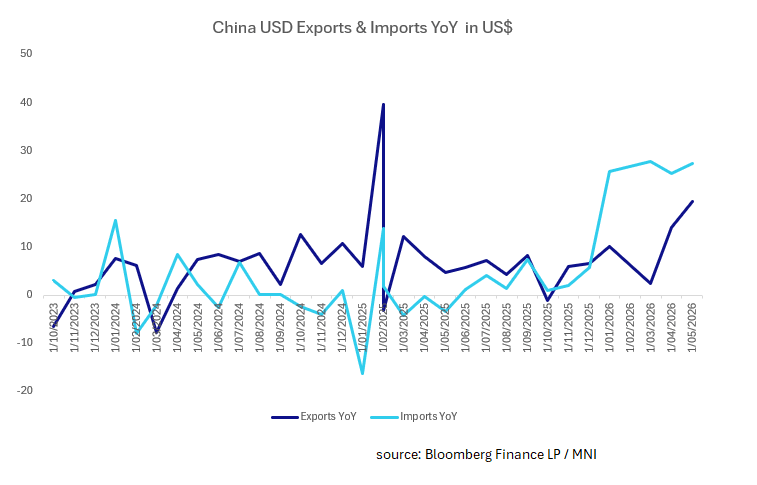
- MNI - China: Exports Top Expectations as Imports Surge. Those still holding reservations about the growing strength of China's economy may be revisiting their view on rates as May's export numbers topped expectations. May exports jumped +19.4% YoY in USD terms topping the April expansion of +14.1%. Imports surged also up +27.4% above April's expansion of +25.3%.
- CFTC Data up to 02/06/2026 shows Asset Managers continuing to reduce their core short positions in the NZD, -26177(Last -34071). The Leveraged community used the bounce to aggressively add their own shorts, -27797(Last -13767).
- Options : Closest significant option expiries for NY cut, based on DTCC data: none. Upcoming Close Strikes : 0.5500(NZD685m June 10), 0.5775(NZD460m June 10), 0.5800(NZD475m June 10) - BBG
- The NZD/USD Average True Range for the last 10 Trading days: 51 Points
Fig 1: NZD CFTC Data
Source: MNI - Market News/Bloomberg Finance L.P
ASIA STOCKS: Positive AI News Sees Sector Bounce; Major Bourses Up
After yesterday's declines Asia's major bourses have had a better Tuesday, with most major indexes delivering positive gains. The NIKKEI is up around 2% taking back around half of yesterday's losses with key AI / tech names like Tokyo Electron +10%, Advantest +5% and KIOXIA +4.6% whilst the bellwether AI stock Softbank is down -2.2%.
The oversubscription of SpaceX's IPO and the Nvidia / SK Hynix deal was enough to re-ignite the interest in the super hot sector.
The KOSPI grasped onto the SK Hynix news and is up +7.6% recovering over 90% of yesterday's losses. Unsurprisingly SK Hynix +9% and Samsung +4.6% led the way despite of news of potential troubles in the newly launched leveraged AI tech ETF markets. A leveraged exchange-traded fund tracking SK Hynix Inc. deviated sharply from the underlying stock’s move for a second day, underscoring the risk of investing in such products.
Onshore China is posting strong gains today as economic data points to the growing strength of the economy. Exports in May jumped +19.4% YoY whilst signs that the domestic economy is improving showed up in stronger than expected Imports at +27.4% YoY. AI stocks are performing strongly as the government released a plan on accelerating development of data sets to support AI deployment across industries including manufacturing, finance, healthcare, education, as well as emerging areas such as embodied intelligence, intelligent driving.
After falling near 15% over the last four trading days, bargain hunters stepped in today in Indonesia and the JCI is up +5.3%, despite bonds and the Rupiah remaining on a knife edge.
ASIA STOCKS: SK Outflows Stabilize, Outflow Pressures Elsewhere
Offshore investors remain a focus point for South Korea. Yesterday actually saw a very modest inflow, see the table below. Whilst it only slightly positive it was the first positive inflow day since May 6 of this year. Yesterday's price action in the Kospi/Kosdaq was very poor (off 8%). As we have noted recently, very strongly selling pressures in recent months has been attributed to the outperformance of local tech bellwethers Samsung and SK Hynix, which has forced portfolio rebalancing flows. Is this a sign that such outflow pressures are starting to dissipate? Today's market is rebounding, the Kospi up +3.4%. BBG's NBUY function has foreign outflows so far today (around $350mn). The KRW continues to rally, with USD/KRW back to 1515/20, up a further 0.70% in won terms, as the authorities step up efforts against one-sided depreciation pressures, while National Pension Service (NPS) FX Hedging has also risen.
- Elsewhere, we have seen Taiwan net outflows pick up in recent sessions. In the US the SOX index has pulled back sharply from the 14k level, although was stronger in Monday US trade. As we noted earlier, the AI trade has run into a market that is starting to take notice of inflation and the NFP print last week is now forcing it to consider a potential rate hike. The Taiex is up today, but will be a watch point for these themes.
- Elsewhere Indian equity outflow pressures remained fairly consistent to last Friday. The RBI has stepped up efforts to curb rupee weakness, but local markets remain under pressure. The Nifty isn't too away from a downside 23k test.
- In South East Asia, the outflow theme remains consistent, with only Thailand positive YTD from a net inflow standpoint.
Table 1: Asian Markets Net Equity Flows
| Yesterday | Past 5 Trading Days | 2026 To Date | |
| South Korea (USDmn) | 22 | -10179 | -75836 |
| Taiwan (USDmn) | -2465 | -6040 | -6994 |
| India (USDmn)* | -872 | -3071 | -28992 |
| Indonesia (USDmn) | -25 | -301 | -3589 |
| Thailand (USDmn) | -107 | 70 | 740 |
| Malaysia (USDmn) | -43 | -303 | -511 |
| Philippines (USDmn) | -12 | -8 | -249 |
| Total (USDmn) | -3502 | -19833 | -115431 |
| * Data Up To June 5 |
Source: Bloomberg Finance L.P./MNI
OIL: Crude Lower On Renewed Hopes, China Fuel Imports Down Sharply
Oil prices are trending lower again in today’s APAC session as hopes cautiously rise that there will be a US-Iran deal that allows the Strait of Hormuz to reopen since Iran and Israel have halted tit-for-tat strikes. President Trump told reporters that talks are continuing and that US-Iran are approaching a “good deal” but Iran’s stance will be clearer in a couple of days. He said that the US blockade of Iran holds and has been more effective at getting close to an agreement rather than military strikes.
- Brent is down 0.8% to $93.52/bbl but off the intraday low of $93.11. WTI is down 1.3% to $90.14 after breaking below $90 briefly.
- China’s May trade data showed a 29% y/y decline in crude import volumes to their lowest level since October 2017 as higher prices and scarcer supplies reduced demand. Refined petroleum import volumes were also very weak down 58.1% y/y to their lowest level since March 2002. More refined products are staying onshore as China banned all exports in March in response to fuel shortages following the onset of the Iran War.
- The consumption of existing global oil inventories has helped to fill the hole left by the impact on oil supplies of the closure of Hormuz. Later US industry-reported stock data for crude and refined products are released.
- US weekly ADP employment, May NFIB small business optimism, April trade, May existing home sales, Canada’s April trade and Germany’s April trade & IP are released. Later ECB President Lagarde speaks.
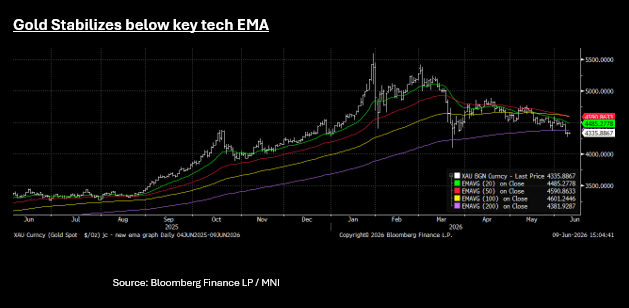
Gold Trades Sideways Ahead of US's May CPI
- Gold has done very little in the Asia trading day and is near to US$4,334 currently and relatively unchanged.
- Gold benefitted in 2025 from expectations of rate cuts and now as US yields head higher on oil related inflation concerns, gold seems to be losing its lustre for investors.
- From a technical perspective, gold prices are somewhere not seen for some time - below the 200-day EMA - for the first time since October 2023. This is widely viewed as confirmation that the multi-year bullish momentum has stalled, flipping the intermediate trend to bearish.
- Expectations in the US for the next move in rates to be higher is the key determinant here. This morning as uncertainty reigns in the Iran war, oil prices are rising which has of late fed through to higher US yields.
- The next major hurdle for the bond market and by default gold, is the May CPI out this week. Expectations are that following April's jump to +3.8%, May could see a further increase to +4.2%, adding to the hawkish outlook.
- One potential factor that may cap immediate, further declines in gold is that it is approaching oversold on the 14-day relative strength index. At 34 on the 14RSI, the sellers (bears) are in charge but could see momentum for lower moderate closer to oversold.
CHINA: Exports Top Expectations as Imports Surge
- Those still holding reservations about the growing strength of China's economy may be revisiting their view on rates as May's export numbers topped expectations.
- May exports jumped +19.4% YoY in USD terms topping the April expansion of +14.1%
- Imports surged also up +27.4% above April's expansion of +25.3%
- Exports to the US jump +35.6% YoY to US$39bn whilst Imports from the US rose +20.2% to US$13bn. The accompanying trade surplus widened to US$26bn from $23bn in April.
- China's export sector, driven by surging global demand for high-tech products, is expected to remain robust in the second half, which will provide strong support for the country's economic growth as the recent thaw in trade relations between China and US could help reduce uncertainty over external demand in the months to come.
- A surge in shipping costs between China and US points to the ongoing strength of demand for trade between the world's two biggest economies.
- From a country perspective imports were relatively consistent from the month prior with goods from South Korea topping US$26bn as the AI boom permeates throughout the region.
- The strength in exports is likely to continue into the near term and pushes out any expectations for monetary policy changes. We see limited likelihood for monetary policy changes in Q3, with fiscal policy the main tool for supporting growth for now.
SOUTH KOREA: Q1 GPD Revised Up: Eyes Turn to July BOK
- Korea's economy grew at the fastest pace in more than 5 years in the Q1, supported by strong exports and better domestic demand.
- GDP was revised up to +1.8%, 0.1 percentage point higher than the earlier estimate and the reading marked the strongest quarterly growth since the third quarter of 2020, when the economy expanded +2.3 percent.
- YoY the economy expanded +3.8%, a sharp pickup from the +1.6 percent growth recorded in Q4 and the highest since the fourth quarter of 2021, when the economy grew +4.5% for the full year.
- The BOK said the upward revision to Q1 GDP came as updated statistics related to facility investment and private consumption were reflected in the latest figures. Asia's fourth-largest economy contracted 0.1 percent on-quarter in the fourth quarter of 2025 due to sluggish manufacturing.
- Rising global demand for artificial intelligence (AI) infrastructure boosted demand for semiconductors, pushing up the country's exports by +5.9 percent -- the highest increase since the third quarter of 2020 -- and facility investment by 6.6 percent, marking the strongest growth in four years.
- The central bank earlier revised up its 2026 growth estimate to 2.6 percent, citing solid exports driven by a semiconductor super cycle.
- Based on solid economic growth, the BOK has shown signs of a possible rate hike in the near future. The central bank's upcoming rate-setting meeting is slated for July and currently our KRW swaps model point to a rate hike.
INDONESIA CENTRAL BANK: BI Hikes Rates To 5.50%
' INDONESIA C.BANK RAISES BENCHMARK INTEREST RATE BY 25 BPS TO 5.50% ON MEETING ON JUNE 9
INDONESIA C.BANK RAISES DEPOSIT FACILITY RATE BY 25 BPS TO 4.50%" RTRS
INDONESIA: BI Surprises with Rate Hikes, Doubles Down on Rupiah Support
- The Bank Indonesia broke cycle and raised rates today by 25bps - despite a central bank meeting scheduled for June 18.
- Commentary out of the BI's surprise move focused on the need to keep inflation in targets, attract foreign flows and to strengthen Rupiah stability.
- The move has caught markets offside with USDIDR down -88 to be near 18,090 / 18,108 after Monday's close of 18,181.
- The JCI has fallen back after posting very strong gains. Having been up +5.3% earlier, profit takers have stepped in and it is currently up +4.8%.
- Front end bond yields have moved aggressively higher with the 3-Yr +10bps to 7.36% and the 5-Yr +13bps to 7.477%.
- The BI has raised the interest rate on the O/N deposits by 25bps and has stated it intends to keep raising SRBI rates across all tenors.
- The BI states it intends to intensify monetary operations of Rupiah, FX and intends to re-open Repo Auctions for 3,6,9,12 month tenors.
- In another attempt to stop the Rupiah's falls the market will yet again be left to decide whether this is enough. Credibility is at test here with deep seated concerns about CB independence and fiscal prudence at the core of the concerns.
- If the Rupiah fails to post gains on the back of this it could lead to further capitulation for investors and a broader more systemic sell off.
UP TODAY (TIMES GMT/LOCAL)
| Date | GMT/Local | Impact | Country | Event |
| 09/06/2026 | 0600/0800 | ** |  DE DE | Trade Balance |
| 09/06/2026 | 0600/0800 | ** | DE | Industrial Production |
| 09/06/2026 | 1000/0600 | ** |  US US | NFIB Small Business Optimism Index |
| 09/06/2026 | 1200/0800 | * | US | NY Fed SOFR |
| 09/06/2026 | 1215/0815 | *** | US | ADP Employment Report |
| 09/06/2026 | 1230/0830 | ** | US | Trade Balance |
| 09/06/2026 | 1230/0830 | ** | US | Trade Balance |
| 09/06/2026 | 1230/0830 | ** |  CA CA | International Merchandise Trade (Trade Balance) |
| 09/06/2026 | 1255/0855 | ** | US | Redbook Retail Sales Index |
| 09/06/2026 | 1300/0900 | * | US | NY Fed EFFR |
| 09/06/2026 | 1400/1000 | *** | US | NAR existing home sales |
| 09/06/2026 | 1400/1000 | ** | US | Wholesale Trade |
| 09/06/2026 | 1400/1000 | ** | US | Wholesale Trade |
| 09/06/2026 | 1530/1130 | ** | US | US Treasury Auction Result for 52 Week Bill |
| 09/06/2026 | 1700/1300 | *** | US | US Note 03 Year Treasury Auction Result |
| 09/06/2026 | - |  EZ EZ | European Central Bank Meeting | |
| 09/06/2026 | - | CA | Bank of Canada Meeting | |
| 10/06/2026 | 0130/0930 | *** |  CN CN | CPI |
| 10/06/2026 | 0130/0930 | *** | CN | Producer Price Index |
| 10/06/2026 | 0600/0800 | ** |  SE SE | Private Sector Production m/m |
| 10/06/2026 | 0600/0800 | *** |  NO NO | CPI Norway |
| 10/06/2026 | 0700/0300 | *** |  CZ CZ | Czech Republic Final CPI |
| 10/06/2026 | 0800/1000 | * |  IT IT | Industrial Production |
| 10/06/2026 | 1100/0700 | ** | US | MBA Weekly Applications Index |
| 10/06/2026 | - | *** | CN | Money Supply |
| 10/06/2026 | - | *** | CN | New Loans |
| 10/06/2026 | - | *** | CN | Social Financing |
| 10/06/2026 | 1200/0800 | * | US | NY Fed SOFR |
| 10/06/2026 | 1230/0830 | *** | US | CPI |
| 10/06/2026 | 1230/0830 | *** | US | CPI |
| 10/06/2026 | 1230/0830 | *** | US | CPI |
| 10/06/2026 | 1230/0830 | *** | US | CPI |
| 10/06/2026 | 1230/0830 | *** | US | CPI |
| 10/06/2026 | 1300/0900 | * | US | NY Fed EFFR |
| 10/06/2026 | 1345/0945 | *** | CA | Bank of Canada Policy Decision |


