JPY: Ueda Leans Toward Hikes, But Timing Signal More Neutral
So no explicit signal of a June hike in the Ueda comments - while the balance of comments certainly err toward rate hikes, there is less evidence that the tightening must occur in the very near-term. In particular, he stresses the BoJ's sensitivity to second-round inflation - meaning the BoJ may have to wait for firmer evidence. USDJPY now middle of the day's range, well off the earlier 159.37 low.
Could be read as Pro-June hike:
- Basic stance is to continue raising policy rate, will continue to raise rates at appropriate pace if baseline scenario rises in likelihood
- Japan has changed - deflationary mindset dispelled, wage-price-setting behaviour more active now
- CPI likely to rise "significantly", pass-through from crude is "faster than before, more prone to spreading"
- If we delay necessary response, could be forced to raise rates more sharply
Could be read as worth waiting beyond June:
- It will be necessary to thoroughly discuss pros and cons of raising rates
- This year's oil price rise not as large as first oil crisis, comparable in magnitude to other shocks
- Typical response to supply shock is not to respond with monetary policy (although acknowledges reality is not that simple)
- If there is a chance of 2nd round effects, BoJ must consider taking action (suggests awaiting further evidence)
- Second-round inflation effects more easily lead to underlying inflation, and upside risks "appear" greater overall according to data and anecdotal info so far
Want to read more?
Find more articles and bullets on these widgets:
Historical bullets
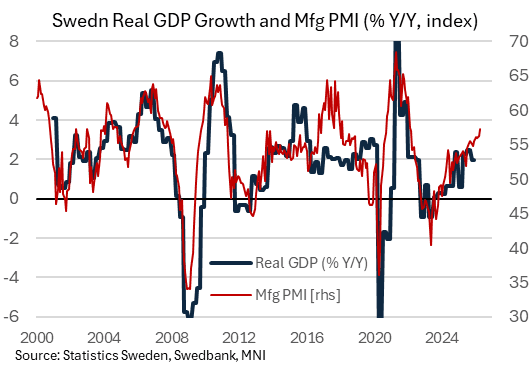
SWEDEN: Manufacturing PMI Hits Fresh High Since 2022, Raw Material Prices Surge
- The Swedbank manufacturing PMI pushed higher in April to 57.2, after three months between 56.1-56.2, for a fresh high since 2022.
- Activity was supported by a strong acceleration in orders, somewhat echoing European and US surveys where orders jumped in a bid to get ahead of Iran war-related price increases. However, in Sweden it was only going back to where orders were running at before the Middle East conflict: 59.4 in Apr after 54.2 in Mar, 59.5 in Feb and 59.6 in Jan after readings generally in the 56-57 region through 2H25.
- Against that, production eased somewhat to 57.6 (-0.8pts) for technically its lowest since September although still clearly a robust pace.
- There were clear signs of growing inflationary pressures as well, with the raw material prices index jumping 11.5pts to a particularly elevated 81.3 vs 58.3 pre-war in Feb whilst the delivery times index climbed 4.7pts to 64.3 for also a new recent high.
ECB: ECB SPF Not So Sure On Moving Away From Baseline, With Survey Date Caveat
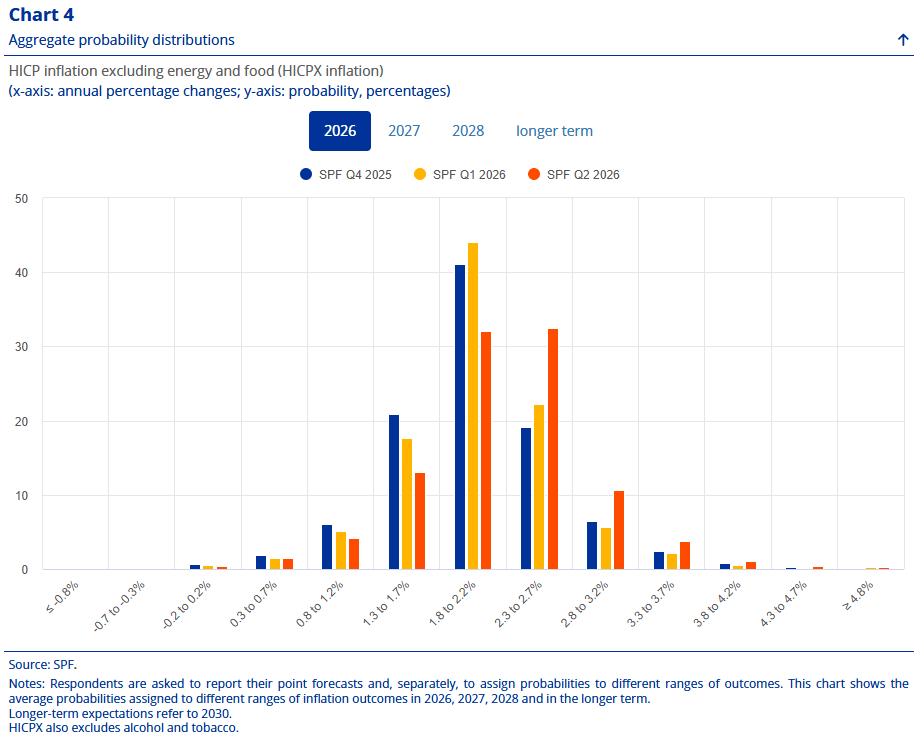
The ECB’s Survey of Professional Forecasters (SPF) for Q2 revealed forecasts that were very close to the ECB’s baseline scenario rather than drifting towards the higher inflation/lower growth adverse and severe scenarios outlined at the March projection meeting.
- Senior ECB members have generally described the developments since that March meeting as being between the baseline and adverse scenario, whilst President Lagarde at last week’s meeting concluded that “we are certainly moving away from the baseline” but wouldn’t be drawn on which outcome was looking more likely.
- The Q2 SPF survey was conducted between Mar 31 – Apr 8 (when Brent 1st futures averaged $106/bbl compared to today’s $110.5 for example) vs the Mar 11 cut-off date for the March economic projections which saw the quarterly average peaking around $90/bbl in 2Q26. Of course, oil front futures have exceeded $125/bbl in the interim with the situation still highly sensitive to peace talk rhetoric.
- We show inflation and growth forecasts compared to the pre-war Q1 surveys and more importantly the baseline from ECB staff projections below. However, to emphasise how much closer these projections are to the baseline than adverse scenarios, analysts see core HICP inflation at 2.2% in 2026 (baseline 2.3, adverse 2.4, severe 2.6), 2.2% in 2027 (baseline 2.2, adverse 2.7, severe 3.9) and 2.1% in 2027 (baseline 2.1, adverse 2.1, severe 2.9).
- Headline HICP inflation: 2.7% (1.8% prior, 2.6% ECB staff) in 2026, 2.1% (2.0% prior, 2.0% ECB staff) in 2027 and 2.0% (2.1% prior, 2.1% ECB staff) in 2028.
- Core HICP inflation: 2.2% (2.0% prior, 2.3% in ECB staff) in 2026, 2.2% (2.0% prior, 2.2% ECB staff) in 2027 and 2.1% (2.0% prior, 2.1% ECB staff) in 2028.
- Expectations for the longer term (2030) were again unchanged at 2.0% for both headline and core HICP inflation.
- GDP growth: 1.0% (1.2% prior, ECB staff 0.9%) in 2026, 1.3% (1.4% prior, ECB staff 1.3%) in 2027 and 1.3% (1.3% prior, 1.4% ECB staff) in 2028.
GERMANY: German Battery Capacity Additions Increased in Q1 2026
Germany commissioned more than 2GWh of new battery storage capacity in the first quarter of this year, according to BSW Solar.
- This was up by around 67% on the year.
- Large battery storage system installations rose by 270% on the year to more than 1GWh in Q1.
- Total battery capacity stood at around 28GWh at the end of Q1.


