USDCAD TECHS: Support Remains Intact For Now
* RES 4: 1.4292 61.8% Retracement Feb'25 - Jan'26 downleg * RES 3: 1.4264 1.618 proj of the Mar 9 - ...
Want to read more?
Find more articles and bullets on these widgets:
Historical bullets
AUDUSD TECHS: Corrective Phase
- RES 4: 0.7223 High May 15
- RES 3: 0.7149/7201 High Jun 4 / High May 29
- RES 2: 0.7088 High Jun 15 and a key short-term resistance
- RES 1: 0.6975/0.7037 20- and 50-day EMA values
- PRICE: 0.6932 @ 08:18 BST Jul 6
- SUP 1: 0.6865 Low Jun 30
- SUP 2: 0.6860 Low Apr 2
- SUP 3: 0.6833 Low Mar 30 and a key support
- SUP 4: 0.6757 38.2% retracement of the Apr 9 ‘25 - May 6 bull cyle
A bear cycle in AUDUSD remains intact and short-term gains are considered corrective. Price has recently pierced a key support marked by the base of a bull channel drawn from the Apr ‘25 low - currently at 0.6927. A clear channel breakout would highlight a stronger reversal. This would open 0.6833, the Mar 30 low and a key support. Key short-term resistance is 0.7088, the Jun 15 high.
JGB TECHS: (U6) Downside Momentum Intact
- RES 3: 133.32 - High Mar ‘26
- RES 2: 130.66 - Low Jan 21
- RES 1: 128.42/128.56 - High Jun 15 / 50-dma (cont)
- PRICE: 127.06 @ 20:35 BST Jul 06
- SUP 1: 126.85 - Low Jul 02
- SUP 2: 126.35/126.27 - 1.0% 10-dma envelope / Low may 20
- SUP 3: 125.70 - Low Feb 1999
A bearish theme in JGB futures remains intact. The latest move down suggests a recent corrective cycle is over. A continuation lower would expose 126.27, the May 20, where a break would confirm a resumption of the primary downtrend. Key near-term resistance has been defined at 128.42, the Jun 15 high. Clearance of this hurdle would highlight a possible short-term reversal and highlight a potential break of the 50-dma - at 128.56.
BOC: War Fogs Otherwise Resilient Business Outlook Survey
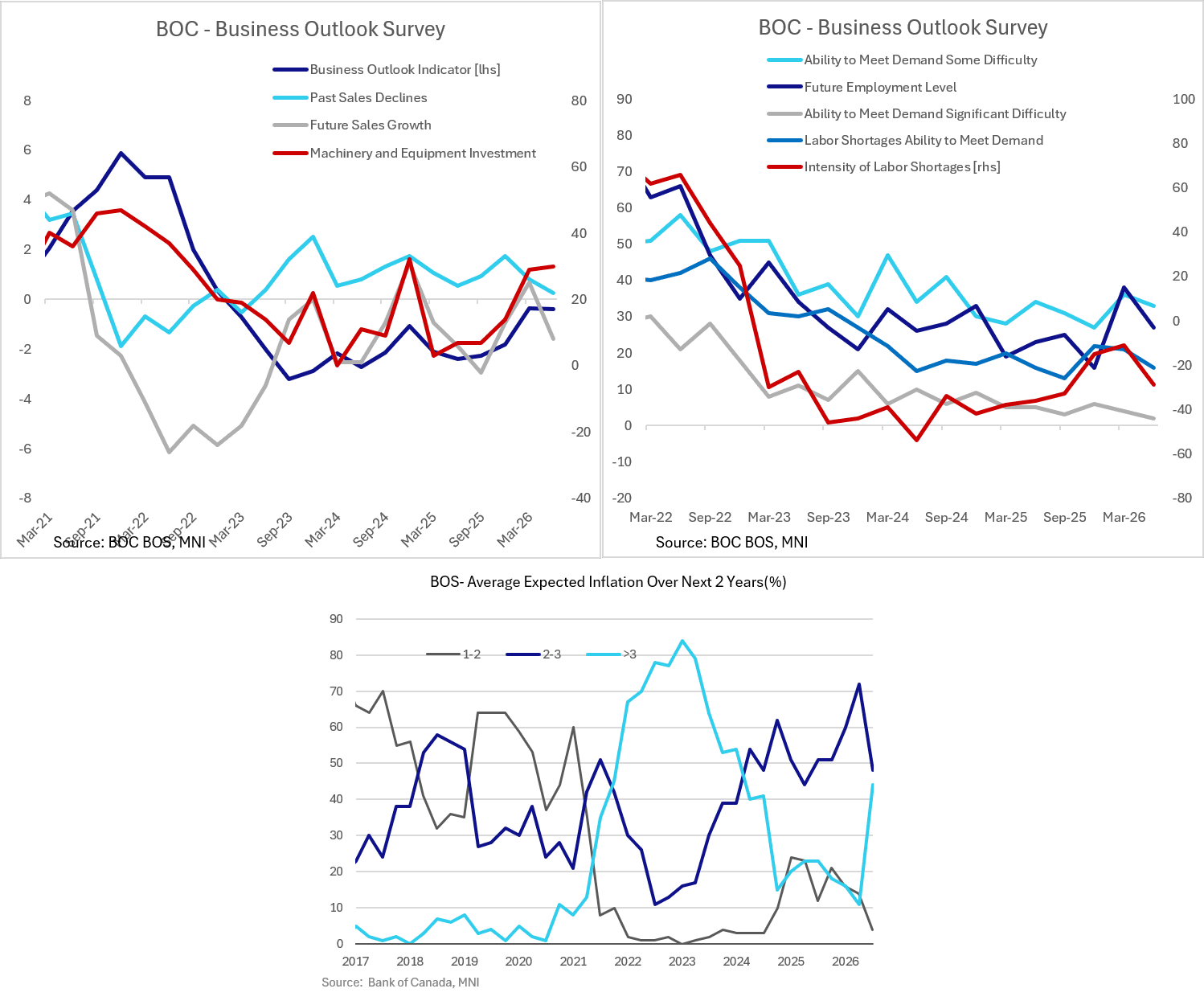
The Bank of Canada's quarterly Business Outlook Survey (BOS) for Q2 showed relative resilience in the private sector and anchored inflation expectations in a challenging period. The survey results should be considered even more stale than usual, given that the main BOS interviews were conducted in May which preceded a substantial drop in oil prices as the US and Iran reached a ceasefire memorandum of understanding (though the Business Leaders' Pulse (BLP) responses were a snapshot as of June 30, including the 5-year ahead inflation metric.). Against this backdrop, indicators of underlying strength are of particular interest since they may have been even more positive coming out the other side of the Middle East conflict. The main findings in the report:
- Business sentiment (taken from the BLP on June 30) weakened after 3 consecutive quarterly improvements. Q1 had seen the best since Q3 2022, with Q2 2026's 14% still above the nadir in Q2 2025. Expectations of future sales growth fell and current sales were negatively impacted by the war though still relatively resilient.
- Meanwhile, employment intentions are weaker than the historical average, with some slack in evidence as the overall intensity of labor shortages abated.
- Firms saw inflation at between 3.0-3.5% over the next two years; 44% of firms saw inflation of 3+%, vs 11% in the prior survey. Passthrough indications were mixed (40% are not passing on cost increases to customers with 25% partially passing them through and around one-third fully passing them on over the next 12 months). And about 1/5 of firms saw cost pressures from tariffs/trade, smaller than prior quarters.
- The report determines that "alongside this weakening in business sentiment...the activity indicator declined, largely reflecting a weaker sales outlook. Meanwhile, the BOS price indicator increased due to expectations for both higher inflation and stronger growth in input and selling prices. This divergence between the indicators is consistent with a negative supply shock associated with the war in the Middle East and with regional and sectoral differences."
- Given developments since then, the BOC will probably downplay the negative growth and upside inflation implications from this survey. Indeed re the latter, 5-year ahead inflation expectations (from the June 30 BLP) remained 2.7% which is unch on the quarter and below last year's averages, suggesting anchored expectations.
- Still, investment intentions remained robust which is a positive for future productivity, key to the BOC's expectation that real GDP growth can pick up. Here's the BOS's description of developments in investment intentions:
- "Domestic demand continues to support investment plans overall, but soft demand and lingering uncertainty are still weighing on investment plans for some firms. Productivity-related investment plans are still more prevalent than in recent years, including investments in equipment upgrades and AI integration. Routine maintenance remains the most common reason for investment spending. Elevated commodity prices are sustaining investment among firms tied to the natural resources sector, particularly oil and gas. Firms expecting increases in sales linked to public spending also have strong investment intentions."