MNI US MARKETS ANALYSIS - Two-Way Risk Into Trump Deadline
Highlights:
- Markets clearly cautious, with two-way risk evident into Trump's 8pm deadline
- Speculation of progress in negotiations undermined by IRGC's escalatory rhetoric
- Heavy Fedspeak meets busier week for data, keeping headline risk live
US TSYS: Two-Way Flows As Ceasefire Breakthrough Hopes Questioned
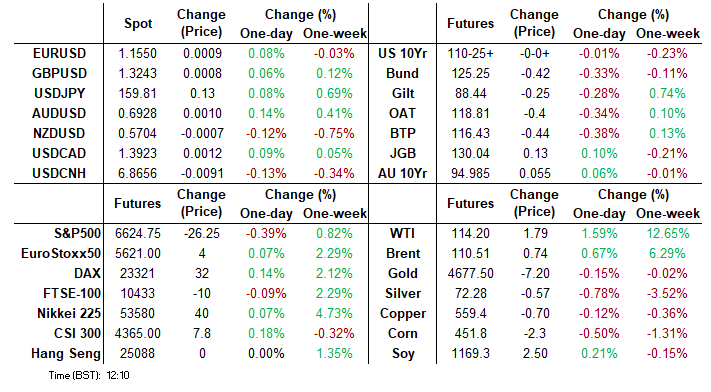
Treasuries have seen two-way trade ahead of the NY crossover, rallying on speculation of a possible "breakthrough" in ceasefire negotiations between the US and Iran before slipping on Iranian rhetoric that doesn’t suggest any de-escalation is in sight along with explosions reported on Kharg Island. It comes ahead of President Trump's perceived deadline for negotiations at 2000ET today.
- Cash yields are 0.8-1.2bp higher across the curve.
- TYM6 trades at 110-24 (-02) off an overnight high of 110-29+ although has held within Friday’s range throughout.
- Cumulative volumes are modest at 360k compared to typical overnight sessions established under the US-Israel-Iran war.
- Recent gains appear corrective, with resistance at 111-14+ (Apr 1 high) whilst a bear threat remains present with support at 110-16 (Apr 2 low) before the bear trigger at 109-24 (Mar 27 low).
- Data: Weekly ADP (0815ET), Durable goods Feb prelim (0830ET), Johnson Redbook retail sales (0855ET), NY Fed consumer survey Mar (1100ET), Consumer credit Feb (1500ET)
- Fedspeak: Williams (0830ET), Goolsbee (1235ET and 1345ET) and Jefferson (1750ET) – see FED bullet
- Coupon issuance: US Tsy $58B 3Y Note auction - 91282CQJ3 (1300ET)
- Bill issuance: US Tsy $70B 6W bill auctions
- Politics: Trump in dinner with US Ambassador to India (1900ET), Trump deadline for Iran negotiations (2000ET)
STIR: Mild Hiking Bias With Two-Way Trade On Ceasefire Talk Prospects
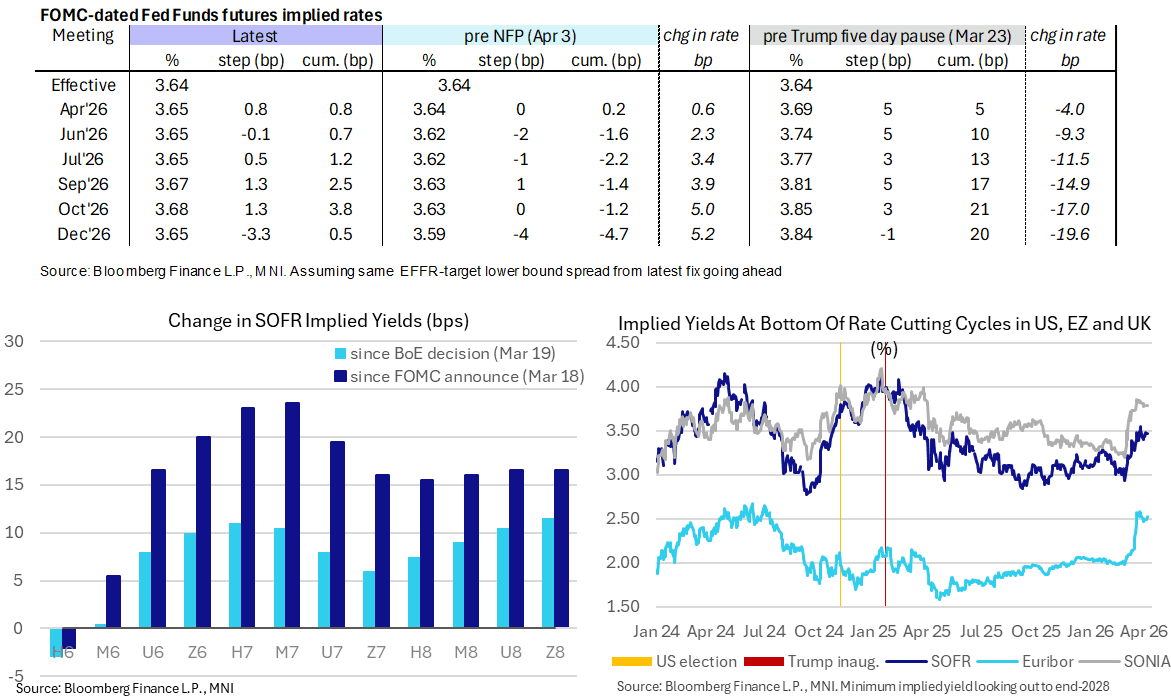
- Fed Funds futures show a very mild hiking bias for 2026 with overnight fluctuations on prospects of a breakthrough in Iran ceasefire talks ahead of President Trump’s 2000ET deadline.
- Whilst off earlier hawkish levels, it on net broadly holds yesterday’s consolidation of reaction to Friday’s solid NFP report.
- Cumulative hikes from 3.64% effective: 1bp Apr, 1bp Jun, 1bp Jul, 2.5bp Sep, 4bp Oct and 0.5bp Dec.
- SOFR futures are up to 1.5 ticks lower on the day with the SOFR terminal implied yield of 3.47% (Z7) still at the higher end of the 3.075% (Mar 2) - 3.55% (Mar 26) range for closes since initial US-Israel strikes on Iran on Feb 28.
- Today sees weekly ADP employment tracking and the NY Fed consumer survey for updates since the start of the US-Israel-Iran war although preliminary durable goods data for February will give an idea of business momentum heading into it.
FED: Two Permanent Voters To Weigh On Whether Mon Pol Still Well-Positioned
Today’s three separate Fedspeakers add to FOMC reaction to Friday’s strong NFP report, after SF Fed’s Daly said it was “really goods news” and “very welcome” as it gives the FOMC “more time” to balance dual mandate risks. We will focus on permanent voters Williams and Jefferson. They may have spoken as recently as Mar 30/26, when they viewed policy as being well-positioned, but WTI prices are another $10/15bbl higher since then in a highly fluid backdrop.
- 0830ET – NY Fed Williams (voter, leaning dove) on BBG TV. On Mar 30, he echoed Powell's commentary in saying policy is well-positioned, while noting risks to both elements of the dual mandate. Williams doesn't appear to be that concerned about the inflationary implications of the conflict in the Middle East beyond the immediate impact, reaching the 2% target by 2027, and expects the unemployment rate declining this year and next.
- 1235ET – Chicago Fed Goolsbee (’27) on mon pol (text tbd). He said on late on Apr 2 that spiking oil prices are “a pretty serious situation” as sustained and increased oil costs would be a tough shock. He had previously said on Mar 24 that the outlook for rates will depend on how long the Middle East war lasts and that he needs to see inflation progress for rates to come down.
- 1345ET – Goolsbee in WJR-AM radio interview
- 1750ET – VC Jefferson (voter) on economic outlook and labor market (text + Q&A). He said Mar 26 "The potential for an extended conflict in the Middle East adds considerable uncertainty to the global economic outlook. I continue, however, to see our current policy stance as appropriately positioned to allow us to assess how the economy evolves." […] "A short period of disruption is unlikely to have a noticeable effect on the economy beyond a quarter or two. A sustained energy price shock, however, could have material implications."
GLOBAL: Price Action Today Suggests Considerable Two-Way Risk Remains
Market moves are sticking on the earlier speculation of a possible "breakthrough" in negotiations, with the dollar extending to new daily lows and tipping EURUSD through yesterday's highs and easing oil prices back below $113.00/bbl.
- Context here is key: markets are well aware of negotiations through both official diplomatic channels in Islamabad, as well as backdoor channels - but any material progress toward a cessation in hostilities would likely be worth considerably more than 30 pips in the major pairs, and 35 points in the e-mini S&P. Possibly giving credence to the earlier social media reports is comments to Reuters from the Iranian ambassador to Pakistan, who said "positive and productive endeavours [were] approaching a critical, sensitive stage."
- This suggests there's still considerable two-way risk in markets headed into Trump's deadline today on either an extension of the conflict, or progress toward a conclusion.
- The overriding messaging from Tehran, at least publicly, has been for strict conditions to dictate any form of ceasefire - namely the introduction of a toll system for the Strait of Hormuz, as well as a withdrawal of all US and Israeli forces from the broader region. In contrast, the US position on nuclear materials and full unhindered passage of the Strait look incompatible - meaning the terms of any ceasefire will give markets sizeable insight into what shape any final settlement could take.
IRAN: USD, Yields Higher as Tehran Rejects Temporary Ceasefire
"SENIOR IRANIAN SOURCE TO REUTERS: TEHRAN HAS REJECTED ANY TEMPORARY CEASEFIRE WITH THE U.S."
- TEHRAN HAS SET PRECONDITIONS FOR TALKS WITH U.S. ON 'A LASTING PEACE
- PRECONDITIONS INCLUDE AN IMMEDIATE HALT TO STRIKES, GUARANTEES STRIKES WILL NOT BE REPEATED, COMPENSATION FOR DAMAGES
- UNDER A PERMANENT PEACE DEAL, TEHRAN DEMANDS FEES FOR SHIPS PASSING THROUGH HORMUZ STRAIT
USD and UST yields are lurching higher on these headlines - market noting the rejection of any temporary ceasefire. Little else in these headlines is new: the conditions outlined by this Tehran source look consistent with the ten-point response that Tehran issued to the peace proposals over the weekend, and again look incompatible with US demands for unhindered passage through the Strait.
- The mechanics within the White House negotiating team now look key: over several reports, POTUS himself is becoming the most hawkish on Iran (e.g. Axios: "Trump might be the most hawkish person [...] on Iran, [Hegseth and Rubio] sound like the doves compared to the president.")
- This contrasts with Vance, Witkoff and Kushner, who reportedly are supportive of a deal being struck "now if possible."
IRAN: AP: Iran Calls For 'Human Chains' Around Infra Ahead Of Trump Deadline
President Masoud Pezeshkian posts on X, "Over 14 million proud Iranians have, up to this moment, declared their readiness to sacrifice their lives in defense of Iran. I too have been, am, and will be a sacrificer for Iran." With US President Donald Trump's 20:00ET (01:00BST, 03:30 local) deadline for the reopening of the Straits of Hormuz, among other demands, Pezeshkian's comments could be viewed as an indication that swathes of Iranians will volunteer to be placed at strategic locations such as bridges and power plants. Some reports have claimed this could equate to these civilians becoming 'human chains' around these sites, to try and deter US/Israeli strikes. The use of unwilling human shields is banned under the Geneva Conventions.
- There remains major uncertainty as to the nature of any attacks on Iran if the deadline passes without Iran agreeing to US terms or if Trump does not offer an extension. These could range from targeted strikes on power plants and infrastructure, through to widespread strikes on civilian targets, to a ground invasion at Kharg Island, the Straits of Hormuz, or Iran's nuclear sites where enriched uranium is believed to be located.
EUROPE ISSUANCE UPDATE:
RAGB Results:
- E1.438bln (E1.25bln allotted) of the 3.45% Oct-30 RAGB. Avg yield 2.845% (bid-to-cover 2.48x; bid-to-issue 2.16x).
- E863mln (E750mln allotted) of the 3.20% Feb-36 RAGB. Avg yield 3.279% (bid-to-cover 3.00x; bid-to-issue 2.61x).
Green Bund Results
- E750mln (E659mln allotted) of the 2.50% Feb-35 Green Bund. Avg yield 2.93% (bid-to-offer 1.31x; bid-to-cover 1.49x).
- E750mln (E387mln allotted) of the 0% Aug-50 Green Bund. Avg yield 3.44% (bid-to-offer 0.71x; bid-to-cover 1.37x).
FOREX: AUDNZD Matches Cycle Highs with RBNZ Decision Wednesday
- After a 5% pullback in March, AUDUSD has recovered around 1.6% of this move and trades back towards 0.6950 on Tuesday, leaving the pair in consolidation mode. The bounce for NZDUSD has been less notable, with the pair remaining over 6% off the 2026 highs, and still close to the 0.5700 level as markets await Wednesday’s RBNZ decision.
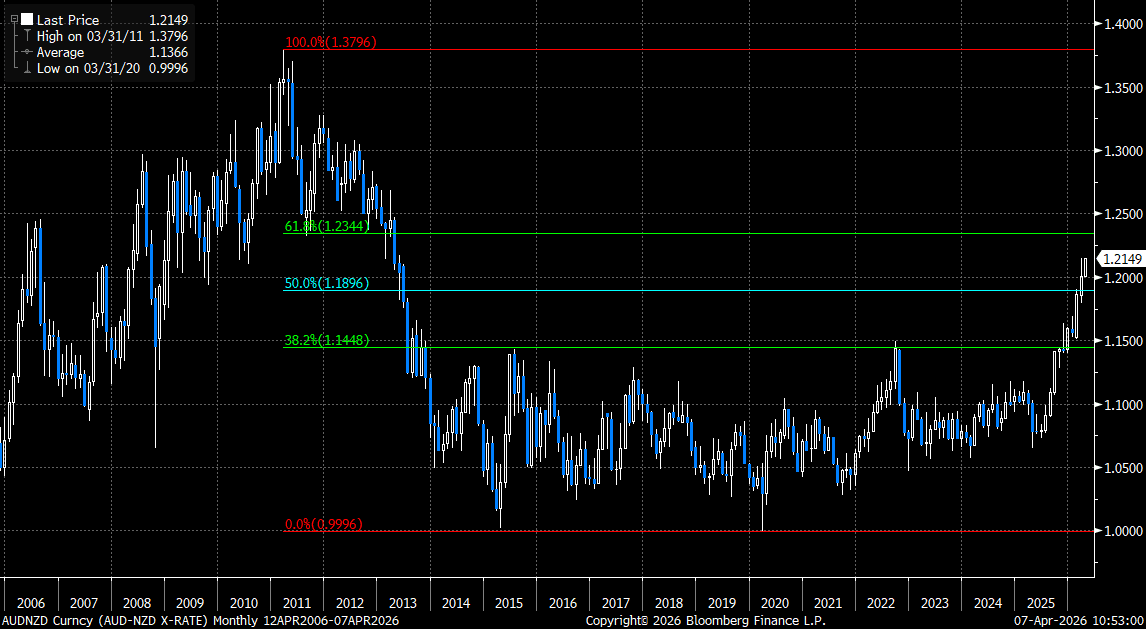
- This has translated into a steady ascent for AUDNZD in early April, with the cross matching the recent cycle highs at 1.2149 in recent trade, a break of which would place the cross at the highest level since 2013. Above here, resistance appears scant until 1.2344, the 61.8% retracement of the 2011-2020 range.
- RBNZ Governor Breman is likely to reiterate this month that given monetary policy lags, it is better for fiscal policy to respond to a supply shock, which it has with some fuel price relief. Our preview is here: https://mni.marketnews.com/4vuZT2y
- The committee could be in the difficult position where the growth outlook softens but price pressures and expectations are rising. Therefore, decisions are likely to be even more meeting-by-meeting and data dependent than usual with Q1 CPI released 21 April, Q2 inflation expectations 13 May, Q1 jobs/wages 6 May and Q1 real retail sales 22 May.
HUF: 1W HUF Vols Spike to Post-GFC Highs Amid Election and Iran Risk
Despite renewed escalation risk around Iran and fading prospects for a deal ahead of Trump’s 20:00 ET (01:00 BST) deadline, the Hungarian forint has started the week on the front foot, up ~1% versus Friday’s close. Positioning appears supportive into the weekend election, with prediction markets still assigning the opposition Tisza party a clear lead (Peter Magyar ~65% implied probability of becoming PM, per Polymarket). EUR/HUF key support at 381.55, the Mar 10 low, has been priced. A clear break would open 380.00 and 374.77, the Feb 25 low.
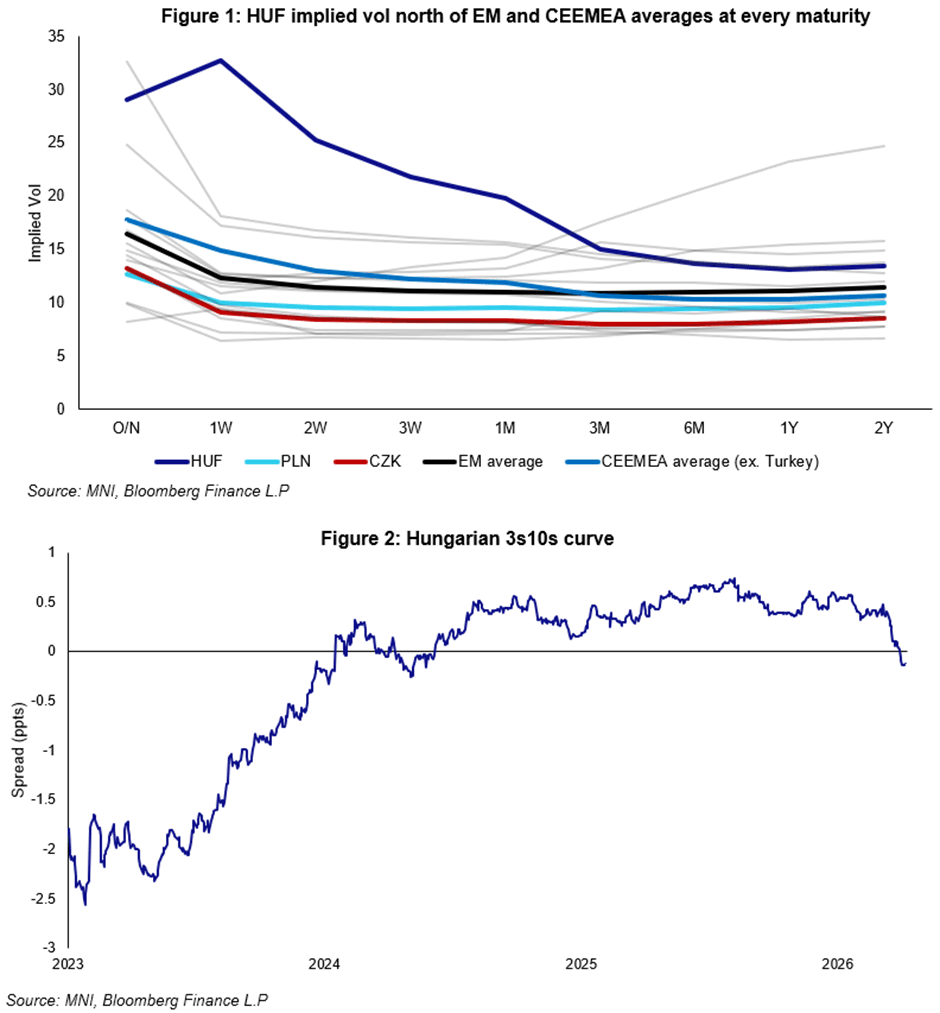
- Event risk is clearly reflected in vols: 1-week implied HUF volatility has surged to ~30%, the highest since 2009, with vols trading rich to EM and CEEMEA peers across all tenors (figure 1). While pre-election positioning underpinned HUF strength into 2026, the backdrop has been complicated by Iran-linked geopolitical risk. EUR/HUF 25-delta risk reversals (1M, 3M) are near 2023-24 highs, but elevated costs of hedging against further HUF weakness likely point to option markets pricing a more protracted war in Iran rather than purely domestic risk.
- Generally, a Tisza victory is broadly viewed as positive for Hungarian assets, reflecting expectations of progress on unlocking ~€20bn in frozen EU funds and a more credible path toward euro adoption. Early steps in a euro convergence program could include lowering Hungary’s inflation target from 3% to the euro area’s 2%, which would likely exert downward pressure on long-term yields. Front-end underperformance has been pronounced since the onset of the Iran war, with the 3s10s curve inverting to its lowest level since 2024 (figure 2), and should the long end rally, further inversion is possible. On the other hand, a Fidesz win would likely imply policy continuity and a more muted FX response. Our full election preview will be published later this week.
EQUITIES: Last Week's E-Mini S&P Rally Highlights Start of a Corrective Phase
- The trend structure in EuroStoxx 50 futures remains bearish and - for now - recent short-term gains are considered corrective. Note that the trend has been in oversold territory recently and the latest recovery has allowed this set-up to unwind. Key pivot resistance is seen at 5722.33, the 50-day EMA, where a clear break is required to signal a possible reversal. For bears, a resumption of weakness would open 5277.64 next, a Fibonacci projection.
- A strong rally in S&P E-Minis last week highlights the start of a corrective phase. Note that a correction is allowing an oversold trend condition to unwind. Initial firm resistance to watch is 6650.03 the 20-day EMA. It has been pierced, a clear break of this average would signal potential for an extension towards 6769.31, the 50-day EMA and a key area of resistance. The bear trigger has been defined at 6753.25, the Mar 31 low.
COMMODITIES: WTI Futures Bull Wave Intact, Contract Hits Fresh Cycle High
- A bull wave in WTI futures remains intact and last week’s rally reinforces bullish conditions. The contract has pierced key resistance and the bull trigger at $113.41, the Mar 9 high. A clear break of this level would confirm a resumption of the uptrend and open $118.99, a Fibonacci projection, ahead of the psychological $120.00 handle. A key support zone to monitor is $95.34 - $82.74, the 20- and 50-day EMA values.
- Recent gains in Gold appear to be corrective. Key near-term resistance is at $4799.5, the 50-day EMA. A clear break of this average is required to signal scope for a stronger recovery. This would open $4914.9, a Fibonacci retracement point. For bears, a reversal would mark the end of the correction and signal scope for a move towards the bear trigger at $4099.2, the Mar 23 low.
| Date | GMT/Local | Impact | Country | Event |
| 07/04/2026 | 1215/0815 | *** |  US US | ADP Employment Report |
| 07/04/2026 | 1230/0830 | ** | US | Durable Goods New Orders |
| 07/04/2026 | 1230/0830 | ** | US | Durable Goods New Orders |
| 07/04/2026 | 1255/0855 | ** | US | Redbook Retail Sales Index |
| 07/04/2026 | 1400/1000 | * |  CA CA | Ivey PMI |
| 07/04/2026 | 1500/1100 | ** | US | NY Fed Survey of Consumer Expectations |
| 07/04/2026 | 1630/1230 | US | Chicago Fed's Austan Goolsbee | |
| 07/04/2026 | 1700/1300 | *** | US | US Note 03 Year Treasury Auction Result |
| 07/04/2026 | 1900/1500 | * | US | Consumer Credit |
| 07/04/2026 | 2150/1750 | US | Fed Vice Chair Philip Jefferson | |
| 08/04/2026 | - |  NZ NZ | Reserve Bank of New Zealand Meeting | |
| 08/04/2026 | 2330/0830 | ** |  JP JP | average wages (p) |
| 08/04/2026 | 2350/0850 | JP | Balance of Payments | |
| 08/04/2026 | 0200/1400 | *** | NZ | RBNZ official cash rate decision |
| 08/04/2026 | 0500/1400 | JP | Economy Watcher's Survey | |
| 08/04/2026 | 0600/0800 | ** |  DE DE | Manufacturing Orders |
| 08/04/2026 | 0645/0845 | * |  FR FR | Foreign Trade |
| 08/04/2026 | 0700/0900 | ** |  CH CH | Unemployment |
| 08/04/2026 | 0730/0930 | ** |  IT IT | S&P Global Final Italy Construction PMI |
| 08/04/2026 | 0730/0930 | ** | DE | S&P Global Final Germany Construction PMI |
| 08/04/2026 | 0730/0930 | ** |  EU EU | S&P Global Final Eurozone Construction PMI |
| 08/04/2026 | 0830/0930 | ** |  GB GB | S&P Global/CIPS Construction PMI |
| 08/04/2026 | 0900/1100 | ** | EU | EZ PPI |
| 08/04/2026 | 0900/1100 | ** | EU | EZ Retail Sales |
| 08/04/2026 | 1100/0700 | ** | US | MBA Weekly Applications Index |
| 08/04/2026 | 1430/1030 | ** | US | US DOE Petroleum Supply |
| 08/04/2026 | 1430/1030 | ** | US | DOE Weekly Crude Oil Stocks |
| 08/04/2026 | 1700/1300 | ** | US | US Note 10 Year Treasury Auction Result |
| 08/04/2026 | 1705/1305 | US | San Francisco Fed's Mary Daly | |
| 08/04/2026 | 1800/1400 | *** | US | FOMC Minutes |
| 08/04/2026 | 1835/1435 | US | Fed Governor Chris Waller |


