MNI RBNZ WATCH: Gov Breman Says Hike Incoming After Hold Vote

The Reserve Bank of New Zealand is likely to raise the 2.25% official cash rate later this year to counter inflation driven by higher oil prices and stabilise inflation expectations, Governor Anna Breman told reporters following Wednesday’s Monetary Policy Committee decision to leave the OCR unchanged.
Breman noted that despite the committee’s four-three split vote, all members agreed rate hikes would likely be needed later this year, though debate centred on the interaction between rising cost pressures and spare capacity in the economy.
“We do see somewhat weaker demand than we expected in February, and we do expect that to put downward pressure on inflation over the medium term,” Breman said. “But we also see the cost pressures going in the other direction, and that’s why I stress that we’re weighing the cost pressures risking pushing out medium-term inflation against weaker demand and tighter financial conditions going in the other direction.”
MNI had noted ahead of the meeting that the MPC was likely to face a difficult decision despite markets pricing only around a 17% chance of a rate increase. (See MNI RBNZ WATCH: MPC Faces Difficult Choice To Hike Or Hold) The markets now give a 25bp July increase a 90% chance.
Breman said that more information over the coming weeks and months would allow the Bank to assess whether weaker demand is enough to ensure inflation returns quickly to target, or if hikes are necessary. "Currently, our assessment with the cost pressures we are seeing is that we expect to hike the OCR at coming meetings,” she added, arguing that the rate's current level remained somewhat accommodative relative to estimates of neutral, even though wholesale market rates and broader financial conditions have tightened.
UPDATED FORECASTS
Hidden PDF the RBNZ projected the OCR would rise to 2.5% by Q3, 20 basis points higher than forecast in February. The bank raised its CPI forecast to 4.3% y/y from a previously-expected 2.5%. (See charts)
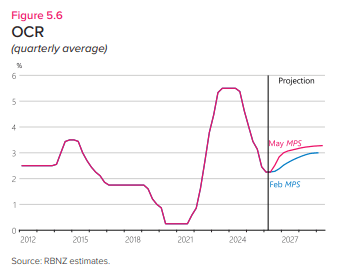
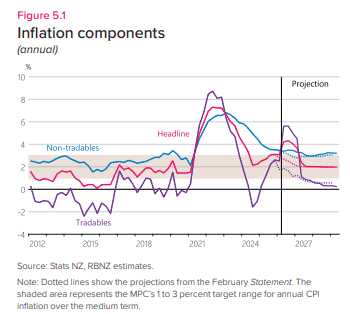
Breman said the key issue for policymakers is how inflation evolves over the medium term as supply disruptions feed through the economy. “Even if the [Iran] conflict stops, we are likely to see some of those effects feeding through over time, and ultimately what will determine policy is how we see the likelihood of inflation falling back to target within a reasonable timeframe.”
The committee is closely analysing incoming inflation data and business feedback to assess whether firms are able to pass on rising costs. “Currently, what we’re seeing in the inflation numbers is mainly fuel prices going up, but we only have data for the first quarter and some data for April,” she said, stressing that the Bank was seeking to return inflation to target without causing unnecessary volatility in economic activity.
SPLIT VOTE
The RBNZ also attributed MPC votes for the first time, showing a clear division between internal and external members. Governor Breman cast the deciding vote after three Bank members — Breman, Karen Silk and Paul Conway — voted to leave rates unchanged, while external participants Carl Hansen, Hayley Gourley and Prasanna Gai supported a 25bp increase.
Breman defended the committee structure and said the split vote reflected healthy debate, noting that the Bank had introduced procedures to ensure members could express views freely, including anonymous preliminary discussions before formal deliberations. “We’re also very pleased that this time we have increased the level of transparency, so there’s more information on the justification for different votes in the record of the meetings,” Breman said.


