MNI EUROPEAN MARKETS ANALYSIS: US Equity Futures Stabilise
- Oil prices jumped on news of explosions in Iran and are up again following reports of further Iran-Israel missiles.
- This also drove Cash Tsy yields to extend Friday's gains. Any US-Iran peace deal now seems some distance away although US President Trump is still pushing for this and insisted the recent strikes don't change US-Iran deal prospects.
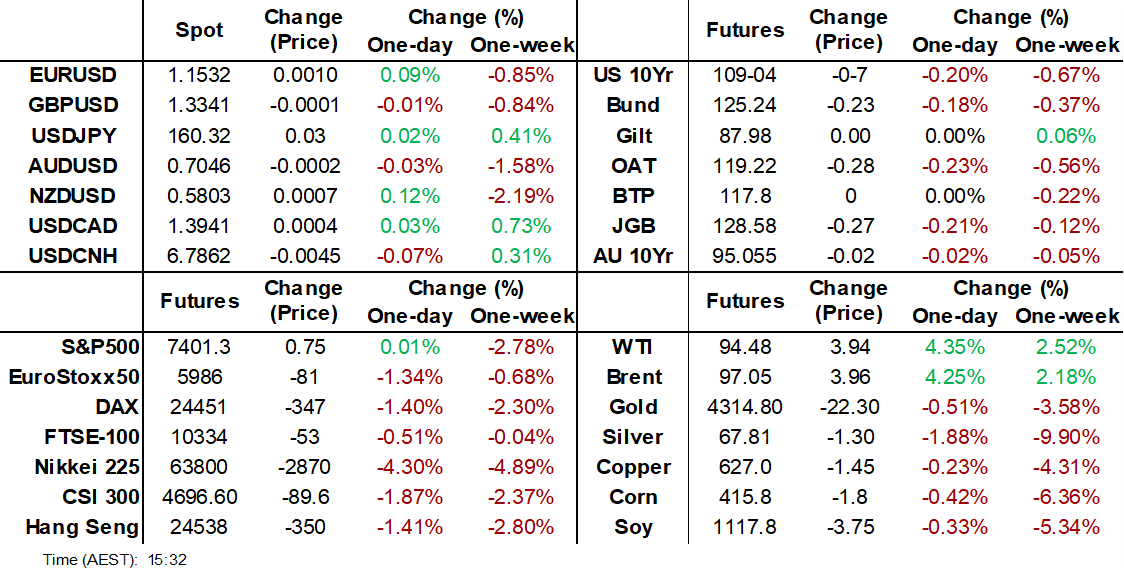
- The early tone in G10 FX was risk off, as the market digested fresh tit for tat strikes between Israel and Iran. However, we have largely reversed these losses as the session has progressed, with the BBDXY index little changed (last near 1211.55).
- Asian equity indices have followed the US’ Friday move lower as the market became jittery over tech stocks. In addition, geopolitical risks rose sharply. US equity futures are slightly higher though. Weak AI/tech sentiment weighed on the Kospi which is down 6.5%.
MARKETS
US TSYS: Cash Yield Rise Extends, 2yr Eyeing Break Above 4.20%, As Oil Spikes
Cash Tsy yields have extended Friday's gains, as oil futures hold up close to 4.2%, as Iran and Israel trade tit for tat strikes. This suggests any US-Iran peace deal will be some distance away although US President Trump is still pushing for this and insisted the recent strikes don't change US-Iran deal prospects. Tsy yield benchmarks are around 3-5bps higher, with the front end still leading the move.
- For the cash US 2yr is around 4.19%, looking to move back into 4.20-4.40% region, last seen back in early 2025. The 10yr is yet to test recent May highs, at 4.57%, we are around 10-11bps short of this region.
- In the TSY futures space, the 10yr is down -07 to 108-27. Bearish risks likely persist in the near term, with the low 108 region, (lows from May) eyed for the active contract.
- Near term sentiment will be dictated by Middle East developments and its spill over to oil prices. Risk sentiment was hit notably on Friday in the equity space, with the NFP result seeing US yields surge. We are doing better today, with Nasdaq futures marginally higher. If this backdrop deteriorates we may see some safe haven US Tsy support, although this is likely to be at the back end.
- The US data backdrop remains very strong, the Citi US surprise index up to 63.2, highs since Oct 2023.This is supporting the more hawkish US Fed backdrop. The next focus point will be Wednesday's CPI print.
JGBS: Futures Lower, Downtrend Intact, Amid Multiple Weights
JGB futures track at 128.51, -.34 versus settlement levels in latest dealings. Negative spill over from a softer US TSY futures backdrop, coupled with higher oil prices (as Iran and Israel trade tit for tat strikes), are weighing. On the data front we also had Q1 GDP revisions, which weren't as bad as feared. This may marginally add to the near term BoJ outlook. Growth was unchanged at +0.5%q/q (the market had been expected a downward revision to 0.3%), with business spending revised to a -0.7% dip (versus -0.9% forecast and 0.3% originally reported).
- For futures, May lows sub 128.00 are still intact but broader downtrend conditions in futures persist. Recent highs were around the 50-day EMA resistance point, which comes in at 129.49. We would likely need a sustained move above this level to challenge the bearish technical backdrop.
- In the cash JGB space we are around 2 to 5bps firmer in yield terms, led by the 7 and 10yr tenors. The 10yr is around 2.725%, with May highs just above 2.80% eyed on a further extension higher.
- The 2/10s curve is back to +130bps, also close to May highs, while the 2/30s curve is is less threatening in terms of these recent highs (last +252bps, May highs were above +270bps).
- On the data front, we have more second tier outcomes this week, but there will be some focus on May PPI, out Wednesday.
BONDS: NZGBS: Yields Firm +7bps, But NZ-US 10 Still In Downtrend
NZGB yields are up a little over 7bps in Monday trade to fate. This puts the 2yr to 3.525%, while the 10yr is around 4.585%. We have played catch up with US Tsy moves, post Friday's NFP beat and the higher oil prices since the open amid fresh Israel-Iran strikes. US Tsy yields have risen a further 2.5 to 4.5bps, led by the front end.
- The 2yr is now testing the 50-day EMA resistance point in yield terms, with upside focus likely on a move back above 3.60%. For the 10-yr the focus will be on a move up through 4.60%. Late May highs were around 4.65%.
- The NZ-US 10yr spread is around +3bps, up from flats. Still, downside risks persist for the spread. Greater risk rests from the US leg, given the up coming US CPI print.
- In NZ this week, the main events this week will be on Friday with some monthly data and RBNZ chief economist Conway speaking. The May BNZ manufacturing PMI is released on Friday. The index moderated to 50.5 in April from 52.8 but has held in expansionary sector since June last year.
• There is further manufacturing sector data on Tuesday with Q1 volumes and activity.
FOREX: Early Risk Off Fades, Despite Oil Bounce, AUD/USD Near 100-day EMA
The early tone in G10 FX was risk off, with the likes of AUD and NZD underperforming, as the market digested fresh tit for tat strikes between Israel and Iran (seemingly derailing near term peace hopes). However, we have largely reversed these losses as the session has progressed, with the BBDXY index little changed (last near 1211.55). Oil futures are holding up strongly, +4% for the benchmarks, but Brent remains under $100/bbl at this stage. Core yields have risen further, building on Friday moves from the US (after the US NFP beat).
- Some offset is likely coming from the resilient US equity futures backdrop, which saw early downside before rebounding back into the green, despite the surge in oil prices. Nasdaq futures are up +0.30%, but this follows sharp cash losses (more than 4%) in Friday trade. Regional Asia Pac equities are all weaker, led by tech related plays, as some of the positive momentum has come out of the AI/chip backdrop.
- AUD/USD got to lows of 0.7018 in the first part of trade, but now sits back at 0.7045/50, little changed for the session. We are currently near the 100-day EMA support point. NZD/USD got to lows of 0.5780, but is now back above 0.5800, slightly above end Friday levels from NY.
- USD/JPY is little changed, holding at 160.35 currently. We had Q1 GDP revisions earlier, which weren't as weak as feared (with headline growth steady at 0.50%). The contraction from business spending wasn't as large as feared. Yen didn't react though.
- Looking ahead, the Fed’s communication blackout has begun ahead of the 17 June FOMC decision. US May NY Fed 1-yr inflation expectations and Germany’s April factory orders are released today.
ASIA FX: IDR Weaker Again As Local Bonds Plunge, KRW Rebounds
Outside of CNH and a resurgent KRW, USD/Asia pairs have pushed higher today, as firmer oil, higher US Tsy yields and weaker local equities all boost the USD. Oil benchmarks are up over 4.5%, although Brent is still sub $100/bbl, as market assess the fallout from Israel-Iran strikes. US President Trump noted that the strikes don't derail US-Iran peace plans/talks. MYR is off close to 1%, while USD/IDR continues its strong uptrend, last up 0.80%, as local bonds capitulate.
- USD/CNH is holding lower for the session, last near 6.7875. The USD/CNY fixing was only set a touch higher, and yuan outperformance is typical during periods of heightened risk aversion. Recent highs rest at 6.7920/25, while the 50-day EMA is further north at 6.8170. The CNY basket tracker continues to rise, last around 101.685.
- Spot USD/KRW has plunged, last under 1540, outperforming general equity risk off and higher oil prices. Over the weekend officials met to step up efforts to curb one-sided depreciation pressures. Via BBG: "Rather than simply warning against excessive market moves, Seoul this time unveiled a detailed response plan that includes tighter scrutiny of offshore currency derivatives, inspections targeting suspected market misconduct, and investigations into potentially illegal FX transactions. Then headlines have crossed this afternoon of the National Pension Fund activating FX hedging. We hit lows of 1537.45 before stabilizing. We are still comfortably above all key EMAS, with the 20-day around 1510.
- USD/MYR has surged near 1% to 4.0700. Outside of broader USD supports, fresh local political uncertainty is also weighing from late last week, with PM Anwar's coalition set to contest against each in key state elections. Today's move puts USD/MYR above its 200-day EMA for the first time since 2025.
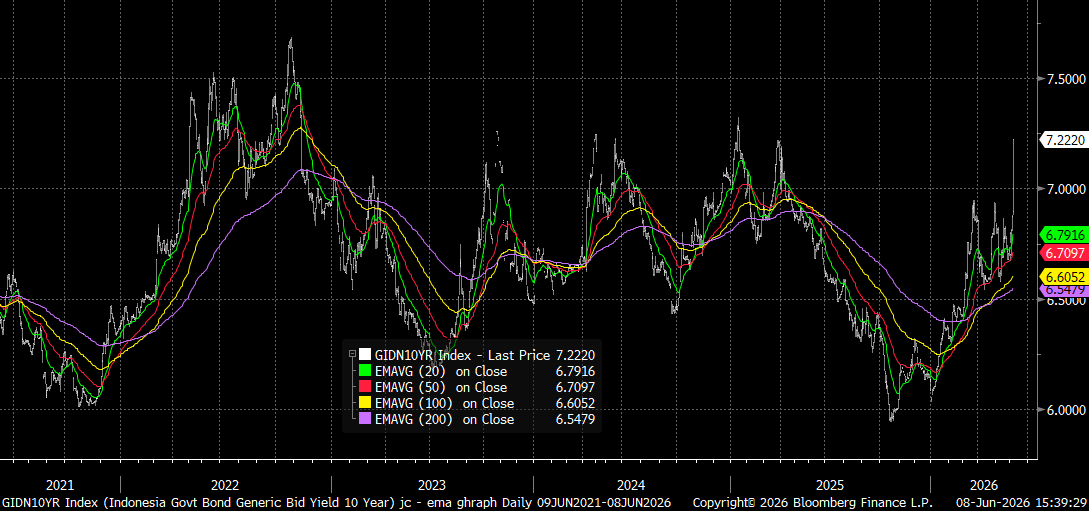
- USD/IDR has risen strongly, as Indonesia assets continue to struggle. Spot is around 18165/70, up a further 0.80%. Notably today, we have seen a break higher in 10yr INDOGB yields, surging +35bps to 7.22%, see the chart below. Other parts of the yield curve are also up very strongly in yield trends, continuing the recent trend of Indonesian asset underperformance. Local equities continue to falter, down around 2.9%.
- USD/THB is also higher at 32.88, up 0.75%, but is yet to test above 33.00, which marked 2026 highs. USD/PHP is up as well, last near 61.72, which brings us back close to recent cycle highs.
Fig 1: Indogb 10yr Yield Breaks Higher
Source: Bloomberg Finance L.P./MNI
EQUITIES: Asian Equities Down As AI- And Geopolitical Risks Rise
Asian equity indices have followed the US’ Friday move lower as the market became jittery over tech stocks. In addition, geopolitical risks rose sharply with a significant escalation of Middle East hostilities in a short time risking what the US and Iran have agreed and the negotiations themselves. Israel and Iran continue to exchange missile fire. US equity futures are slightly higher though.
- Israel struck military targets across Iran in retaliation for Iran targeting Israel earlier and following reports of more Iranian missiles heading towards Israel, an Iranian Petrochem plant was reportedly struck. Iran said after its first attack that it was the “beginning of a full week of continuous strikes”.
- The S&P e-mini is up 0.1% while the Nasdaq is +0.3% after the physical market fell 4.2% on Friday. Social media giant Meta’s announcement of an AI-related new share offering spooked the market.
- Weak AI/tech sentiment weighed on the Kospi which is down 6.5% while Taiwan’s TAIEX is 3.5% lower. The Nikkei is down 4%.
- The Kospi is off its lows due to a turn around in Samsung Electronics and SK Hynix helped by Nvidia’s announcement of increased cooperation in developing future AI chips.
- The Hang Seng is down 1.3% while China’s CSI 300 is -1.8%. China’s Moonshot AI startup is looking for an extra $2bn bringing the total requested funding to $30bn. There is increasing demand for its large language models and chatbot.
- The ASX was closed due to a holiday across most of Australia but the NZX50 is down 0.9% - outperforming most of APAC.
OIL: Crude Up Over 4% As Iran-Israel Strikes Continue But Still Below Resistance
Oil prices jumped on news of explosions in Iran and are up again following reports of further Iran-Israel missiles. WTI is up 4.3% to $94.42/bbl, close to the intraday high at $94.80 reached earlier, and Brent is 4.3% higher at $97.10/bbl after a peak of $97.32. Given the escalation of Middle East hostilities in less than 24 hours and the ever-growing risk to what the US and Iran have agreed and the negotiations themselves, oil’s response has been fairly restrained and benchmarks remain below initial resistance levels.
- Israel struck military targets across Iran in retaliation for Iran targeting Israel earlier and following reports of more Iranian missiles heading towards Israel, an Iranian Petrochem plant was reportedly struck.
- There were also reports that Saudi Arabia triggered its missile alert amid reports of the Saudi Prince Sultan base being targeted. Iran denied it was them.
- Iran said after its first attack that it was the “beginning of a full week of continuous strikes” and recent reports confirm this. Despite the apparent unravelling of the prospects for free shipping through Hormuz, President Trump told the FT that he thinks the US-Iran deal is “still on”.
- US Central Command reported 1000 commercial vessels had passed through the Strait of Hormuz since the ceasefire in early April, above Bloomberg’s estimate of 650 using its ship tracking data, which is likely due to vessels increasingly turning off transponders to go undetected.
- Saudi Arabia reduced its July oil price for Asian customers for the second straight month.
- The Fed’s communication blackout has begun ahead of the 17 June FOMC decision. US May NY Fed 1-yr inflation expectations and Germany’s April factory orders are released today.
Gold Breaks Below Support, Inflation Worries Offset Save Haven Flows
Gold rallied early in Monday’s APAC session on increased safe-haven flows following an escalation of the Middle East conflict. It reached a high of $4353.38/oz before falling as derailed US-Iran talks to open the Strait of Hormuz would push average oil prices higher, which could trigger interest rates hikes. There is now a full 25bp Fed hike priced in by year end with strong May payrolls signalling that monetary policy is more likely to tighten in the US rather than ease. Bullion is down 0.2% to $4317.6 after falling to $4300.1, breaking below support at $4306.4 opening $4200.
- Israel struck military targets across Iran in retaliation for Iran targeting Israel earlier. There were also reports that Saudi Arabia triggered its missile alert amid reports of the Saudi Prince Sultan base being targeted. Iran denied it was them. However, the IDF detected more Iranian missiles heading to Israel.
- Silver has range traded around $67.80/oz. It fell to $66.94 before recovering to around $67.84.
- Asian equities are sharply weaker while the S&P e-mini is up 0.2% and Nasdaq +0.5%. The USD index is slightly lower but US 2-year yield is higher. Oil prices are up with WTI +3.7% to $93.84/bbl.
- The Fed’s communication blackout has begun ahead of the 17 June FOMC decision. US May NY Fed 1-yr inflation expectations and Germany’s April factory orders are released today.
UP TODAY (TIMES GMT/LOCAL)
| Date | GMT/Local | Impact | Country | Event |
| 08/06/2026 | 0600/0800 | ** |  DE DE | Manufacturing Orders |
| 08/06/2026 | 1200/0800 | * |  US US | NY Fed SOFR |
| 08/06/2026 | 1300/0900 | * | US | NY Fed EFFR |
| 08/06/2026 | 1500/1100 | ** | US | NY Fed Survey of Consumer Expectations |
| 08/06/2026 | 1530/1130 | * | US | US Treasury Auction Result for 13 Week Bill |
| 08/06/2026 | 1530/1130 | * | US | US Treasury Auction Result for 26 Week Bill |
| 09/06/2026 | 2301/0001 | * |  GB GB | BRC-KPMG Shop Sales Monitor |
| 09/06/2026 | 0600/0800 | ** | DE | Trade Balance |
| 09/06/2026 | 0600/0800 | ** | DE | Industrial Production |
| 09/06/2026 | 1000/0600 | ** | US | NFIB Small Business Optimism Index |
| 09/06/2026 | - | *** |  CN CN | Trade |
| 09/06/2026 | 1200/0800 | * | US | NY Fed SOFR |
| 09/06/2026 | 1215/0815 | *** | US | ADP Employment Report |
| 09/06/2026 | 1230/0830 | ** | US | Trade Balance |
| 09/06/2026 | 1230/0830 | ** | US | Trade Balance |
| 09/06/2026 | 1230/0830 | ** |  CA CA | International Merchandise Trade (Trade Balance) |
| 09/06/2026 | 1255/0855 | ** | US | Redbook Retail Sales Index |
| 09/06/2026 | 1300/0900 | * | US | NY Fed EFFR |


