GERMANY: Growth Forecast Downward Revisions To Impact Budget And Tax Estimates
Apr-22 12:42
The downside revision to German growth forecasts reported earlier will impact Finance minister Klingbeil's 2027 budget proposal (expected for next week, around April 29) as well as later bi-annual tax estimates (to be published around May 7, latest update from October here). All else equal, lower growth means lower taxes but also more favourable business cycle buffer calculations in terms of debt brake limits.
- Recapping, "German output is set to grow by 0.5% this year, the Economy Ministry in Berlin said Wednesday. That compares with a January projection for a 1% expansion. The ministry also revised its outlook for next year down to 0.9% from 1.3%", Bloomberg quotes an emailed statement from the German economy ministry.
- These government forecasts now sit below both the median sellside analyst forecast we track (0.6% for 2026, -0.4pp from a month ago), and a set of recently published public sector forecasts from a) the IMF (0.8% 2026, 1.3% 2027, both figures down 0.3pp since January) and b) a joint one from German institutes (0.6% 2026, 0.9% 2027, down 0.7pp and 0.5pp since last autumn). For a full writeup of these views see here.
Want to read more?
Find more articles and bullets on these widgets:
Historical bullets
EGBS: Bund Futures Retrace About Half Of Trump-driven Rally
Mar-23 12:32
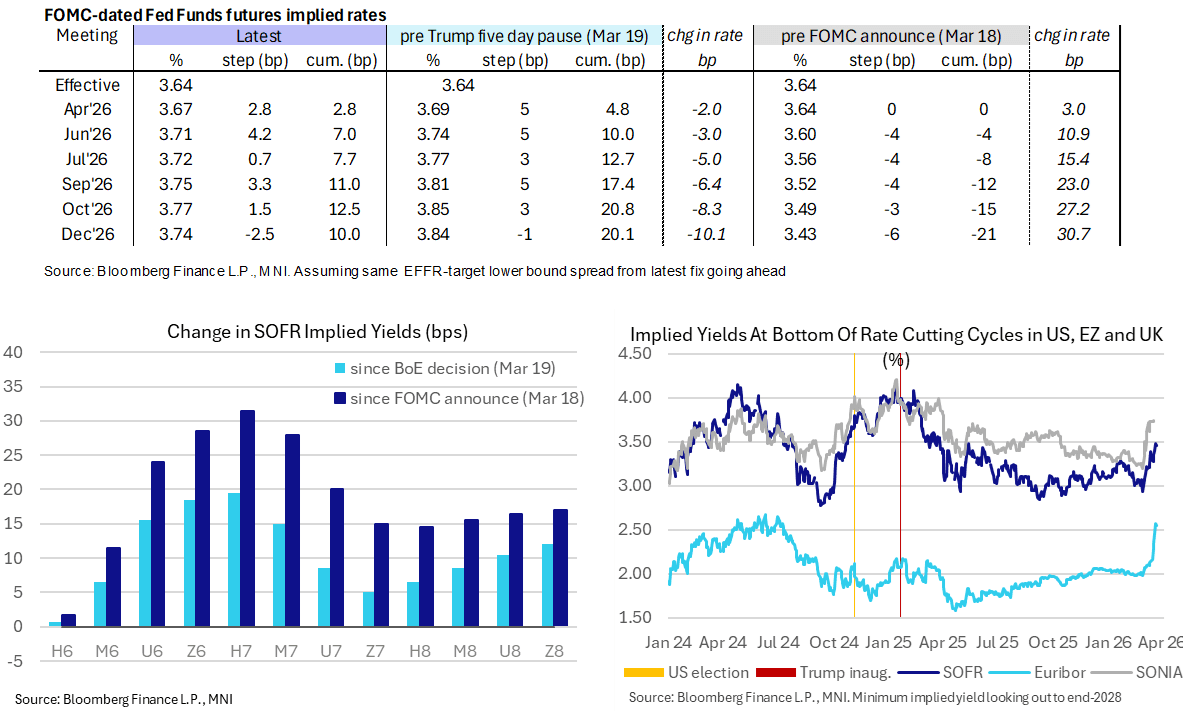
- Following a heavy suite of conflicting messages from both sides of the US/Iran war (alongside Israeli military continuing to strike Tehran), Bund futures are +19 ticks at 125.45, down from a knee-jerk high of 126.05 but still comfortably above the sub-125.00 levels seen before Trump’s initial Truth Social post. Importantly, Friday’s 126.27 high was unchallenged, which keeps a bear cycle intact for now.
- The German 5s30s curve is up 2bps to 77bps, but remains below the ~90bp level seen at the start of last week.
- The 10-year BTP/Bund spread was pushing above 100bps before Trump’s post, but has since narrowed back to ~90bp at typing.
- ECB-dated OIS now price 71bps of hikes through year-end, down from ~90bps earlier this morning and also below Friday’s 79bp close. Although sensitivity incoming headline flow remains acute, markets will still be interested in the results of tomorrow’s March flash PMIs, in particular the input/output price components.
Figure 1: Bund Futures (Source: Bloomberg Finance L.P)
US TSY FUTURES: BLOCK: Jun'26 5Y Buy
Mar-23 12:24
- +5,000 FVM6 107-23.75, post time offer at 0757:46ET, DV01 $218,400.
- The 5Y contract trades 107-26.5 last, +.75
STIR: Fed Hike Odds In 2026 Shift From 90% To 0% to 50% In <90 Minutes
Mar-23 12:23
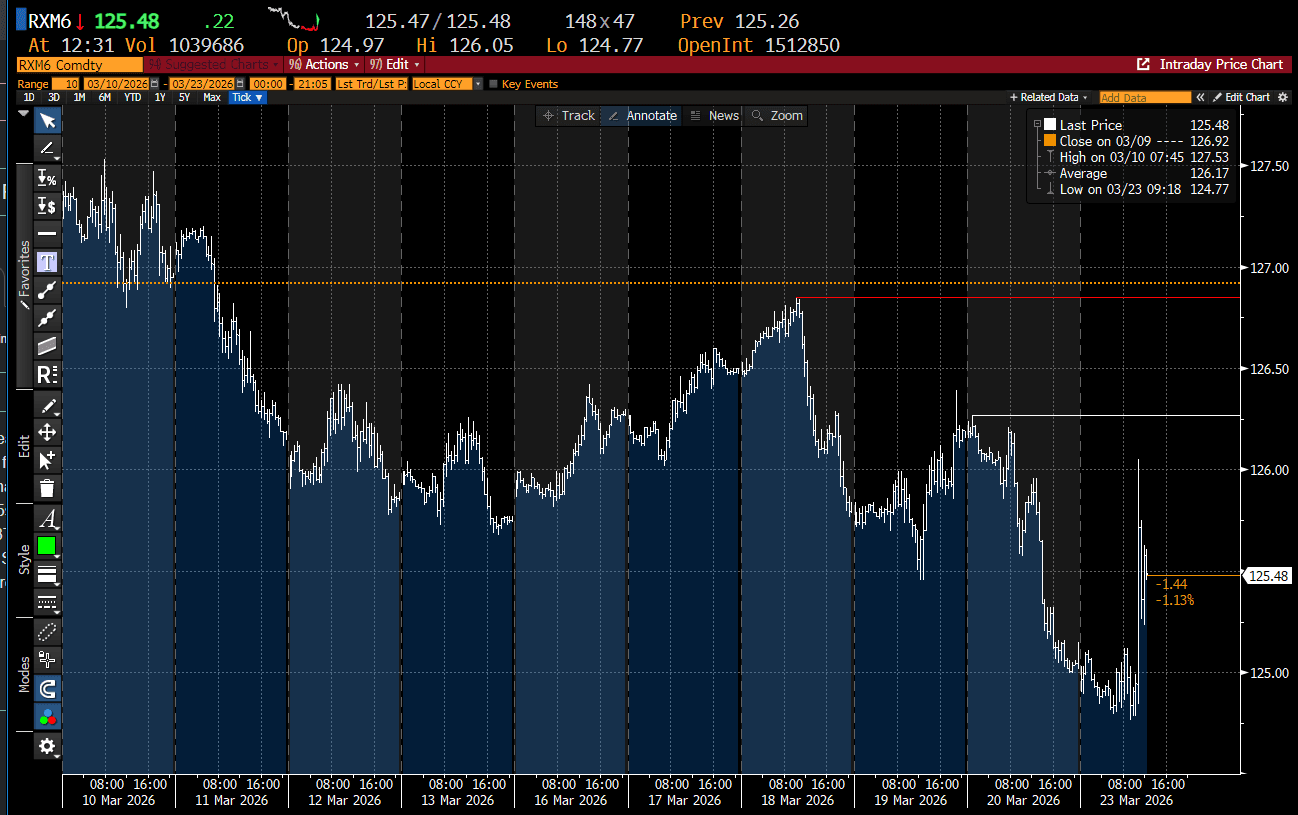
- US rates still see a fluid backdrop but have currently pared around half of very large earlier gains seen on the Trump post on a five-day pause in strikes on Iran power plants and energy infra, with the caveat coming from multiple reports of varying degrees of authenticity questioning whether there were talks.
- Fed Funds futures now see 12.5bp of cumulative hikes out to Oct vs 23bp shortly ahead of the post on Truth Social and via briefly pricing out hikes for the year.
- FF cumulative changes from 3.64% effective: +3bp Apr, +7bp Jun, +7.5bp Jul, +11bp Sep, +12.5bp Oct and +10bp Dec.
- SFRH7, the contract with heaviest losses in recent weeks, is back to unchanged on the day at 96.235 (+0.005) in a huge range of 96.055 to 96.370.
- The terminal implied yield of 3.465% (H8, -1.5bp) comes off fresh highs since early Apr 2025 but is still elevated (for example, 15bp higher than shortly before Wednesday’s FOMC decision).