OPTIONS: Expiries for Feb05 NY cut 1000ET (Source DTCC)
- EUR/USD: $1.1725-35(E2.0bln), $1.1800(E2.9bln), $1.1825-35(E1.8bln), $1.1880(E706mln)
- USD/JPY: Y153.00($1.6bln), Y154.00($1.1bln), Y155.00($1.0bln), Y156.00($1.2bln), Y156.15-25($1.1bln)
- GBP/USD: $1.3490-00(Gbp798mln)
- EUR/GBP: Gbp0.8650(E624mln)
- AUD/USD: $0.6840-50(A$1.4bln)
- USD/CAD: C$1.3675($740mln)
- USD/CNY: Cny6.9711($600mln)
Want to read more?
Find more articles and bullets on these widgets:
Historical bullets
UK: DMO Launch TBill Consultation, Meeting Budget '25 Commitment
UK government launch a consultation on the UK Treasury bill market: https://www.dmo.gov.uk/media/nrgnywtz/pr050126.pdf
- This is as announced at the Budget last year: "Budget 2025 on 26 November 2025, the government announced that it would launch a consultation on expanding and deepening the UK Treasury bill (“T-bill”) market."
- They're looking to explore options to promote participation and help develop a more active and liquid secondary market.
UN: Sec-Gen Raises Concern About Precedent Set By US' Venezuela Operation
In a statement to a meeting of the UN Security Council, Secretary-General Antonio Guterres says that the UN is "concerned about the possible intensification of instability in Venezuela" following the US operation that saw President Nicolas Maduro captured and transported to the US to face narco-trafficking charges. Guterres says there are also concerns regarding the precedent the operation may set for how relations among states are conducted, and whether the op respected the rules of international law.
- Guterres calls on all Venezuelan actors to "engage in an inclusive, democratic dialogue", and says the UN is ready to support all efforts aimed at assisting Venezuelans in finding a peaceful way forward.
- It is unclear if a resolution will be put to a vote to condemn the US's actions in Venezuela. Even if a resolution is passed, it is unlikely to have any impact on the future actions of the Trump administration vis-a-vis the immediate control of Venezuela, and its interactions with the newly inaugurated interim president, Delcy Rodriguez.
- The precedent set by the US's actions are being closely followed in other NATO states following President Trump's comments after the Maduro operation regarding future control of Greenland. Danish PM Mette Frederiksen said a short time ago that she believes Trump is "serious about wanting to take over Greenland", but that both Denmark and Greenland have said no. Adds that any US attempt to seize Greenland will see "everything stop" with regards to NATO cooperation.
US DATA: Tariff Concerns Abound In Limp ISM Manufacturing Activity Data
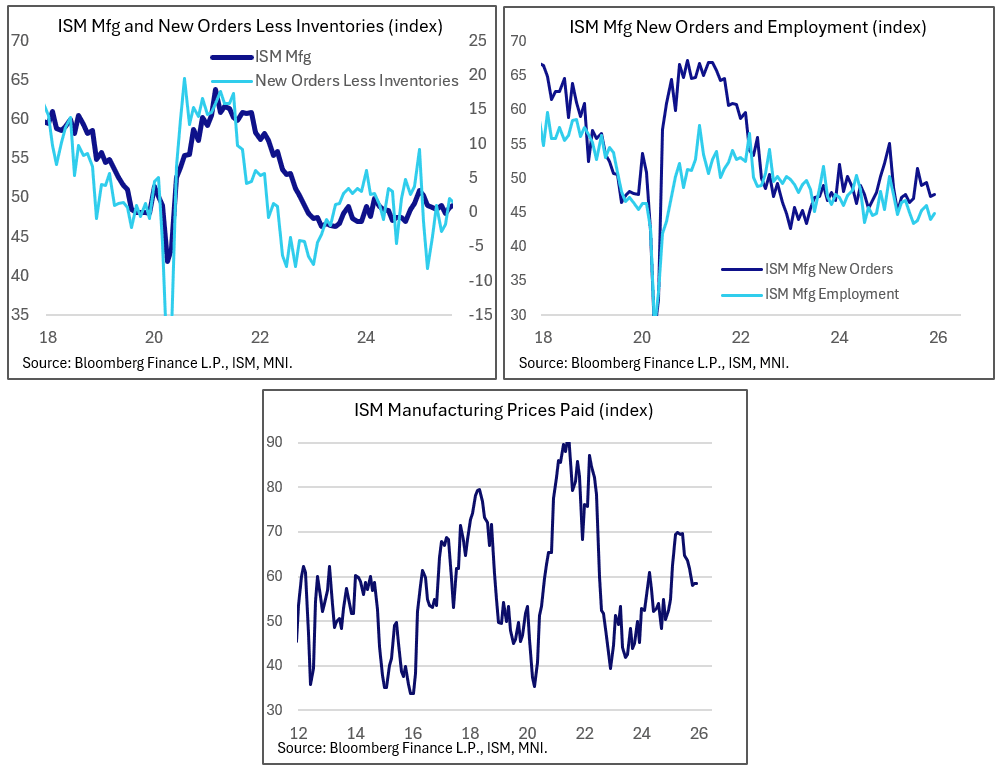
The ISM Manufacturing report for December was relatively steady vs November and in line with broad expectations, quietly falling to a 14-month low (Oct 2024) in showing continued softness in activity with price pressures steadying at a high level.
- The headline PMI reading was a little weaker than the consensus of analysts had anticipated at 47.9 (48.4 expected, 48.2 prior), though MNI had signaled that some deterioration should be unsurprising given poor regional Fed surveys and a dip in the S&P PMI for the month.
- This marked a 10th consecutive sub-50 reading indicating contraction in sector activity, and the sub-indices pointed to softer production but a potential bright spot in improved demand vs November. Reflecting the fairly flat headline reading, the sub-indices were relatively steady: New Orders +0.3 to 47.7, Production -0.4 to 51.0. Two standouts were backlogs up 1.8 to 45.8 with inventories down 3.7 to 45.2.
- In trade, the volatile imports reading was down 4.3 points to a 7-month low 44.6 due to "Tariff-related pricing pressures" per the report, but conversely export orders were up 0.6 to a 9-month best 46.9 despite "softer international orders tied to tariffs and ongoing uncertainty around U.S. economic policy".
- Attention as always was on the employment category which ticked up 0.9 to 44.9, suggesting a slower pace of contraction in manufacturing jobs. That said "For every comment on hiring, there were three on reducing head counts. Companies continued to focus on accelerating staff reductions due to uncertain near- to mid-term demand. The main head-count management strategies remain layoffs and not filling open positions."
- Additionally prices paid were steady at 58.5, defying consensus eyeing an uptick (58.7 expected, 58.5 prior) though again this suggests continued elevated pressures due in large part to tariff policy ("The Prices Index reading continues to be driven by increases in steel and aluminum prices that impact the entire value chain, as well as tariffs applied to many imported goods.") The lack of an increase is consistent with regional Fed indices and the S&P PMI which showed a pullback in inflationary pressures albeit at high levels.
- The anecdotal comments from various respondents were universally negative, with many citing soft demand and price pressures due to tariffs (that aren't able to be fully passed on, impacting margins). On New Orders, "For every positive panelist comment about new orders, 1.3 comments indicated concern about near-term demand, driven by tariff costs and other uncertainties."