STIR: $-Bloc Year-End Pricing Unchanged Over Past Week Except For NZ Firming
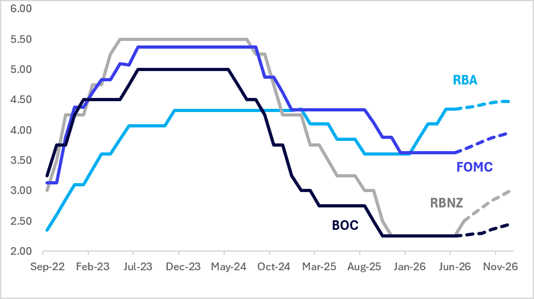
Interest-rate expectations through December 2026 were little changed across the $-bloc over the past week except for New Zealand, which is 15bps firmer.
- $-bloc pricing relative to late February (pre-war) for December 2026 is 19-89bps firmer across the $-bloc, with the US leading and Canada lagging. Australia is 34bps firmer and New Zealand +45bps.
- The highlight over the past week was the RBNZ Policy Meeting, which saw the OCR lifted by 25bps to 2.50%, as expected, in a unanimous decision. It decided that it was “appropriate” to remove some accommodation to return inflation to the 2% band mid-point and prevent further easing in financial conditions.
- Further removal of monetary stimulus is likely, but the RBNZ kept its options open regarding timing stating that it would be “highly uncertain” and very data dependent. However, Governor Breman two more hikes before year end were “not not realistic”. This opens the two remaining 2026 Monetary Policy Statement meetings, which include updated staff forecasts, on 2 September and 9 December to further tightening with a possible pause on 28 October.
- The next major regional policy event will be the BoC policy meeting on 15 July. Currently, the market attaches ~11% probability of a rate cut at that meeting.
- Looking ahead to December 2026, current market-implied policy rates expected are as follows: US (FOMC): 3.96%, +33bp; Canada (BOC): 2.44%, +19bps; Australia (RBA): 4.47%, +12ps; and New Zealand (RBNZ): 2.99%, +49bps.
Figure 1: $-Bloc STIR (%)
Source: Bloomberg Finance LP / MNI
Want to read more?
Find more articles and bullets on these widgets:
Historical bullets
MNI EXCLUSIVE: Former RBA Economist Shares Cash Rate View
GLOBAL MACRO: Energy Main Iran War Inflationary Impact, Food Turning Up Though
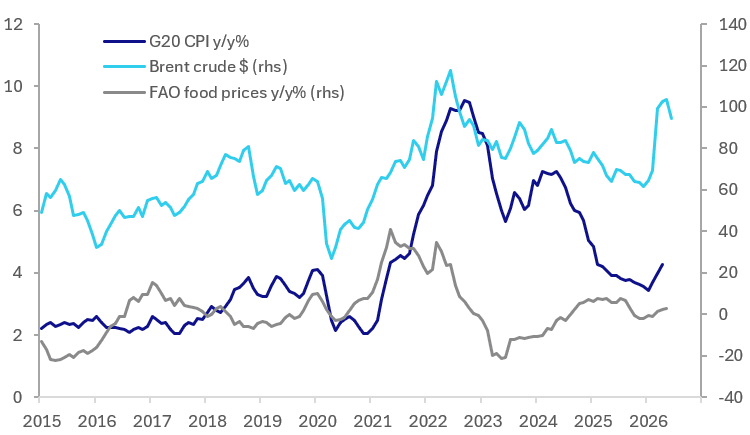
The conflict in the Middle East and Iran’s closure of the Strait of Hormuz have resulted in shortages of fuel as well as fertiliser, resulting price rises. While food prices rose 2.9% y/y in May after a low of -2.2% y/y in December 2025, higher energy prices and supply chain pressures seem to be the main source of upward pressure on global inflation for now. However, food inflation is now positive and supply may emerge as a issue given fertiliser shortages, especially in EM.
Global inflation
Source: MNI - Market News/LSEG
- FAO food prices rose each month between February and April but were down slightly in May to be up 2.9% y/y, the highest growth rate since September. The monthly May decline was driven by oils and dairy.
- The response since February is mixed by type of food with cereal, meat, oils and sugar higher but dairy little changed. Cereal prices rose 4.9% y/y in May, meat 6.3% y/y, oils 21.6% y/y but dairy fell 22.4% y/y and sugar -13.1% y/y.
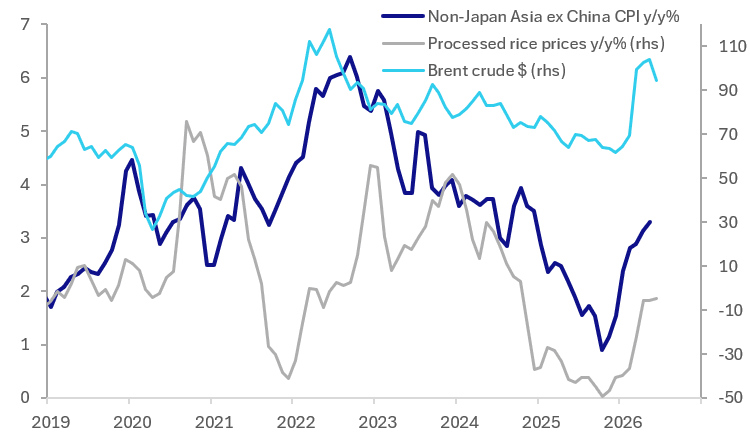
- Rice prices are lower compared to a year ago and are down in June to date. Non-Japan Asian inflation troughed in October in line with the peak in processed rice deflation, signalling the importance of certain food prices in EM. There were monthly price rises over January to April but then they declined again in May and June.
- The average June price of Brent is down 8.9% m/m but still up 53% since December. It rose each month over January to May. The impact of higher oil prices is dampened in much of Asia due to government subsidies.
Non-Japan Asian inflation vs oil and rice prices
Source: MNI - Market News/LSEG
JGBS AUCTION: 30Y Supply Faces Similar Yield But Cheaper On The 20/30/40 Fly
The Japanese Ministry of Finance (MoF) will today sell Y600bn of 30-Year JGBs. The MoF last sold 30-year debt on 14 May 2026.
- This month’s 30-year JGB auction features an outright yield ~5bps higher than the level at last month’s issuance but 35bps below its cycle peak.
- The 10s30s yield curve is flatter than the level to the previous auction and around 50bps below its cycle peak at 170bps.
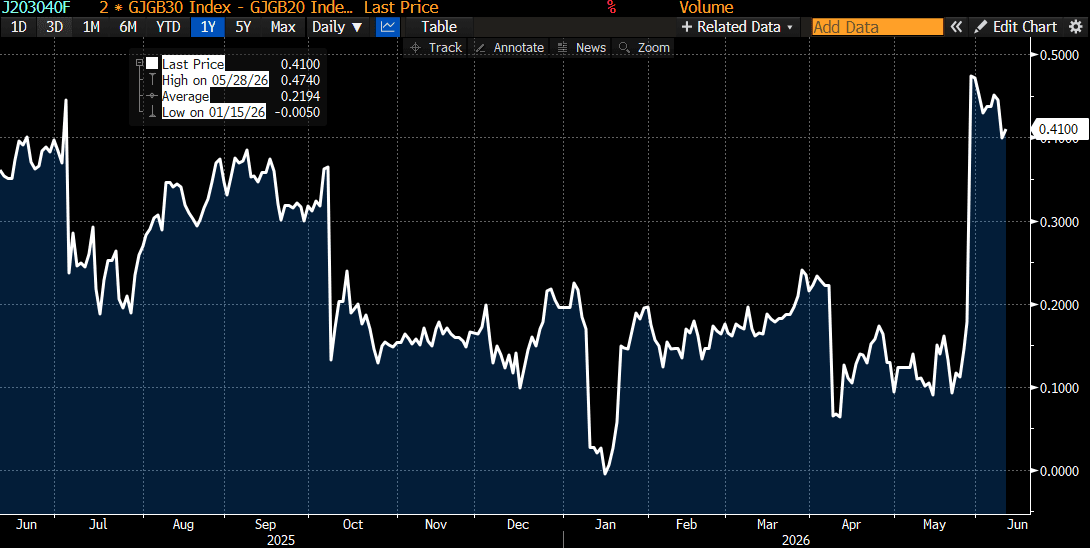
- On a relative value basis, the 30-year bond valuation is sharply cheaper versus last month, based on the 20-/30-/40-year butterfly spread. The 30-year is at the top of the range seen over the past 12-months.
- Sentiment toward longer-dated bonds remains pressured by the Middle East conflict.
- Against this backdrop, today’s 30-year auction will serve as a real test of investor appetite of ultra-long maturities.
- Results are due at 0435 BST / 1235 JT.
Bloomberg Finance LP


