UK DATA: BRC Retail Sales Softer in February Due to Wet February Weather
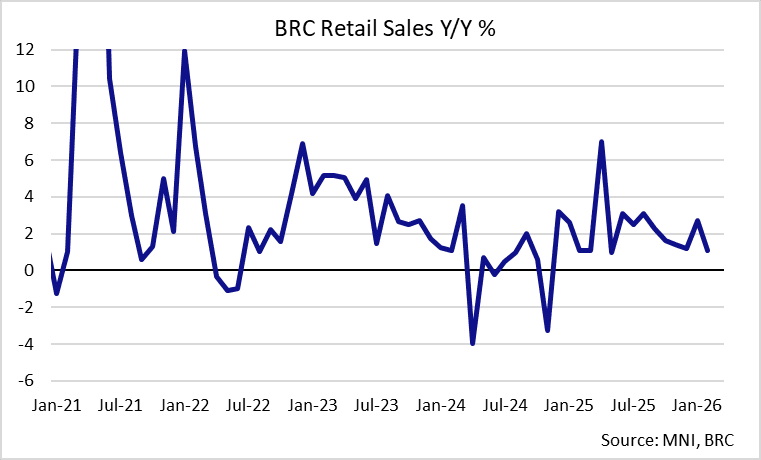
BRC retail sales growth dropped to 1.1% Y/Y in February (2.7% Jan, 1.2% Dec), unwinding some of the strong January rise (which was the highest rate since last August). This comes after last week's poor BRC footfall data (the weakest since early 2025), with wet weather highlighted as a driver of the weakness in both releases. Both food and non-food sales growth fell, now sitting below the rates seen in December.
- Although inflation has helped boost headline growth in recent releases, the large reversals here (and negative growth in non-food) point to some meaningful underlying weakness.
- Food sales slowed to 2.9% Y/Y (3.8% Jan, 3.1% Dec), propped up by high food inflation (as has been the case in recent releases), with the BRC noting that "Food sales were flat in real terms".
- Non-food sales fell back to negative at -0.4% Y/Y (1.7% Jan, -0.3% Dec), with the largest negative contributions coming from clothing, footwear, and "other non-food" retailers. BRC footfall data released last weak pointed to poor clothing/footwear sales, driven by one of the wettest Februarys on record.
- Comments from the press release: "February’s grey, wet weather hit retail sales hard. Spending was weak across most categories, online and instore, as households pulled back after Christmas and January’s rebound. Food sales were flat in real terms as shoppers tightened their belts."
- The press release also highlights some offset from Valentine's Day providing some support to jewellery, watches and perfume sales, and that "Health and wellbeing related purchases helped to drive modest monthly retail sales growth".
- On consumer sentiment, the release adds: "shopper sentiment still saw a modest lift thanks to easing inflation and news of a forthcoming 7% cut in energy prices, offering a rare sense of financial reprieve. Seasonal spikes around Valentine’s Day and Pancake Day boosted at home dining but failed to translate into volume growth. As March begins, the outlook is deteriorating ... whilst the conflict in the Middle East is strengthening concerns over fuel costs, which could impact food price inflation, if the situation continues."
- While it could have been expected for online sales to be given a boost by the wet weather, this doesn't look to have come through in today's data: "Online Non-Food sales decreased by 1.3% Y/Y in February, against a growth of 1.9% in February 2025. This was below the 12-month average growth of 1.2% ... The online penetration rate (the proportion of Non-Food items bought online) decreased to 36.1% in February from 36.3% in February 2025. This was below the 12-month average of 37.3%."
- The reporting period covers the four weeks 1 - 28 Feb 2026, the same as the upcoming ONS retail sales data (due Fri 27th March), which saw a strong upside surprise in Jan (1.8% M/M vs 0.2% cons, 0.4% Dec), after positive signals from BRC data. Weak footfall and now retail sales data from the BRC add some downside risk to the official ONS print, combined with an already likely expected monthly reversal lower.
Want to read more?
Find more articles and bullets on these widgets:
Historical bullets
AUSSIE 10-YEAR TECHS: (H6) Found Bottom?
- RES 3: 95.982 - 76.4% retracement Sep’24 - Nov’24 downleg
- RES 2: 95.960 - High Apr 7 (cont.)
- RES 1: 95.900 - High Oct 17
- PRICE: 95.125 @ 16:19 GMT Feb 06
- SUP 1: 95.075 - 2.0% Lower Bollinger Band
- SUP 2: 95.030 - Low Jan 28
- SUP 3: 94.190 - 1.0% 10-dma envelope
Aussie 10-yr futures remain under pressure, although the CPI print has helped alleviate some of the worst of the pressures. adding to the downside argument. This puts prices still south of all major support levels. With 95.275 cleared, prices are pushing to new contract lows, opening vol-band support through 95.075 and into 94.190. Any recoveries need to break back above 95.900 to signal near-term bullish traction.
MACRO ANALYSIS: MNI US Macro Weekly: Soft Labor Surprises Precede Payrolls
We've just published our US macro weekly: Download Full Report Here
- January’s Employment Report may have been pushed back to Feb 10 due to the brief federal government shutdown, but in the meantime there was plenty of labor market data to chew on this week.
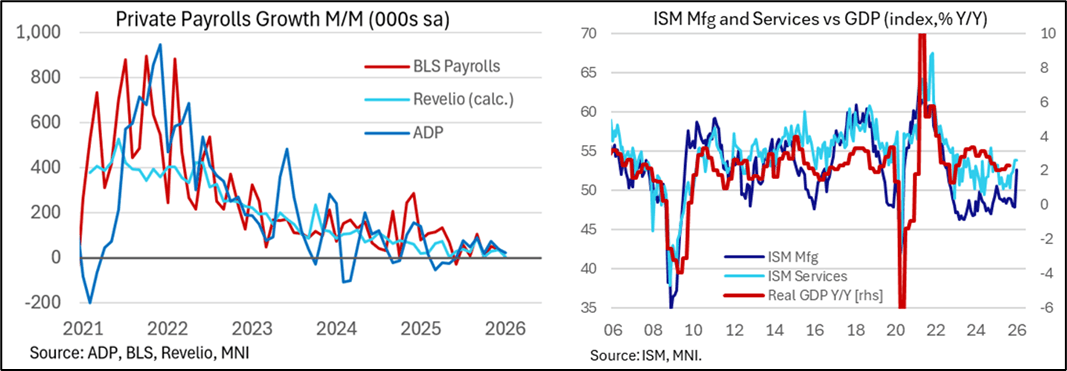
- Most of it was weaker than expected, including ADP payrolls and Revelio Labs payrolls, Challenger job cuts and hiring announcements, JOLTS job openings, and the latest weekly initial jobless claims.
- There are mitigating explanations (JOLTS doesn’t line up with private sector estimates so may bounce in January; jobless claims look impacted by severe weather), but overall theme of a lower hiring and lower firing (with the exception of the Challenger data) labor market easily remains intact.
- That remains in divergence with the continued solidity in the latest activity data, with ISM Manufacturing soaring (highest since Aug 2022) and Services putting in another solid print (joint-15 month high).
- The flawed UMichigan survey suggested that consumer sentiment has bottomed, while the latest credit indicators appeared to show slight acceleration. Latest retail sales metrics are solid if somewhat mixed.
- Rate markets largely tracked the bifurcation in data. Strong ISMs saw Fed easing potential fade early in the week, but there was a reversal in a more dovish direction by week-end alongside the soft labor data and tech-led equity weakness exacerbating negative risk sentiment.
- Fed Funds futures at one point implied 63bp of cuts to end-2026. That has since pulled back closer to 55bp with some stabilization in risk assets and a subsequent boost from U.Mich consumer sentiment firming.
- FOMC speakers were mostly patient on the next move, including increasingly cautious-sounding Board members Cook and Jefferson, with non-voter Daly one of the few flying the dovish flag.
- In general there’s a sense that the economy is resilient with downside labor market risks in relative check, with more evidence required that inflation is converging to 2% before declaring victory on inflation.
- We’ll all be watching the two major releases next week with January reports for nonfarm payrolls (Wed) and CPI (Fri), with Retail Sales on Tuesday also bearing watching (but it’s only for December).
- Monthly payrolls growth is currently expected at 70k in January for a slight acceleration from the 50k in December. The market likely currently views that to be on the high side considering a swathe of soft labor indicators this past week. The unemployment rate will again be a key component in shaping reaction to the report, with consensus currently looking for 4.4% after the 4.38% in December.
- As for CPI inflation, January is always an important month as it begins to capture start-of-year price resets - historically about 20% net price increases for the year come in January and another 20% in February. Consensus currently stands at 0.3% M/M for both headline and core CPI in the early days for the Bloomberg survey.
EUROPEAN INFLATION: MNI Eurozone Inflation Insight: January 2026
We've published our Eurozone Inflation Insight for the January 2026 flash round - CLICK HERE FOR FULL REPORT
Executive Summary - Services Y/Y Lower But Drivers Ambiguous
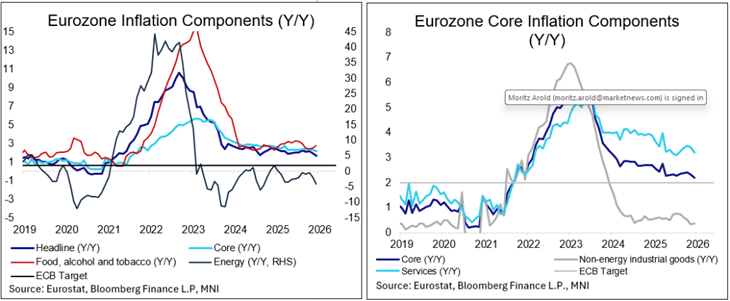
- HICP inflation decelerated in January, closely in line with initial analyst consensus. Core HICP also closely in line with expectations.
- Services decelerated more substantially than anticipated on the yearly rate. Details from some countries point towards slower annual repricing behind some of the move but seasonally-adjusted data makes the print look quite firm.
- The full January release on Feb 25 will provide an update on exact drivers, especially on services.
- By country, trends were mixed: Germany, Italy and Spain surprised to the upside while France was lower than expected.
- Methodology updates in January only brought material changes to processed and unprocessed foods categories.
- Ongoing rhetoric suggests the ECB Governing Council thinks the bar to a move into either direction is high.