BOE: Bailey speech highlights: Not a lot new here
Nov-18 15:05
Bailey's comments more explain the reason for the hike in November (rather than pointing to anything...
Want to read more?
Find more articles and bullets on these widgets:
Historical bullets
US: Donald Trump To Sign Executive Order In Oval Office Shortly
Oct-19 14:59
US President Donald Trump is shortly due to sign an executive order in the Oval Office alongside First Lady Melania Trump. LIVESTREAM The X account of the First Lady described the order as a "historic action to advance women's health."
- While the order is not market-moving, Trump is likely to engage with reporters on a range of issues, including his Friday executive order to waive sanctions on Russia and the status of the conflict with Iran.
NOK: Unconvincing Evidence That FX Transactions Impact NOK In Isolation
Oct-19 14:57
- Whether and to what extent Norges Bank FX transactions impact spot NOK outcomes are a common discussion point.
- On the one hand, changes in Norges Bank transactions through the year (i.e. outside of budget proposals) largely reflect shifts in petroleum revenue estimates/tax payment timing, which themselves may be impacted by energy price levels. In a sense, transactions can be thus considered a factor that dampens the impact of a terms of trade (i.e. energy price) shock on NOK.
- That said, FX transactions are slower to respond than market prices, so short-term windows can occur where both terms of trade and transactions are working in the same direction (e.g. the positive terms of trade shock earlier this year came at a time where Norges Bank was already purchasing NOK)
- Additionally, there may be a psychological impact when the central bank is making consistent purchases or sales of NOK through a month.
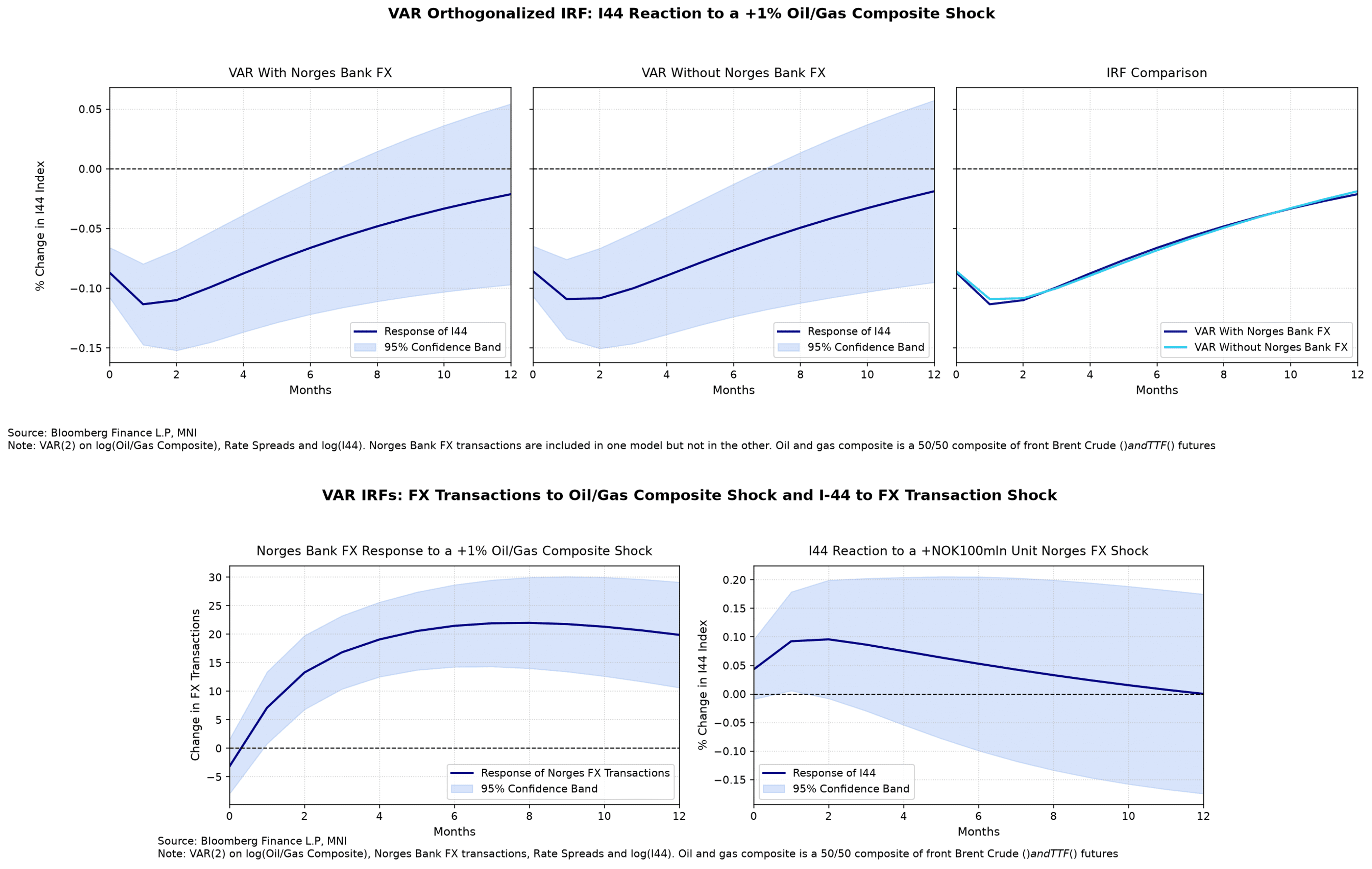
- To examine this more quantitatively, we show below a set of impulse response functions from two monthly VAR(2) models estimated on an oil/gas composite, I-44-weighted rate spreads and the I-44 index. One model also includes Norges Bank FX transactions, but the other doesn’t.
- The estimates from these models suggests that the I-44 index’s reaction to a 1% oil price shock is similar when FX transactions are and are not accounted for.
- Looking at the model which includes FX transactions, there is an intuitive response to a 1% oil/gas shock. Higher energy prices lead to higher petroleum revenues all else equal, and a reduced need to convert GPFG funds into NOK to finance the non-oil budget deficit.
- In contrast, the I-44 index’s response to an FX purchases shock has the correct sign (i.e. I-44 higher if FX purchases/NOK sales higher), but is not statistically significant.
NOK: 2027 Budget Draft Suggests Norges Bank Will Buy NOK Next Year
Oct-19 14:54
- The Norwegian 2027 budget proposal, presented earlier this month, is forecasted by the Government to have a broadly neutral impact on mainland GDP. However, the Government’s macro models estimate a small 0.1-0.2pp contribution to growth. The budget proposal will now be debated by Parliament, with a revised version expected to be passed in December.
- Based on the current draft, the structural non-oil budget deficit is seen at NOK608.4bln, 2.7% of the GPFG (in line with 2026 but a tenth below Norges Bank’s September MPR projection). This corresponds to 12.6% of mainland trend GDP (vs 12.7% in 2026).
- The non-oil budget deficit is seen at NOK561.7bln, well above the NOK454.8bln in 2026 thanks to another strong year of GPFG returns.
- Petroleum revenues are expected at NOK358.9bln in 2027, down from NOK389.1bln in 2026. Taken alongside the higher non-oil budget deficit, and incorporating other relevant categories in the draft proposal, we estimate just over NOK210bln of NOK needing to be purchased by Norges Bank next year. Assuming 245 selling days, this corresponds to almost NOK900mln of purchases per day. There may be downside risks to this estimate, as petroleum revenues could be higher than expected if energy prices stay high.
- Summarising a few sellisde views on Norges Bank FX purchases and broader fiscal-related NOK flows below:
- JP Morgan: “Using a simplified model for Norges Bank FX purchases that suggests around 250bn of NOK purchases for 2027. However, we think this may underestimate how much foreign exchange may ultimately need to be purchased, as petroleum tax revenues may end up being higher than assumed given how sticky energy prices have been and may continue to be.”
- UBS: “Our simple framework for judging the balance of NOK-relevant fundamental flows, taking the difference between the non-oil fiscal deficit (inflow into NOK) and the non-oil trade deficit (outflow from NOK), suggests that 2027 could be unusually supportive for NOK under the budget proposal”
- SEB: “A simple equation by the budget proposal data suggests that there will be a need to buy NOK in the market to fund the deficit next year. In 2026, the budget also showed a NOK-buying need (which has then turned to NOK-selling due to higher petroleum tax income). As a comparison, revised 2026 numbers based on the new budget numbers imply an annual NOK need of approx. NOK 75bn in 2026 and 210bn in 2027.”


