FED: Warsh At Jackson Hole: Analyst Views (3/3)
Natixis: “Thus far, Warsh has focused more on potential structural changes to the Fed and has eschewed forward guidance of any kind. He has also touted the “big picture” issues that will shape the long-term trajectory of the economy and, in turn, policymaking. While it’s certainly appropriate to contemplate these lofty, ivory tower issues, investors now are looking for something more grounded - a clearer sense of the Fed's reaction function and reassurance that the central bank has a credible plan for returning inflation to target. We do think he will speak to the “big picture” issues and the Fed’s task forces but will also ultimately give the market some of what it’s looking for as well…. We don’t think Warsh will opine on the timing or magnitude of [productivity] structural shifts, but the implication that we would draw is that Warsh could be reluctant to impose yesterday’s estimates of these relationships on today’s economy. Again, we highly doubt that Warsh will be too declarative in his assessments of what’s to come, but it would not be surprising if he expressed some skepticism about previous policy assumptions and generally struck an anti-doctrinaire approach…. Warsh will likely hone and improve his communication style in the coming meetings and markets will learn to better interpret his particular brand of Fed-speak. In the meantime, we think Warsh and the Fed would benefit from a clear and unambiguous statement that clarifies that if inflation stays high, the Fed will act and the policy rate will be the tool… It would be helpful if Warsh, without front-running the results of the work of the task forces, added some color in terms of the magnitude of the changes that could be coming down the road. We suspect that the task forces will be used to hone and improve the status quo on the margin and not to enact wholesale changes. With this uncertainty present, clarifying that an evolution (not a revolution) is in store, would help to address one of the many outstanding questions about Fed policymaking.”
Scotiabank: “If Warsh does go the route of teeing up future possible moves, then a) it would conflict with his stance against providing explicit forward guidance, but b) would probably lean more toward the neutral-dovish side of expectations… It may also be too soon to begin sharing the work of the five Task Forces that Warsh set up to report back into the Fall and by year-end.”
TD: “We think Warsh's options for the speech largely come down to two key topics: what he calls the "big questions" (structural economic views) and/or regime change at the Fed. We fear the chairman will need to walk a fine line when discussing these topics lest he will be interpreted as dovish by the market… Warsh could frame his Jackson Hole remarks around how he is judging the big structural shifts that are currently transforming the US economy, with artificial intelligence as the big focal point and recent supply shocks as ancillary to that view… Given his known ideological reluctance to even mention the word "guidance", we do not anticipate the chair will change his June/July approach toward discussing the outlook. If the market is looking for a brand new strategy from Chair Warsh toward forward guidance, it will be highly disappointed, in our opinion… The market's reaction function to Warsh is likely to be asymmetric. Additional guidance around his reaction function could allow investors to breathe a mild sigh of relief, but a continuation of current communication policy could disappoint markets further. While Secretary Bessent has attempted to push back against the moves in long-end rates by announcing additional buyback operations, the tone in the long end remains extremely tenuous. Markets will look to Warsh as a potential stabilizer, but we believe the risk of disappointment is high.”
Wells Fargo: “Over about the last decade and a half there have been only two big speeches that we would describe as truly consequential for the near-term policy path (Powell’s “pain” speech in 2022 and Bernanke’s hint at QE3 in 2012). That’s it. Two speeches in the last 14 years. You would think given Warsh’s proclivity to want to say less, not more, this would be another year when little actually happens. And while we tend to lean in that direction as it relates to JH, the one thing that has us wondering a bit more about this than typical is the “clean up” article that occurred in the FT following the last FOMC presser. If Warsh cared enough to bless that (assuming he did), then it may be on his mind that his current approach may need some refining and could decide to address it… we think he will be careful not to get too far ahead of the task forces and commit to any changes. We think he'll also stress that he seeks to keep what's working at the Fed, not just come in and completely upend the place, to warm relations with existing FOMC members and help secure buy-in for the task forces' eventual recommendations. It's certainly possible Warsh touches on recent developments in the Treasury market and the overlay with monetary policy, or more clearly articulate the Committee's near-term reaction function. However, we think the dominant aim of his speech will be to buy the Committee time until the task force findings are released, and hope the data cooperates with the current policy stance over the interim.”
Want to read more?
Find more articles and bullets on these widgets:
Historical bullets
FED: More Dovish Analyst Views On Rate Outlook (2/2)
A few analysts on the more dovish end of the rate outlook spectrum, looking for 50 to 75bp of cuts through end-2027 include:
- Goldman Sachs: “Market pricing implies that investors see the outcome of the July meeting as unusually uncertain, likely because the FOMC has been split recently, Chairman Warsh’s own position remains unclear, and some of the re-escalation with Iran occurred during the blackout period. But most voters appear unlikely to push for a hike next week after the softer June inflation data, the Fed has historically avoided delivering surprise rate hikes, and we suspect that voters might be especially reluctant to do so at a meeting without a Summary of Economic Projections.” Future action: 25bp cuts in Jun and Dec 2027. “while our baseline forecast remains that the Fed will remain on hold through year-end, we have raised our probability of eventual rate hikes from 25% to 35%.”
- ABNAmro: “The recently released FOMC minutes for the June meeting provided a useful guide to the FOMC’s reasoning. It contained a key paragraph outlining the fact that the FOMC essentially sees two plausible scenarios. The first is one where inflation improves ‘soon’, where they deem it appropriate that rates will be held steady in the near term before eventually being cut. The word ‘soon’ is ill-defined, but it suggests the pace of inflation needs to improve in the coming months. The second scenario is one of sticky inflation (due to e.g. AI-related demand, the energy shock or tariffs) and a stable labour market, which would require ‘some firming’.” Future action: 25bp cuts each meeting from Mar to Jun 2027 (75bp total)
- UBS: “The 18 FOMC participants other than Chairman Warsh are evenly split, between hiking and not hiking this year. Let's assume for July, and perhaps September too, that the split between hikers and holders is about even. Then, we assume the participants that want to hike probably have more conviction about hiking than the holders have about holding. Thus, if Chairman Warsh wanted to tip the scales, and nudge a few holders to become hikers, Warsh probably could get the FOMC to raise rates, if that is what he wanted. Hence the uncertainty. He's the median voter in a way, and we do not know how he wants to vote.” Future action: 25bp cuts in Q1 Q2 and Q4 2027
- Citi: “We and almost all other economists who submit forecasts to Bloomberg expect the Fed to keep policy rates unchanged []. However, the market is pricing in a meaningful 30% probability that the Fed will raise rates as oil prices have been increasing again and low jobless claims point to stability in the labor market. We do not think the majority of the committee, including the Chair, would want to hike after a very soft core CPI reading in June.” Future action: 25bp cuts in Oct, Dec, Jan
FED: Analyst Views On July FOMC And Rate Outlook, Starting With Most Hikes (1/2)
Some key analyst commentary from July FOMC previews, along with the analyst's view on the rate outlook, listed in descending of order from most hikes to most cuts through end-2027 (the median is roughly -50bp, ie two more cuts in this cycle). For more commentary see our Fed Preview with analyst updates Here
- BofA : “With markets now pricing nearly 10bp of hikes in July, Chair Warsh faces a difficult choice. Not hiking could challenge the Fed's credibility on inflation. But raising rates would go against his framework of looking through supply shocks.” Future action: 25bp hikes in Sep, Oct, Dec then hold through 2028
- Deutsche: Our baseline remains that the Fed raises rates by 50bps this year (25bps hikes in September and December). There are two-sided risks to this view. A July rate hike and even a full reversal of last year’s 75bp reduction are quite possible. On the dovish side, a replay of summer labor weakness, a string of softer inflation prints, or a sharp tightening of financial conditions could delay or forestall hikes."
- JPMorgan: “There are sound arguments for hiking and holding [] with the difference usually coming down to one’s inflation forecast. We think the strongest case for holding [] is that a hike would send a confusing signal about how the Fed responds to data. The Committee voted unanimously at the last meeting to keep rates on hold. Since then, we’ve had one inflation reading, and the core measure was the softest in years. Eschewing forward guidance is uncontroversial in contemporary thinking about monetary policy provided the public has an understanding about how policy reacts to developments. No forward guidance combined with an unstable reaction function would be concerning.” Future action: Next move: hike in Q3 2027
- Barclays: “the latest economic data and recent comments from Fed speakers reinforced our expectation that the FOMC will remain on hold [in July], with the center of the committee appearing content to wait for additional inflation data, particularly following June's softer-than-expected CPI and PPI reports. At the same time, policymakers continue to view more persistent inflation pressures as the dominant risk, leaving the door open to additional tightening should disinflation fail to resume over the next several months.” Future action: Hold through end-2027, 25bp cut sometime beyond that
- Morgan Stanley: “Despite the rebound in oil prices, other data points to patience. Employment growth has slowed and evidence of disinflation has emerged. The case to hike in June was stronger, in our view. That said, at some point the Fed will run out of patience and repeated commitments to achieve price stability need to be followed by action. We may have misjudged the reaction function.” Future action: 25bp cuts in Q1 and Q2 2027
- Wells Fargo: “We expect Kevin Warsh's second meeting as FOMC Chair to be a punt to September as the Committee awaits more data that either confirm or dispel their hawkish leanings.” Future action: Hold through 2027.
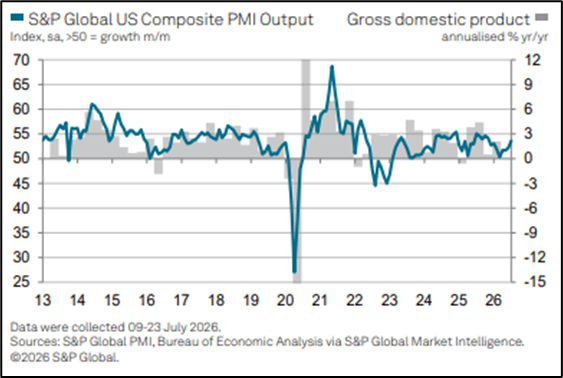
FED: Maco Since Last FOMC - Growth: Solid PMIs Despite Renewed Geopol Risks
- As for more timely indicators, the S&P Global composite PMI was stronger than expected in Friday’s preliminary July release at 53.6 for an eight-month high.
- From the press release (link): "US business activity growth accelerated at the start of the third quarter, according to provisional PMI survey data, reaching an eight-month high and prompting firms to add staff for the first time in three months. Business confidence in the year-ahead outlook also rose to an eight-month high. However, the improvement was confined to services, while manufacturing growth slowed sharply."
- However, this could have been boosted by the FIFA World Cup and possibly USA 250 anniversary activities according to S&P Global. We suspect the final July update along with ISM surveys due early August will provide a more complete look at early implications from the rise in energy prices.