LOOK AHEAD: US Macro Week Ahead: NFPs Friday
Jul-31 20:00
* Friday's July nonfarm payrolls report will be watched with interest after the June report was su...
Want to read more?
Find more articles and bullets on these widgets:
Historical bullets
US LABOR MARKET: Wage Growth Seen Stabilizing Further After Trend Moderation
Jul-01 19:50
- Average hourly earnings growth is expected to see a second month at a seasonally adjusted 0.3% M/M in June although with analysts skewed towards a dovish surprise.
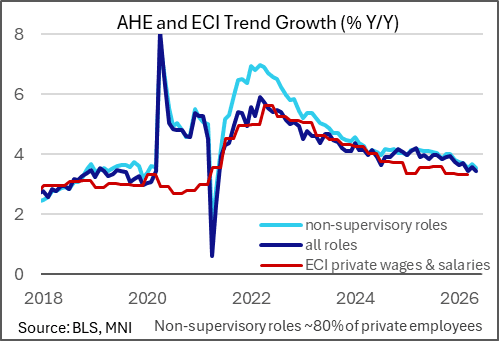
- The 3.5% Y/Y seen for the broad Bloomberg consensus would mark some continued stabilization in wage growth having recently bottomed back in March at its lowest since Mar 2021. Specifically, it follows 3.45% Y/Y in May or a three-month average of 3.48% having cooling from last year’s peak of 4.2% in Mar 2025 and more recently 3.9% in November.
- The non-supervisory category has been running slightly hotter but has also broader kept to this trend of sizeable moderation before recent stabilization, most recently at 3.56% Y/Y in May.
- Current levels of wage growth should continue to see little direct inflationary pressures whilst very strong productivity growth continues. That said, with the Fed increasingly eyeing stubborn core services prices there will be more scrutiny than usual on AHE growth this month.
- The average work week meanwhile is expected to hold steady at 34.3 hours for a third consecutive month, at typical but still relatively low levels on a historical basis.
US LABOR MARKET: World Cup Boost vs Typically Subdued Outright Hiring In June
Jul-01 19:45
The following is taken from the MNI US Payrolls Preview, which can be found in full here (link).
- The past few months have comfortably passed the hiring test of a labor market that had been characterized as “low hire, low fire”, especially in April but also in May. May saw an outright 741k nonfarm payrolls added compared to 664k in May 2025 and 747k in May 2024.
- June tends to be a much less important month for hiring as activity winds down over the summer, including an education-related drop in July (payrolls increased by only 267k in June 2025).
- That could still see any World Cup related job creation this month have a larger seasonally adjusted impact than would have been the case with the same amount in May. That could however be at least partly limited by the fact that June has seen one of the more pronounced shifts in its seasonal profile with historically stronger increases (396k in June 2024, 663k in 2023 and 911k in 2022).
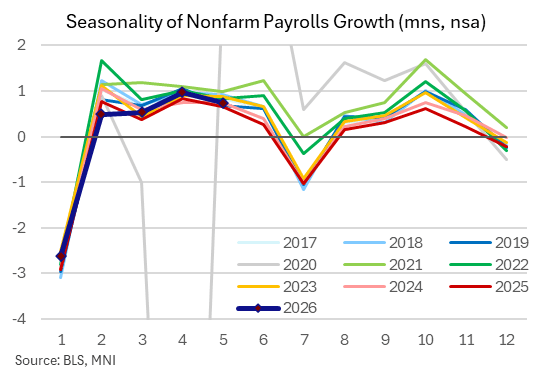
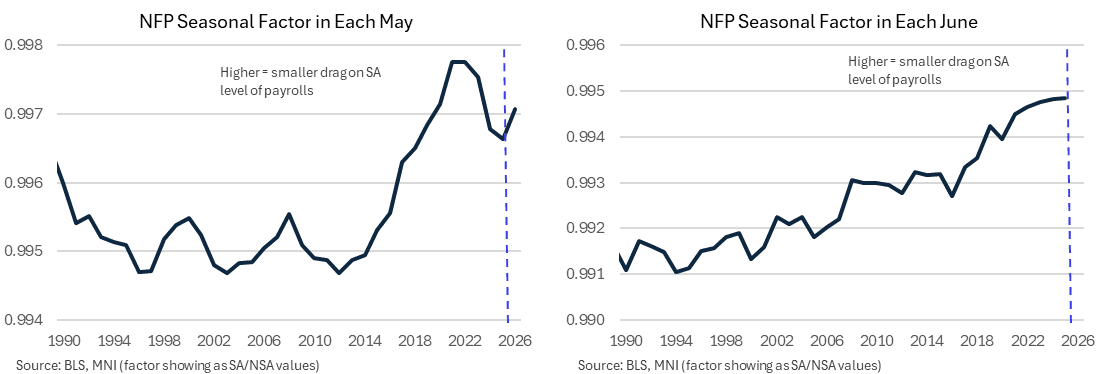
- Seasonal factors should also be watched after providing a notable tailwind to seasonally adjusted jobs growth in May with its most favorable factor for a May since 2022 as it bucked a trend of increasingly less favorable ones.
- Indeed, using the May 2025 seasonal factor crudely suggests we would have seen seasonally adjusted jobs growth of 103k vs the 172k reported in what would have been much closer to the 88k expected.
- As for June, seasonal factors have shifted to being their most favorable in decades.
US LABOR MARKET: Government Payrolls Seen Flat, Poll Worker Reversion Possible
Jul-01 19:35
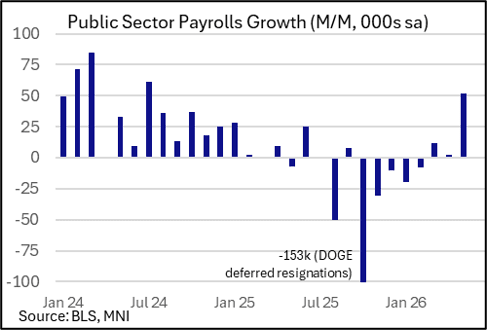
Public payrolls are seen flat in June by the median primary dealer though arguably risks here are to the downside. Government employment rose 52k in May, the strongest month since July 2024, with local government non-education employment forming the bulk of that with a 43k jump (overall local government job gains had averaged a paltry 5k over the prior 9 months).
- That was speculated to have been fueled by primary elections, which could imply a reversion in June, though primary season runs across May and June. JPMorgan writes of the May rise that “some of that might have reflected poll workers, and were that to be the case it could persist into June given ongoing elections. However, state-level employment data shows employment rose in almost every state to some degree in May, so this could also reflect the difficulty of seasonally adjusting the normal summer rise in government employment. That would mean a higher likelihood of a June pullback.”
- Meanwhile, weather was estimated to have been a major headwind to May’s payrolls reading, with the San Francisco Fed’s weather-adjusted change in the month at +364k (vs 172k actual). That suggests weather could be a tailwind to June’s figure, particularly given unusually warm weather in the month.
- The ending of strikes should provide a small boost relative to marginal drags in the past two months, with zero workers on strike compared to 4k in the May reference period (in what was a 2.6k sequential increase on top of the 1.4k in April). Education payrolls will be 4k higher than they were in April from this impact alone.
- Whilst much harder to quantify, there could be some spillover to firms exposed to the collapse of Spirit Airlines after the direct effects should have mainly been felt in May. Spirit said about 17k direct and indirect employees lost their jobs as a result although Morgan Stanley ahead of the May report estimated a drag of around 10k in May (based on WARN notices totalled about 8k along with potential spillover). Trucking payrolls might also come under pressure following the federal Department of Transportation previously calling for the cancellation of the commercial drivers’ licenses of the “non-domiciled”.
Trending Top
Jul-31 19:08


