SOFR OPTIONS: SFRM7 95.50 Calls Blocked
3 blocks lodged in recent trade, a cumulative 10K of the SFRM7 95.50 calls blocked at 26.5 vs. 95.30...
Want to read more?
Find more articles and bullets on these widgets:
Historical bullets
OAT: Sell-Side Reluctant On OAT Longs, Despite Some Seeing Cheap Valuation (2/2)
The sell-side notes that we have read point to ongoing hesitance to engage in long OAT exposure, despite several desks highlighting attractive/undervalued levels on their metrics. The French fiscal and political situations continue to provide the obvious fundamental headwinds, while increased beta to broader risk appetite and oil price swings is noted:
- Morgan Stanley: We believe a combination of deteriorating global sentiment and still negative headlines in France help explain the recent widening with an increasing beta compared to the first few months of the conflict. This is also reflected in France further cheapening against our fair value framework. Our recommendations in EGB/SSA space remain focused on underweighting countries with higher-deficit/GDP ratios (France, Belgium, Austria) against countries with low debt/ GDP ratios (Netherlands, Ireland until last week) and EU. We retain a broadly unchanged bias: OAT underperformance into the Presidential elections, tightening back after the vote and underperforming against into the 2028 budget discussion.
- TD Securities: OAT-Bund spreads have widened beyond 100bp as higher oil prices continue to pressure euro area spreads, while France faces an additional risk premium from budget uncertainty, Despite the sell-off, OAT valuations are becoming increasingly attractive, with limited near-term rating downgrade risk and limited exposure of non-European holders in OATs.
- UBS: We had been advising clients to wait for better levels to go long Bunds, France and France vs. Germany. Back in early July, we called for a summer lull ahead of the budget given contained fiscal risks in near-term, stable net supply to the market, and strength in broader risk sentiment. But spreads widened steadily and we think that 10-Year French spreads around 90-110bps are a fair price for real macro risk. The team has been short 10-Year OATs vs EU targeting 65bps. The market is waiting to get more clarity on how centrist parties could position into the elections and consolidate voters.
OAT: Sell-Side Reluctant On OAT Longs, Despite Some Seeing Cheap Valuation (1/2)
The sell-side notes that we have read point to ongoing hesitance to engage in long OAT exposure, despite several desks highlighting attractive/undervalued levels on their metrics. The French fiscal and political situations continue to provide the obvious fundamental headwinds, while increased beta to broader risk appetite and oil price swings is noted:
- Bank of America: The current economic, budgetary and political situation in France are likely making it harder for investors to contemplate buying "the dip" in OATs. Both the beta of 10-Year OAT/Bund to Bunds and its Rsquare are higher than those observed for 10-Year BTP/Bunds. Besides a rally in 1y1y and/or Bunds, on lower energy prices or a change in ECB communication, we see five elements that could help cap the widening in OAT-Bunds: A reduction in maturity of OAT issuance. The rise in OAT yields may increase caution amongst politicians during the budgetary exercise, with greater willingness to compromise. France can still appear a better credit long term. Banks and lifers have scope to increase exposure. The ECB can reign in pricing in the EUR front-end. It can slow down the current QT pace and/or offer country specific relief.
- Goldman Sachs: Incremental budget news has been slightly on the negative side. Ongoing market pressures are highlighting the need for fiscal consolidation among contenders (and polls suggest it is a concern for the population too), which can be a positive for OATs. But we note that this is not matched by concrete and commensurate commitments by Presidential candidates to improve public finances at this stage. When benchmarked against peers on spot debt levels, OATs look increasingly cheap. We do not view this as a compelling buy signal as it is consistent with markets pricing a protracted increase in debt ratios, which is also our economists’ expectation too. More encouragingly, we note that the idiosyncratic widening in OATs over the last months has reached significant levels, comparable to the 2017 elections or recent changes in government. This suggests to us another leg of idiosyncratic widening is unlikely in the near term, and points to increasing risk-reward in OATs into Q4.
- HSBC: On a constant maturity basis, OAT spreads have widened ~35bp since the lows of mid-May, only 15bp less than the widening move in 2017 - and the Presidential election isn't even until next year. Eurozone spreads have been systematically widening in response to the surge in yields, but France's move is far larger than we would expect given its debt/GDP. In fact, using our valuation model based on debt levels, France is as cheap as it has been since at least 2008. France is now significantly higher-beta than Italy relative to the rise in rate expectations, and Friday's move was even bigger than the beta would suggest. In the short term, geopolitics and headlines permitting, we expect some consolidation of spreads around the 100bp level as the market adjusts to this new reality. There is little point in trying to draw "lines in the sand" beyond which spreads will not rise, but 120bp may be the next psychological level in any further spread weakness. We think it is unlikely the ECB will wish to intervene at this stage using its TPI.
- J.P.Morgan: French spreads remain the relative underperformer, reinforcing our view that France is currently acting as the high-beta proxy in risk-off episodes. Across our recent client discussions (20+ real money accounts across the region), feedback has been broadly consistent, namely that investors broadly agree that it is still too early to position for 2027 Presidential election scenarios, and that the 2027 budget process may ultimately be less noisy than feared. That said, there is also a clear expectation that French political news flow will remain choppy. In our view, this, alongside ongoing volatility in broader rates, continues to keep investors cautious on France, despite increasingly attractive valuations. We now find 10Y France-Germany spread trading almost 15bp too wide on our fair value framework, with similar levels last seen during August-September 2025 budget/political noise. In our view, a stabilisation in global rates volatility could shift the focus back to carry and France’s attractive valuations. We stop out of long 10Y France vs. Italy on discipline despite still holding the view that the market is over-estimating political risk premia around budget noise in France while underestimating the same in Italy.
NZD: Breman/Risk Provide Kiwi Reprieve as Momentum Stalls Sub-0.57
- The latest positive moves for risk on the back of both the IRGC comments and the Kyodo News report have abruptly stalled the dollar’s early upward momentum as Brent crude futures slide aggressively back below $100. While this USD turnaround has been most notable against the yen from a price action perspective, NZD continues to outperform its G10 peers on Tuesday.
- One of the key drivers behind this Kiwi outperformance was RBNZ Governor Breman speaking to local businesses overnight. Notably the Governor said that “If higher oil prices persist, they are expected to result in somewhat higher near-term inflation than we assumed in the September Statement.” On growth Breman recognized the recent GDP figures, but highlighted on-going uncertainty amid an uneven recovery.
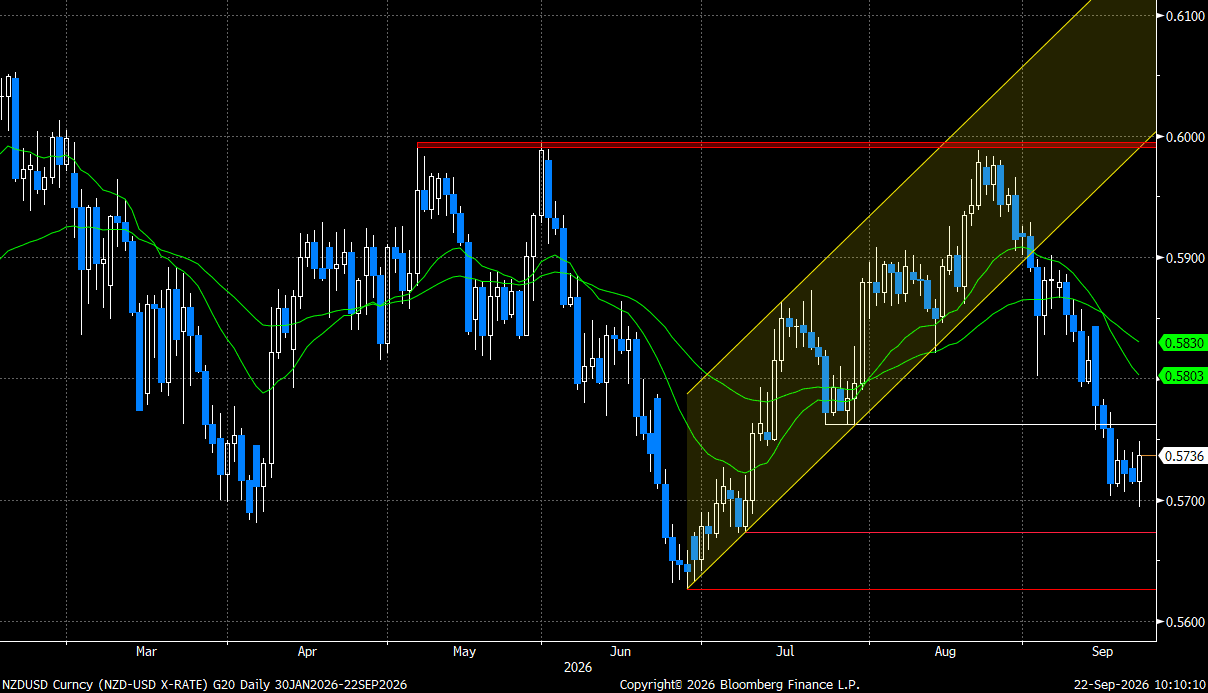
- The most recent sentiment shift prompted NZDUSD to rise quickly from 0.5720 to a new session high at 0.5748, and a prior breakdown point at 0.5762 provides initial resistance. Stronger resistance is found at the 20-day EMA, just above the 0.58 handle. Dynamics have also allowed AUDNZD to track back below 1.24 this morning.