US DATA: Philly Manufacturing Impresses As Firms See Transitory Price Jump
Apr-16 13:12
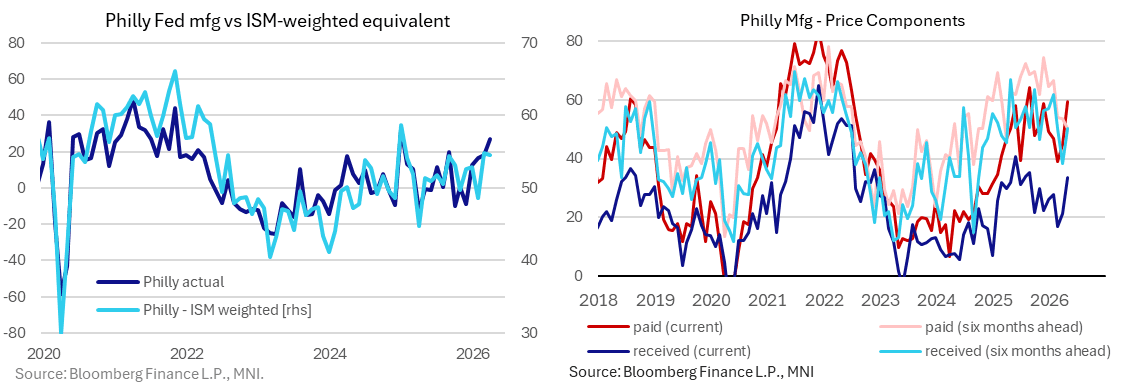
April's Philadelphia Fed manufacturing survey was much stronger than expected, with the headline index (General Business Conditions 26.7 from 18.1, highest since January 2025 and vs 10.0 consensus) underpinned by solid underlying details. Current price indications soared, but there's a hint firms think the war-induced energy shock will prove temporary.
- Standing out in the survey were a near-12 point jump in Shipments to 34.0, the best since May 2022, and New Orders soaring over 24 points to 33, best since November 2021. 6-month Capex expectations, one of the more closely watched sentiment gauges, jumped to 35.2 from 25.8 for the best since last August.
- The weak spot was Employment which fell to a 10-month low -5.1 (0.8 prior) for a 2nd sub-zero month in 3. And from an ISM translation perspective, there was also a pullback in Delivery Times and Inventories.
- Overall the national ISM-equivalent PMI was 54.5, from 54.8 prior - though the latter had been a 14-month high so activity looks to be holding up at strong levels. Combined with the very strong Empire release this month in the neighboring New York region, and the national manufacturing picture looks very solid in April so far, despite the ongoing conflict in the Middle East.
- On that note though, also like Empire, Philly's current prices gauges soared: current Prices Paid rose to 59.3 from 44.7, with received at 33.5 making a similar jump (21.2 prior). This is suddenly the highest current prices paid since June 2022, up from a 13-month low of 38.9 as recently in February and illustrating the impact of energy prices on manufacturers.
- The survey ran through April 13 so the uptick in activity/sentiment may reflect the Iran-US ceasefire agreement reached earlier this month, but clearly, price pressures are building in a way they haven't since 2022.
- It may be some comfort that manufacturers may see this as transitory: the 6-month expectation for prices paid actually dipped to 50.2 from 53.7 for the lowest since August 2024; however the consumer price implications aren't quite so straightforward as passthrough looks to be elevated with 6-month Prices Received up almost 12 points to 50.2.
Want to read more?
Find more articles and bullets on these widgets:
Historical bullets
FOREX: USD Slips on Little Material De-Escalation, Leaving Positioning in Focus
Mar-17 13:12
In tandem with the gradual pullback in crude prices mentioned above, FX markets have begun to catch up, with EURUSD, GBPUSD and others re-orienting with US equity futures on the tick chart.
- The recovery in EURUSD puts prices over 1% clear of the weekly lows and shows either: markets can continue to price de-escalation even with no firm progress or headlines suggesting an imminent end of the Iran conflict (further missile exchanges between Iran and Israel already today signal no slowdown in strikes), or that positioning is beginning to retrace and we're seeing a relief rally in one of the few sessions this week that presents little major event risk (e.g. CB decisions from tomorrow onwards).
- Volumes are barely ahead of average, and are softer compared to both yesterday and the activity noted at the tail-end of last week, which may suggest a sharper extension, or reversal, of today's risk-positive moves on any material headlines out of the middle-east later today.
ECB: MNI ECB Preview: Goodbye To A Good Place?
Mar-17 13:02
We have published and e-mailed to subscribers the MNI ECB Preview, found here: https://media.marketnews.com/ECB_Preview_Mar2026_2292b20fa0.pdf
- See the report for analyst expectations of baseline economic projections
- Analysis on the sensitivity to the cut-off date used for economic projections
- What scenario analysis might look like with the ongoing US-Israel-Iran war
- A detailed review of pertinent ECBspeak
- Key macro developments since the last ECB meeting
- A snapshot of 34 analyst views
GILT PAOF RESULTS: GBP225.0mln of the 4.125% Mar-31 Gilt sold.
Mar-17 13:01
- GBP1.000bln had been on offer.
- This leaves GBP29.097bln of the gilt in issue.


